Coaches Toolbox

  • Home
  • Mental Toughness
  • Leadership
  • Motivation
  • Staff Development
  • Program Building
  • Archives
  • Sport Specific Sites
    • Athletic Performance Coaching
    • Basketball Coaching
    • Football Coaching
    • Soccer Coaching
    • Track and Field Coaching
    • Volleyball Coaching

Communication Delivers Results

July 21, 2018 by

By Dawn Redd-Kelly.

Communication builds trust. Trust generates commitment. Commitment fosters teamwork. Teamwork delivers results.”–Jon Gordon

You want results?  Jon Gordon knows how to help.

  1. Communication builds trust. For the most part, the time of the coach who just hollers, but doesn’t explain has passed.  Have a communication plan for your team.  Whether it’s weekly check-ins or regular individual meetings.  Tell your team your vision for the program…and recruits…and your team’s parents.  Everyone should know why you love coaching/your sport and where you think your team is going.
  2. Trust generates commitment. If you’re one of those coaches who is trying to figure out how to get their team to be committed in the off-season or to hold their teammates accountable, building trust is key.  Trust between the coaching staff, trust between athlete and coach, and trust between the athletes.
  3. Commitment fosters teamwork. This is the good stuff! Teamwork means you’ve got players who don’t care about playing time, who are willing to sacrifice their personal desires for the greater good, who lead or follow as your team dynamics require.  Teamwork is competitive, cooperative, and collaborative…not combative.
  4. Teamwork delivers results. If you continually put in the work mentioned in the previous points, then you can bask in the wonderfulness that is a well-functioning team.

As you can see, this has to be intentional, but it’s good work and well worth the effort.

Article #2–Do You Want to Be Great?

This article and other helpful coaching tools can be found at Coach Dawn Writes

By Dawn Redd-Kelly, Head Volleyball Coach at Beloit College.

“A team with talent can be good but they must have a shared vision and a greater purpose in order to be great.”—Jon Gordon

If you’re not following Jon Gordon on Twitter and you’re a coach, go do it right now.  His stuff is amazing and will make you think of the kind of team you are creating each and every day.  This quote summarizes an amazing TEDtalk by Simon Sinek that totally changed how I manage my team’s culture.

Shared vision

  • Who should share it? Ideally coaches first, then captains, players, your athletic administration, your team’s parents.  It’s not really much of a vision if it’s not shared with and by others.
  • Who creates it? You do, Coach.  You find a vision that speaks to who you are as a coach and where you want your team to go and then you formalize it.
  • Who nurtures it? You do.  You tell your friends, neighbors, coaching colleagues…anyone who will listen!  If your vision doesn’t excite you, then it won’t excite your team and they won’t have your back when you’re not around.

Greater purpose

  • What is it? Why do you coach your sport?  Sure, sure…to win.  But what else?  Most people who choose to work with young folks enjoy the maddening, frustrating, wonderfulness that makes up young adults.  Somewhere in there is your purpose.
  • Who should it speak to? You, your team, your assistant coaches, future players. It’s why we keep doing this crazy job even though the hours are crazy and there aren’t nearly enough thank you’s to balance out the complaints.
  • Why? Because most athletes won’t compete professionally, so there’s more to it than a potential paycheck. You’ve got to believe in your value as a coach and your sport’s ability to teach life lessons that will enhance a young person’s future.

Talented teams are good.  Talented teams who believe in a vision and serve a greater purpose can be great!

Are you tired of walking into practice and seeing lackluster effort from your players?  Have you had it with trying to get your female athletes to care about the team as much as you do??

Click here to find out more about Coach Dawn’s eBook: Motivating Female Athletes

Comes with a FREE PowerPoint presentation called Guarantee Your Success: Using John Wooden’s Pyramid of Success To Increase Your Team’s Cohesion.
Filed Under: Professional Development

Let Failure be Your Fuel

June 18, 2018 by

Failure is not something to be ashamed of, it’s something to be powered by.

By John O’Sullivan, Founder of Change the Game Project

In May 2018, retired US Women’s National Soccer team star Abby Wambach gave the commencement address to 600 women from Barnard College in New York City. Wambach, the all-time leading scorer for Team USA, an Olympic and World Cup champion, and an inspirational athlete known for playing with passion and giving her all every time she stepped on the field, gave an incredible talk to the graduates, sharing stories from her career, and lessons she learned. (You can read the amazing talk here, I think every young woman should read this, my 12-year-old daughter did!)

One of those lessons she learned over decades at the top of her sport:

Make Failure Your Fuel!

As Wambach stated to the attendees:

“Here’s something the best athletes understand, but seems like a harder concept for non-athletes to grasp. Non-athletes don’t know what to do with the gift of failure. So they hide it, pretend it never happened, reject it outright, and they end up wasting it.

Listen: Failure is not something to be ashamed of, it’s something to be powered by. Failure is the highest octane fuel your life can run on. You gotta learn to make failure your fuel.

When I was on the youth national team, only dreaming of playing alongside Mia Hamm… I had the opportunity to visit the national team’s locker room. The thing that struck me most wasn’t my heroes’ grass stained cleats, or their names and numbers hanging above their lockers. It was a picture. It was a picture that someone had taped next to the door, so that it would be the last thing every player saw before she headed out to the training pitch. You might guess it was a picture of their last big win, or of them standing on a podium accepting gold medals. But it wasn’t. It was a picture of their long time rival, the Norwegian national team celebrating after having just beaten the USA in the 1995 World Cup.

In that locker room I learned that in order to become my very best — on the pitch and off — I’d need to spend my life letting the feelings and lessons of failure transform into my power. Failure is fuel. Fuel is power.

Women: listen to me. We must embrace failure as our fuel instead of accepting it as our destruction.”

Yes, Abby, yes! We must embrace failure, and not let it destroy us, but use it as fuel to get better. As fuel to get moving again. As fuel to not let anyone tell us our dreams are not worthy of pursuing. As fuel to put aside the disappointments that come along with pursuing something worthy and great.

Failure is oxygen. Like a fire uses oxygen as a to grow, we use failure as our fuel.  It is a natural part of pursuing excellence. It is supposed to happen.

We have written about adversity here before. In their research on elite and near elite performers, or what they call “Super Champs” and “Champs,” Dave Collins and his colleague Aine MacNamara have found that those who make it to the very top, who play internationally and have the greatest success, have a path filled with struggle. They are presented with both on field and real-life struggle, disappointment, and at times pain, yet they persevere. “The talent pathway,” they conclude, “should not be a comfortable place to be.”

It is a rocky road to the top.

Collins and MacNamara have also found that well-timed character and psychologically based interventions from coaches and supportive adults help these athletes develop coping skills, grit, and resilience. In other words, it is not our job to smooth the pathway of our athletes, to give them plush fields, carry their gear for them, and remove all obstacles from their supposed path to greatness. In fact, it’s quite the opposite. It is our job to help them learn from struggle, and see that the path to the top is not supposed to be easy.

If we really want to help our athletes, students, musicians, and entrepreneurs achieve something great, we need them to understand the path is filled with potholes. And we need to be sure not to pave them, but to ensure each one of those potholes is an opportunity to learn.

For many children in sport, May and June mean tryout season. This is inevitably a season of disappointment for many children, some who do not make the team they want, and others who do not make a team at all. It is a time where they face uncertainties such as new teammates, a new coach, perhaps a new club and whole new friend group. Many families move towns, and young athletes are thrust into trying situations, with no friends or familiar faces to look upon.

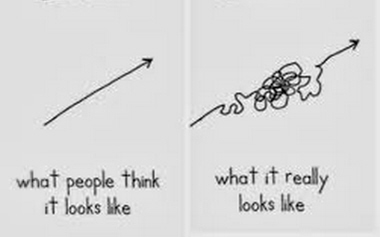
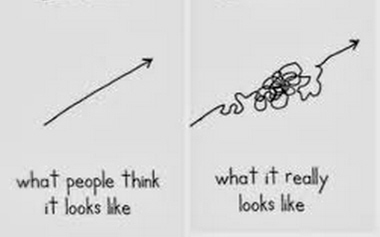
They may face failure and adversity this month. They will definitely face it if they continue in sports. I love this image about talent development:

It is not a smooth path nor a straight line to the top. That is where we come in parents. It is up to us that failure becomes their fuel. How do we do that?

We can help our children learn from adversity, and embrace the struggle. To do so, try these ideas below:

1) Help your athletes focus on the process: nothing worth doing comes easily, especially in sports. You will have your good days and bad days, your injuries and your healthy periods, your good coaches and your bad ones. Help instill a growth mindset in your kids by, as noted Stanford Researcher Carol Dweck says in her great TED talk, introducing the word “yet” into their vocabulary. “I didn’t make the top team YET, I need to practice more.” “I have not earned a starting spot YET, time to get to practice early and stay late.”

2) Ask your athletes the right questions when they struggle: though times of adversity can often lead us to criticize, or focus on the negative, a great approach after a struggle is to ask these three questions

What went well?

What needs work?

What can you learn from today that will help you practice better this week and perform better in the future?

These are not only process-oriented questions, but they help athletes realize that it never all goes wrong. There is always some good, and always opportunities to learn. When your athlete faces adversity, focus on ‘what is good about this?”

3) Don’t blame the uncontrollables; instead focus on their response to events: Athletes do not control the actions of officials, or what the opponent does. They cannot account for a bad field or poor weather. Blaming and complaining about those things will never make an athlete better, and they only bring negative energy into the conversation and the team. Help them focus on what they control (effort, focus, training time, etc) and let the other stuff just roll off. As Ohio State Football coach Urban Meyer says, E + R = O. The EVENT plus our RESPONSE equals the OUTCOME. We control our response, so respond well!

4) Help them find things they are passionate about: One of the critical ingredients needed for athletes to overcome adversity is ownership of the experience. As parents, when it comes to sports it is very helpful to assist our kids in finding their passion, instead of determining it for them. When a young athlete loves what she is doing, and is doing it because she owns the experience, she is far more likely to keep pushing through injuries, adversity, etc. It is great when kids fall in love with the sports we love or played, but that does not always happen. You cannot force passion, and passion is what overcomes adversity.

5) Show them how to embrace the hand they were dealt, and play it well: We all have faced adversity, and when our children struggle, it is a great time to share our own struggles, and what we learned from them. Be vulnerable, and teach them how adversity helps you develop grit, resilience, and more love of a sport, or a job, or anything you do. As Wambach shared in her speech, going into the 2015 World Cup, as one of the greatest players and leaders the US National Team had ever known, she was asked to lead from the bench. “You’re allowed to be disappointed when it feels like life’s benched you,” said Wambach. “What you aren’t allowed to do is miss your opportunity to lead from the bench. During that last World Cup, my teammates told me that my presence, my support, my vocal and relentless belief in them from the bench, is what gave them the confidence they needed to win us that championship. If you’re not a leader on the bench, then don’t call yourself a leader on the field. You’re either a leader everywhere or nowhere.”

I wrote this today not only because I just heard Abby Wambach’s inspiring commencement address. I wrote it because I am a coach, and my teams just finished tryout season. I have been coaching for over two decades, and I still hate tryouts. This year, like every other, there were disappointed players. But there was one who was thrilled.

Recently, I had to have a very difficult conversation with this young player who was devastated not to make the top team in her age group. It is a conversation every coach dreads having.

She could have quit. She could have blamed everyone. But she did not. She got to work. She showed up focused and prepared every day. She joined extra practices. She embraced her role as a leader on her new team. She took every opportunity to play up, and gave her best effort every time. She learned from the good days, and from the bad days. And one year later, she was back on the top team in her age group.

Her failure was her fuel. And that fuel helped her earn her spot.

Because in the end, it was not really even a failure at all. Just a bump in the long rocky road to the top.

Help your athletes to make their failure their fuel. Help them navigate those potholes that sports, and life, throws in their way. Not by blaming, avoiding, or paving over those bumps, but by helping your athletes see that there is always a path forward.

Coach O’Sullivan is a former college and professional player as well as a high school, club team and college coach. He is offering a FREE video series that is part of his Coaching Mastery program. For more information about gaining access to that program click the link above or in the image below. The video series includes a wealth of coaching education including some motivational and team building ideas used by some of the most successful coaches.


Filed Under: Motivation

Humility is Not Optional

June 16, 2018 by

Humility is not Optional.  It’s a Necessity

Cory Dobbs, Ed.D.  The Academy for Sport Leadership

“Humility is not thinking less of yourself, it’s thinking of yourself less.” –C.S. Lewis

As we descend deeper into a society characterized by polarization and division, cooperation is increasingly a curious characteristic.  First, let me suggest that cooperation is a product of humility, a dispositional drive of a selfless ego.  I introduce cooperation here to set it up as a desired individual behavior to be exercised in a team environment.

Consider humility to be a serious personality characteristic; one that is geared toward the positive construction and building of healthy relationships.  But don’t align humility with meekness or shyness—as is usually the case.   Resist the temptation to dismiss humility simply because it hasn’t been lionized like “grit,” or “mental toughness.”

One of the biggest mistakes coaches make is thinking that humility means a lack of self-confidence or a personal shortcoming such as a fragile sense of one’s self.

In team relationships humility shows through by the team members’ commitment to serve and support one another, through showing appreciation for the contributions of teammates, expressing encouragement, and acceptance of each other.  The person possessing a healthy dose of humility is generous with his or her support of others as expressed through loyalty and respect for teammates.

The humble teammate displays a strong sense of duty to the team.  Let me be clear: humility is the social glue that holds the team—a fragile eco-system—in balance.  Humility always contributes to unity.

It is worth exploring how to mesh cooperation with competition.  Competition—a cherished quality in the field of sport—is often considered to be the opposite of cooperation.  Competition is the drive and compulsion to win, to earn, to get, to have, to do.  Sports and competition are synonymous.  Yet, an ego attuned to only competition breeds a self-interested ego.  At this point I’m sure you’re saying…”and so?”
[thrive_leads id=’3019′]
We live in a culture with a high tolerance for individualism.  This breeds status and ego.  It promotes selfishness (might I get creative and say “selfieness”), and an “It’s all about me” attitude.  Society rewards those who use self-promotion to stand-out.   Of course, many young people have bought into this approach to life.  However, there is often a darker side to ego.  Ryan Holiday, author of Ego is the Enemy, reveals:

“The ego we see most commonly goes by a more casual definition: an unhealthy belief in our

                own importance.  Arrogance.  Self-centered ambition….The need to be better than, more than,

recognized for, far past any reasonable utility—that’s ego.  It’s the sense of superiority and certainty that exceeds the bounds of confidence and talent.”

An ego out of control can and often does promote a sense of self-justification giving an individual the “freedom” to say and do whatever is in their best interest.  Ego driven people often are self-absorbed and seek only individual fulfillment.  Certainly such behavior can and often is displayed on the playing field.

However, don’t confuse this with a default proposition that competitiveness is bad; it’s clearly not.  But when an ego (triggered by a social or psychological event) is out of touch with reality it can quickly put a person on a path to self-destruction.  And when this happens good luck reaching the person; you likely won’t until they meet with a fall that humbles them.  Reality meets humility.

A humble person, one driven by a strong and stable sense of humility, is simply more likely to help a teammate, to regard others as equals and worthy of a deep, close relationship.   Simply said, the humble person who practices humility keeps their accomplishments, gifts, and talents in a proper perspective. They possess self-awareness, avoid self-serving distortions, and are keenly aware of their limitations. They value the welfare of teammates and have the ability to mindfully attend to the uniqueness of each team member.  Humility always contributes to unity.


About Cory Dobbs, Ed.D.

Cory Dobbs is the founder of The Academy for Sport Leadership and a nationally recognized thought leader in the areas of leadership and team building.  Cory is an accomplished researcher of human experience. Cory engages in naturalistic inquiry seeking in-depth understanding of social phenomena within their natural setting.

A former basketball coach, Cory’s coaching background includes experience at the NCAA DII, NJCAA, and high school levels of competition.  After a decade of research and development Cory unleashed the groundbreaking Teamwork Intelligence program for student-athletics. Teamwork Intelligence illuminates the process of designing an elite team by using the 20 principles and concepts along with the 8 roles of a team player he’s uncovered while performing research.

Cory has worked with professional athletes, collegiate athletic programs, and high schools teaching leadership and team building as a part of the sports experience and education process.  As a consultant and trainer Dr. Dobbs has worked with Fortune 500 organizations such as American Express, Honeywell, and Avnet, as well as medium and small businesses. Dr. Dobbs taught leadership and organizational change at Northern Arizona University, Ohio University, and Grand Canyon University.

“Tell me and I’ll forget. Show me and I may remember. Involve me and I will care.” -Your Student-Athlete The world of coaching is changing. In Coaching for Leadership you’ll discover the foundations for designing, building, and sustaining a leadership focused culture for building a high-performance team. To find out more about and order Sport Leadership Books authored by Dr. Dobbs including Coaching for Leadership, click this link: The Academy for Sport Leadership Books


Filed Under: Leadership

Building a Culture of Positivity

May 20, 2018 by

By Dawn Redd-Kelly.

If you’re not happy with the culture of your team, how are you working daily to change it around? Here are five Tips

As was said over at Leadership Freak, “Toxic environments are the result of neglecting culture-building and tolerating toxicity.”

When we find ourselves with a negative team culture, it’s easy to blame the athletes, but we hold some accountability as well.  We’ve both neglected the culture and tolerated the things that are counter to our beliefs.

So what now?

5 quick tips for building a culture of positivity:

  1. Encourage your athletes to express gratitude: for practices, for getting coached hard, for their teammates, etc.
  2. Find ways to honor culture builders: if you’ve got an athlete who has bought in, whether they’re a starter or bench dweller, point them out!
  3. Reward those who are on board: perhaps you can create a weekly team award for the athletes who best represent the qualities you’re trying to instill with your team.
  4. Remove the worst offenders: if you’ve worked and worked with them…sometimes they just have got to go.
  5. Show interest in your athletes as people: crazily enough, our athletes have other interests besides our sport…find out about them.

Be a culture hawk for your team!  Not only will your athletes enjoy coming to practice more each day, I’d bet your outcomes in the win/loss column will also turn from negative to positive.


Filed Under: Program Building

5 Ways to be a Better Leader

May 19, 2018 by

This post was provided by InnerDrive, a mental skills training company

How do we become better leaders? An effective leader is someone who can create an inspiring vision, motivate and inspire their team, manage the delivery of that shared purpose and then coach and improve that team in order to achieve that end goal. So what are the best leadership skills, and what are the keys to becoming a better leader?

1. UNDERSTANDING YOUR LEADERSHIP STYLE
According to research, there are loads of different leadership styles and they vary between men and women. However, 4 main styles have been commonly agreed. These four leadership styles include autocratic, democratic, laissez-faire and transformational. By finding out what type of leader you are, you will then be able to identify your strengths and areas in which you need to improve.

For more ideas on how to help your team members develop and improve, have a look at our page on how to improve metacognition.

Autocratic

This leadership style includes, close supervision, lack of input from followers, complete control and solo decision-making.

Democratic

This leadership style includes, shared decision-making responsibilities, social equality, creativity and high engagement from group members.

Laissez-faire

This style includes, little direction from the leader, lots of freedom for group members, team members are responsible for making all decisions and a great deal of autonomy.

Transformationala-better-leader

People who have this leadership style are often described as energetic, passionate, enthusiastic, trustworthy, creative and intelligent.

A more in-depth description of these styles can be found here.

2. Be a role model

This doesn’t necessarily mean leading from the front, as keeping a watchful eye from a distance can allow your team to develop their own forms of leadership and management strategies. This point refers to the way you, as the leader, exemplify your behaviours and characteristics for your team to follow. Your actions can have a profound impact on the behaviours of your team. Research has shown that by showing your organisation what is possible, a leader can empower them to develop their own skill sets.

3. Be authentic

Being authentic in your approach to leadership provides your group with a true understanding of who you are as a person, away from your professional role. Research has shown that by doing what is promised, being visible to your organisation and being honest helps manifest a sense of trust within the group you’re leading. Be true to your values and in doing so, your team can understand the direction you want to take them in.

4. Listen to, and communicate with, your team

Research has shown that non-verbal cues like body language, facial expressions, eye movement and hand motions are an important form of communication. Matching your non-verbal cues to your actions and words can help with authenticity.

Whilst verbally and non-verbally communicating with your team, it is also important to listen to what they have to offer. Be an active listener, in doing so approach conversations with concentration and regard for the speaker’s thoughts and considerations. Likewise, studies have shown that skilled listeners also pick up on the speaker’s underlying thoughts and concerns by tuning into their non-verbal cues, showing genuine care for the person’s feelings and morale.

5. Motivate your team

Leaders can motivate people in various ways, but by making sure the individuals inside the team understand that their investment of time and effort is something worthwhile, and can encourage the desired actions. Evidence indicates that this can be done by providing recognition and praise, offering rewards, inclusion and by being passionate.

Final thought

John F. Kennedy once said, “Leadership and learning are indispensable to each other.” Highlighting how leadership is a constant learning process and that it can most definitely be taught. Anyone can become a great leader as long as you are willing to listen and learn.


Filed Under: Leadership

  • « Previous Page
  • 1
  • …
  • 7
  • 8
  • 9
  • 10
  • 11
  • …
  • 63
  • Next Page »

© Copyright 2026 Athletic Performance Toolbox

Design by BuzzworthyBasketballMarketing.com

Privacy Policy