Coaches Toolbox

  • Home
  • Mental Toughness
  • Leadership
  • Motivation
  • Staff Development
  • Program Building
  • Archives
  • Sport Specific Sites
    • Athletic Performance Coaching
    • Basketball Coaching
    • Football Coaching
    • Soccer Coaching
    • Track and Field Coaching
    • Volleyball Coaching

Why Student-Athletes Don’t Lead

December 15, 2017 by

“Who am I to…”
Why Student-Athletes Don’t Lead

Dr. Cory Dobbs

One of the deepest needs within people is belonging.  If you’re a coach you belong to the coaching “fraternity” or “sorority.”  And it feels good to belong.   These are your people, your friends, colleagues and confidants.  They think much like you do which makes it easy to be around one another.  There are coaching and administrator associations that hold annual events that you love to attend to be around others just like you.  Belonging is natural.

Your student-athletes—team captains or team leaders—want to belong too.  They seek an inner congruence for order, harmony, and peace with their teammates.  They too want the team to be like a fraternity or sorority.  They want to belong.  So when it comes time to lead, the typical team captain or team leader is afraid to do something that seems incongruent with their values and beliefs.  Their first thought is “Who am I to tell her she needs to stop doing that.”  They feel a real mental conflict.

Dr. Leon Festinger, a researcher and professor at Stanford University, coined the term “cognitive dissonance” to explain this mental conflict that the team leader feels.  Cognitive means the mind, the way we think.  Dissonance means conflict.  Cognitive dissonance literally means to have a mental conflict.

According to Festinger, and subsequently many other researchers, when an individual experiences cognitive dissonance they quickly search for a way to reduce the incongruence causing the dissonance.

The person with the conflict is motivated to reduce the inner turmoil in some manner.  For example, the thirty-five year old factory worker who smokes a pack a day on his breaks knows (doesn’t everyone?) that smoking is bad for you.  So to reduce the psychological tension he adopts the position, “My aunt lived to one-hundred and she smoked a pack a day so it must not be that bad for you.”  This cognitive maneuver reduces the internal tension caused by his actions—smoking—and his knowledge of facts—smoking is bad for you but it can’t be that bad if my aunt could smoke and live to one hundred.

Why is it that student-athletes fear leadership roles and responsibilities?  Simply put, when a student-athlete is asked to perform a peer-to-peer leadership action, it is, by default, inconsistent with his or her existing values, beliefs, and perceived skills.  This causes a conflict—dissonance—that inhibits the likelihood of the peer leader taking action.  The internal dialogue of “Who am I to do this” will generally rule the day.

How then can you change the outcome of inaction?  Practice, practice, practice.  Just as you practice your offensive and defensive systems, you must practice your leadership system.  To change internal beliefs is a challenge, it takes time and commitment.   Is it complicated?  Yes, of course!   But if you don’t make a deliberate effort to address the issue of cognitive dissonance, your team is vulnerable to the costs that come with the lack of team leadership.  «

To find out more about and order Sport Leadership Books authored by Dr. Dobbs including a Leader in Every Locker that this post was taken from, Click this link: The Academy for Sport Leadership Books

This article was written by Cory Dobbs, Ed.D., President of The Academy for Sport Leadership.  The Academy for Sport Leadership is a leading educational leadership training firm that uses sound educational principles, research, and learning theories to create leadership resources.  The academy has developed a coherent leadership development framework and programs covering the cognitive, psycho-motor, emotional and social dimensions of learning, thus addressing the dimensions necessary for healthy development and growth of student-athletes.

About the Author

Cory Dobbs is the founder and president of The Academy for Sport Leadership, a national leader in research‐based curriculum for coaches and student‐athletes. Dr. Dobbs is a college educator, a coach to successful coaches (helping coaches attain a higher level of success), and an accomplished human performance specialist whose expertise is in the field of leadership, team building, and creating a high‐performance culture in the arena of team sports. Cory blends social‐personality, psychology, and applied social psychology, which means he studies how people’s thoughts, behaviors, and preferences are influenced by both who they are and the situations they’re in. He uses Teamwork IntelligenceTM to help teams explore how the mix of perspectives brought by their individual members influences their work together.

About The Academy for Sport Leadership

The Academy for Sport Leadership is a leading educational leadership training firm that uses sound educational principles, research, and learning theories to create leadership resources.  The academy has developed a coherent leadership development framework and programs covering the cognitive, psycho-motor, emotional and social dimensions of learning, thus addressing the dimensions necessary for healthy development and growth of student-athletes.

The Academy for Sport Leadership’s underlying convictions are as follows: 1) the most important lessons of leadership are learned in real-life situations, 2) team leaders develop best through active practice, structured reflection, and feedback, 3) learning to lead is an on-going process in which guidance from a mentor coach helps facilitate learning and growth, and 4) leadership lessons learned in sport should transcend the game and assist student-athletes in developing the capacity to lead in today’s changing environment.
Filed Under: Leadership

Relationship Building

December 12, 2017 by

This article was provided by Coaches Network


By Dr. Wade Gilbert

A great way to learn about quality coaching is to listen to coaches and athletes talk about the coaching styles they believe are most helpful for achieving success. Coverage of recent sporting events such as the women’s World Cup, and the NBA and NHL finals, provided many opportunities to hear some of the world’s most successful athletes and coaches share their insights on this topic.

Whether coaching females or males, and regardless of differences in coaching styles, these championship coaches all share one thing in common: they make building relationships with their athletes a top priority.

U.S. women’s national soccer team coach Jill Ellis, who led the American team to their first World Cup championship in 16 years, has been lauded by current and former players alike for her open and honest communication style. Moreover, she places great emphasis on learning how to connect with players in ways that are uniquely meaningful and relevant to each one of them.

Chicago Blackhawks coach Joel Quennville has gained the trust of his players, and led them to three ice hockey championships in the past six years, by keeping an open-door policy and showing a genuine interest in listening to his players.

Golden State Warriors coach Steve Kerr, in just his first year of coaching the team, built a culture of trust and engagement by making relationship building a regular part of his daily routine en route to the team’s first basketball championship in 40 years.

A quote from coach Kerr perhaps best summarizes the emphasis these championship coaches place on relationship building with their athletes: To me, the X’s and O’s … they’re an important part of coaching but a relatively small part. Eighty percent of it is just relationships and atmosphere.

Successful coaches have long known that the time and energy invested in building quality relationships with their players pays huge dividends. For example, one of the winningest college football coaches of all time Eddie Robinson proclaimed that showing genuine care for each of his players was the cornerstone of his coaching approach. More recently, Cameron McCormick – longtime coach of the world’s hottest golfer Jordan Spieth – revealed that building quality relationships with athletes was at the top of his the list for becoming a successful coach, based on his study of the world’s best golf coaches.

The surest way to show players that you care about them is to ask them about their lives and then give them your undivided attention. Never forget that you are coaching people first, and the sport second. Keep a file for each athlete to record notes about things and people that are meaningful to them. Regularly check in with each athlete and update their ‘life’ file.

Some high coaches like to give their athletes a survey to complete at the start of the season, with questions about their dreams, passions, favorite subjects in school, and family. Other coaches find that setting aside a few minutes before practices for ‘social time’ allows them to speak with athletes about their lives while athletes are starting to warm-up.

However, for relationship building to work, coaches must also be willing to share information about people and things that are meaningful to them. If you want your athletes to share with you, you must share with them. Ultimately, building relationships with athletes is an act of courage – both for the coach and for the athlete. Each must show the courage to be vulnerable.

Coaches show courage, and build relationships, when they create emotionally safe environments. Giving frequent encouragement and helping athletes pull the lessons from performance failures creates an environment where athletes feel safe to risk failure.

Ask any championship coach to reflect on what they cherish most from their career and they’ll tell you it was the relationships they built with their athletes along the way. Take a page from the playbooks of the world’s most successful coaches, and set aside time in your daily routine to make a personal connection with each of your athletes. This simple strategy not only leads to better performance, but makes for a more enjoyable and enriching sport experience.


This article is adapted from an article on the Human Kinetics “Coach Education Center” website.  Click here to read the full article.


Filed Under: Professional Development

Consequences Matrix

December 9, 2017 by

By Dr. Cory Dobbs

A short, but very powerful post to share with your athletes.

How Will Your Decisions Help or Hurt Your Teammates?

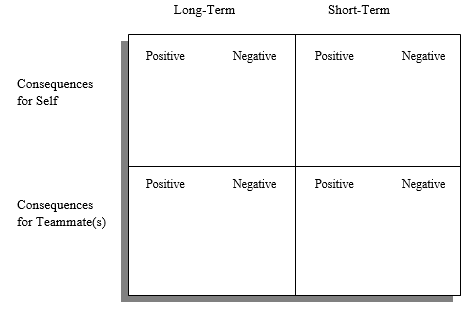
You will make better decisions if you focus on how the consequences of your actions affect your teammates.  While this is only one criterion which can and should be applied to any decision you make, it is an important one.  You begin by asking “What will happen to my teammate(s) if I act upon this decision?   Over time, such reflective thinking will become habit.


Decision-Making
-I should act on this decision.
-I should not act on this decision.
-I cannot decide at this time (Need more information, time, etc.)

Using this matrix will not guarantee that your decisions will be good ones.  However, the consideration of the consequences of a given decision in terms of one’s self and one’s teammates in the near and distant future should increase the probability that harm to relations and relationships can be avoided.


Reflection and Discussion Questions

  • Do you agree with the idea that the best decisions are those that have the most positive consequences for you and your teammate? And that the poorest decisions are those that have the most negative consequences?  Give an example to explain your reasoning.
  • How do you know positive consequences will result from your action(s)? Inaction?
  • How do you know negative consequences will result from your action(s)? Inaction?
  • In which of the four quadrants would you find the most “immature” behavior? Why?
  • As a team member, how can you use this matrix to help your teammates make better decisions?
  • [thrive_leads id=’3019′]
    About the Author

    Dr. Cory Dobbs is a national expert on sport leadership and team building and is the founder of The Academy for Sport Leadership.  A teacher, speaker, consultant, and writer, Dr. Dobbs has worked with professional, collegiate, and high school athletes and coaches teaching leadership as a part of the sports experience.  He facilitates workshops, seminars, and consults with a wide-range of professional organizations and teams.  Dr. Dobbs previously taught in the graduate colleges of business and education at Northern Arizona University, Sport Management and Leadership at Ohio University, and the Jerry Colangelo College of Sports Business at Grand Canyon University.

    NEW RESOURCE

    Coaching for Leadership: How to Develop a Leader in Every Locker. ($24.99)


    The Academy for Sport Leadership 


Filed Under: Leadership

How to Build Cohesion from the Inside Out

December 6, 2017 by

Dr. Rick Perea

This presentation as explained by Dr. Perea deals with organizational motivation and performance along with self and team efficacy, Intrinsic versus Extrinsic motivation, and individual and team cohesion. Dr. Perea explains the difference between groups versus teams and how organizational climate and culture is formed and developed. This presentation goes into detail explaining the difference between self-efficacy and team efficacy.

This video is provided by Glazier Clinics Head Coaches Academy.

Please make sure that your sound is on and click on the video to play.

PUT YOUR CURSOR OVER THE LOWER RIGHT CORNER OF THE VIDEO AND CLICK (IMAGE LOOKS LIKE THIS)TO WATCH THE VIDEO ON FULL SCREEN TO BE ABLE SEE LARGER DIAGRAMS AND VIDEOS

This is a You Tube video, so please make sure that your network allows you to access You Tube.

Click the play arrow to see the video:


Filed Under: Professional Development

The Process of Leadership

December 3, 2017 by

It’s All About Style
Mobilizing Purpose and Possibility with Transformative Leadership

Dr. Cory Dobbs, The Academy for Sport Leadership
Coaching Maxim:  Leadership demands we make decisions that define who we are and how we interact with others.

We often talk about a leader having a “style” of leadership, a distinctive way of thinking, feeling, and acting.  And it is true; coaches do have a style that shapes who they are and what they do.  The relationship between style and leadership is expressed as a systematic process in how a coach gets things done and inspires his or her players to be their very best.

Over the past decade I have watched many coaches in action and have detected a distinct difference between two dominant leadership styles.  There are many ways to describe the leadership habits of coaches, but it appears to me that as leaders most fall into one of two categories—drivers or builders.   Drivers tend to be what leadership experts refer to as transactional leaders while builders fall pretty naturally into the category of transformational leaders. Drivers and builders have two very different leadership mindsets and skill sets.

Drivers are generally after impressive achievements, especially the attainment of fame, status, popularity, or power.  Not that there is anything wrong with that, as Jerry Seinfeld would say.  Drivers view success to be mastery of the technical and tactical aspects of their sport. Builders commit to their calling and enjoy the human development side of coaching.  For them, significance is found in contributing to the lives of their players.  It’s not that they don’t want to win; it’s simply that winning includes building self-confident people who will succeed away from the playing field.

Coaching is a major factor in any team’s success.  Most players recognize this.  They’ve been coached since they were tots playing in youth leagues.  And for the most part they’ve believed in and trusted their coaches to teach them to play the game while instilling life skills and personal values.  However, many adults reveal years later that they learned little from coaches they encountered in their student-athletic experience.  Generally, the coaches that fail to have a long-term impact on student-athletes are transactional leaders.  Many former student-athletes view their experience as being a pawn in the game of student-athletics.
[thrive_leads id=’3019′]
Transformational leaders (builders) do more with and for their student-athletes than transactional leaders (drivers).  These leaders tend to empower student-athletes with challenge and persuasion and actively engage in supporting and mentoring the holistic development of their players.  Transformational leaders seek to inspire their followers to commit to a shared vision of how student-athletics can enhance their lives.  For the transformational leader the sport situation offers an opportunity for the participant to learn such life skills as perseverance, character development, relationship building, and goal attainment.

Transactional leaders, on the other hand, are those that prefer to set up simple interactional exchanges or agreements with their followers, often investing little in building relationships.  They manage players through the use of carrots and sticks—offering a reward (usually playing time) for a desired behavior.  These leaders are those that often use the maxim “the bench is my best teacher.”

This is a prime example of contingent reinforcement—you do “X” and I’ll give you “Y.”  A transformational leader, while certainly not shy to use the bench as a learning tool, would not view the bench as a teacher—that’s a role they cherish.  The transactional coach keeps his or her distance from the athlete, preferring to have a “distant” relationship.  Some coaches will fake the relational process, but the lack of authenticity is quickly recognized by the student-athlete.  The transformational coach is more likely to spend time building relationships with players and showing them he or she cares.  Their mindset is that people aren’t going to care about you and your concerns unless they know you care about theirs.

Transformational leaders don’t do this just to be nice, they understand it to be an effective and appropriate way to deal with young and developing student-athletes.  Building relations is not a road block to success as many coaches find that because they show they care about the person, they can ask for and demand more performance.  Think about it.  Are you more likely to extend yourself for someone you care about or someone you don’t like and care for?

Coaches do many things.  They inspire and motivate, they teach and instruct, and they set an example.  More than anything else, however, coaches help the student-athletes make sense of some of life’s most important lessons.

Over time many coaches move from a driver dominated way of coaching to that of a builder.  Take for example Westmont College men’s basketball coach John Moore.  “Coaching and teaching is more meaningful for me today than it was eight to ten years ago,” said Moore.  “It is more significant because of the kinds of things that are important in coaching.  Someone once said to me, ‘You don’t have a philosophy of coaching until you get to 15 years as a head coach.’ I discounted that originally, but there was a point for me, and it was in that 15-year range, that I realized that I had a philosophy of coaching – that makes it more meaningful for me and more meaningful for my players.”

Being a driver, a transactional leader, can be very effective in producing immediate results.  However, the constant pounding and intimidating of your student-athletes will reduce the motivation of most student-athletes.  Student-athletes prefer to be guided and seek motivation from the collaborative process of coaching.  Even the most self-motivated player will lose their drive if you don’t provide them with positive reinforcement and a sense of worth.

Transformational coaches appeal to players by working with the athletes to create a compelling and collective purpose; a purpose beyond individual ambition that enriches the possibilities of each team member.  By valuing both relationships and results, a builder’s influence leads to higher levels of trust, empowerment, and community.

For builders, the real definition of success is a life and work that brings personal fulfillment, lasting relationships, and makes a difference in the world in which they live.

Are You a Driver or a Builder?

Drivers  / Dominant Leadership Style: Transactional Builders / Dominant Leadership Style: Transformative
  • Put results first. Relationships are subordinate to results, a means to an end.
  • Put people first.  Relationships are priorities to producing results.
  • Make the decisions. Drivers like being decisive and in control.  Drivers set the agenda.
  • Stress team capabilities.  Builders want to build systems and talent.
  • Possess a controlling spirit.  They feel if they can control people, they’ll maintain absolute authority.
  • Get others involved.  Builders seek input from other coaches and value input from players.
  • Resort to more regulations.  Drivers use rules and regulations to enforce compliance.  Drivers want things done their way.
  • Let solutions emerge.  Builders don’t try to tackle every problem knowing that some problems solve themselves.
  • Crack the whip.  Drivers keep pressure on for accountability.  Come down hard when goals aren’t attained.
  • Take a long-term focus.  Builders assemble players, programs, and processes.
  • Take a short-term focus.  Drivers tend to focus on the day’s or week’s results.
  • Are mission driven. It’s the mission that sets the priorities.
  • Focus on “what” have you done for me lately? Enough said.
  • Are servant leaders. What’s my contribution?  Builders possess a mental model stimulated by a “What can I contribute to the lives of my players” approach to leading.
  • Get “in your face.”  Drivers thrive on confrontation.  “My way or the highway”.
  • Embrace empowerment. Builders work to prepare others for leadership roles.
  • Are more critical than positive.  Drivers find it difficult to accentuate the positive.
  • Support identity of team. No two teams will ever be the same.  Builders see value in the diversity of personalities.
  • Power trip.  Fear giving away power.  Empowering student-athletes to become team leaders is not a priority.
  • Vision is the main course, not an appetizer.  Builders weigh the costs of today’s decisions on  tomorrow.
  • Span of vision.  Concern is for results today regardless of costs tomorrow.


About the Author

Dr. Cory Dobbs is a national expert on sport leadership and team building and is the founder of The Academy for Sport Leadership.  A teacher, speaker, consultant, and writer, Dr. Dobbs has worked with professional, collegiate, and high school athletes and coaches teaching leadership as a part of the sports experience.  He facilitates workshops, seminars, and consults with a wide-range of professional organizations and teams.  Dr. Dobbs previously taught in the graduate colleges of business and education at Northern Arizona University, Sport Management and Leadership at Ohio University, and the Jerry Colangelo College of Sports Business at Grand Canyon University.

NEW RESOURCE

Coaching for Leadership: How to Develop a Leader in Every Locker. ($24.99)


The Academy for Sport Leadership 


Filed Under: Leadership

  • « Previous Page
  • 1
  • …
  • 14
  • 15
  • 16
  • 17
  • 18
  • …
  • 63
  • Next Page »

© Copyright 2026 Athletic Performance Toolbox

Design by BuzzworthyBasketballMarketing.com

Privacy Policy