Coaches Toolbox

  • Home
  • Mental Toughness
  • Leadership
  • Motivation
  • Staff Development
  • Program Building
  • Archives
  • Sport Specific Sites
    • Athletic Performance Coaching
    • Basketball Coaching
    • Football Coaching
    • Soccer Coaching
    • Track and Field Coaching
    • Volleyball Coaching

10 Ways To Control Your Emotions (Part 2)

October 10, 2017 by

Are our emotions something that help us when it comes to sport, or do they hold us back? The answer? Both. Learning how to balance and control your emotions is what matters.

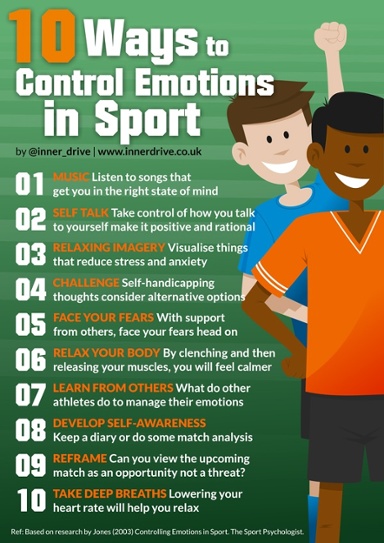
In our first part of this two part series,  we covered five strategies to help regulate emotion ranging from facing your fears head on, to listening to inspiring music to get you in the zone. This was based on research by Professor Marc Jones at Staffordshire University on how athletes can better manage their emotions when competing. In this second part, we cover tips 6-10.
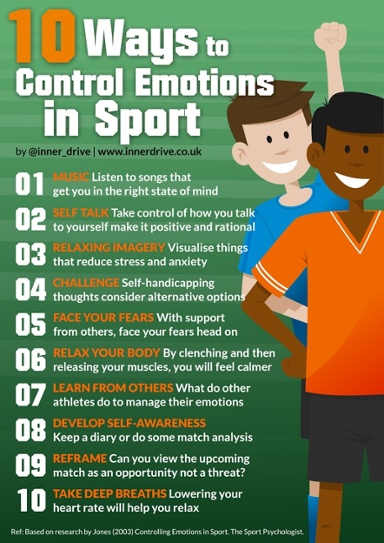
Relax Your Body: Try tensing your muscles for a few seconds and then consciously relaxing them to feel a sense of calm, physically as well as mentally. Research shows that this leads to a reduced heart rate, lesser feelings of physical exhaustion, and diminished anxiety. 

Learn From Others: Try to emulate athletes that deal with emotionally difficult situations well; this is an effective strategy to manage anger and stress. For instance it has been shown that Role-playing exercisesoff pitch reduce angry behavior on pitch. The ability to learn from others is a hallmark of developing a growth mindset and a very important life skill.

Develop Self-Awareness: Keep a journal or review film of situations where strong emotions arise during play and how you dealt with them. This allows you to identify which emotions are healthy, competitive ones for you and which are not. This is important to know so that you can get the best from your emotional state. Keeping a diary to improve self-awareness is a simple and effective way to improve metacognition.

This can be incredibly effective when combined with challenging self-handicapping thoughts (check out part one of this blog), as your newfound awareness can help you identify which thoughts and emotions need challenging.

Reframe The more important you believe the situation to be, the more likely you are to have a strong emotional response to it. Research suggest that reminding yourself that “it’s just another match” can help reduce the noise and intensity that emotions can bring.

Reframing our ideas of failure and success can also be effective. In the earlier mentioned research by Professor Jones, he details an example where a Premier League striker was struggling to score goals, and feeling down because of it. Helping him reframe his definition of success to include all the other things he was doing well helped raise his spirits and find his goal scoring form again.

Take Deep Breaths: Much like muscle relaxation, focusing on taking deep slow breaths can be an important factor in regulating emotion. These breaths increase feelings of relief and lead to lower physical symptoms of negative emotions such as muscle tension.  It also provides a sense of control of the situations, slows things time and gives you space to consider how best to proceed.

Final Thought: Every athlete no matter their level needs to learn how to balance their emotions. There is no perfect formula. What works well for someone else is no guarantee that it will work well for you. Using some of the techniques described in both parts of this blog series will provide a strong platform to explore what works best for you.


Filed Under: Mental Toughness

10 Tips to Help Athletes Control Their Emotions

October 9, 2017 by

This article was provided by InnerDrive, is part 1 of a two part post.

What does it take to really excel in the world of elite sport? The ability to deliver your best when it matters the most is a fundamental part of performing under pressure. Can this ability be taught, learned and developed?

We have previously explored why some athletes perform better under pressure than others and what it takes to thrive in a pressurized environments.  However, what makes emotions in sport so complicated is that no emotion is truly good or bad during competition. For example, anger can make you try harder, but it can also make you lose focus on the task at hand.

Even two people experiencing the same emotion can react in different ways. So a  footballer who is embarrassed about missing too many shots may shy away from receiving the ball, whereas another might react by calling for it more to get a chance to redeem themselves.

Research by Professor Marc Jones at Staffordshire University offers fascinating insight into how athletes can better manage their emotions when competing. In this two part blog series, we are going to look at 10 tips to control emotions in sport based on his research.

How to control emotions music.jpgMusic: Listening to music is a great way for an athlete to get into the zone. Upbeat or inspirational music for example improves an athlete’s confidence and motivation, leading to better on pitch performance. Music acts as a way to boost arousal levels whilst also helping to block out distracting thoughts.

Self-Talk: Negative self-talk leads to a poor emotional state, which in turn hurts athletic performance. Replacing it with positive self-talk such as “I played really well in my last match” or “I’ve succeeded at this before, I know I can now” counters negative emotions and creates positive ones too.   This positive self-talk creates helpful emotions such as happiness. As many as 76% of elite level figure skaters utilise this technique to cope with the stress of competition. For more tips on how to talk to yourself, check out our blog on it here and how self-talk is linked to growth mindset.

Relaxing, Positive Imagery: If you find yourself stressed out over competing or are worried about failing,  try imagining positive scenarios like scoring a goal. As a young athlete, Wayne Rooney used to lie in bed imagining himself scoring goals and dribbling around defenders.  He uses these visualization techniques this day and credits them for his accomplishments.

It has been found that Imagery focused on toughness, control, and confidence leads to increased motivation, emotion regulation, and self-belief. This is a great technique to do the night before a match or just before you go out to compete.

Challenging Self-Handicapping Thoughts: It’s important to consistently review your behavior both on pitch and off to ensure it is helping, not hindering your performance. If you are exerting energy and focus on behavior that is hurting you, you’re wasting energy.

One elite tennis player in this study was asked how many times in her career she argued with the referee and how often it had actually resulted in a call being changed (very rarely). The massive difference in the energy wasted compared to the result she gained, helped her realise there were better things to choose to focus on.

Face Your Fears: As discussed in our blog on The Fear of Failure, psychologists believe that there are three ways people cope with situations. These are Avoidant, Emotional and Problem Focused. Let’s say you are worried about snakes in your garden. You could decide to never go into your garden again (avoidant focused), or convince yourself that having snakes in your back garden isn’t that bad (emotion focused) or go into your garden and get rid of the snakes (problem focused).

Whereas avoidant and emotional focused coping may provide a short relief, problem focused coping addresses the issue head on, allowing you to make long term gains. Don’t be an ostrich and bury your head in the sand. If something is worrying you, work out how you can make it better.

Make sure to check back in a few weeks for part two of our blog on how athletes can better manage their emotions. We would like to massively thank Professor Jones for allowing us to blog about his research.

If you’d love some more great sports psychology tips to keep you going until then, check out our another great post from Inner Drive:  What to Think About Before a Match.


Filed Under: Mental Toughness

Ethics and Leadership

October 5, 2017 by

A Few Thoughts on Ethics and Leadership

Cory Dobbs, Ed.D., The Academy for Sport Leadership

The following is an excerpt of an interview conducted by Dr. Cory Dobbs, President of The Academy for Sport Leadership.  Dr. Dobbs interviewed ethics experts Ann Tenbrunsel (Professor, the University of Notre Dame) and Max Bazerman (Professor, Harvard University). This interview took place following the release of Bazerman and Tenbrunsels’ bestselling book, Blind Spots: Why We Fail to Do What’s Right and What to Do About It.

When confronted with an ethical dilemma, most of us like to think we would stand up for our principles. But we are not as ethical as we think we are. In Blind Spots, leading business ethicists Max Bazerman and Ann Tenbrunsel examine the ways we overestimate our ability to do what is right and how we act unethically without meaning to. From the collapse of Enron and corruption in the tobacco industry, to sales of the defective Ford Pinto and the downfall of Bernard Madoff, the authors investigate the nature of ethical failures in the business world and beyond, and illustrate how we can become more ethical, bridging the gap between who we are and who we want to be.

  1. Jim Tressel, the former Ohio State University football coach, resigned as a result of his failure to properly handle an NCAA violation committed by one or more of his players. How does the process of ethical fading apply to coaches?

We know from our research that when decisions are made in environments that are heavily sanctioned ethical fading is much more likely to happen. In one study, individuals were asked to make a decision involving ethical implications. Half of those participating were in a “no sanction” condition – they were told there would not be any monitoring or sanctions of the behavior. In some sense, the decision to do what was right was up to them. The other half were in a “sanction” condition in which they were told that there would be monitoring and sanctions of the decisions. We found that 55% who made the decision in the no sanction environment saw the decision as an ethical one whereas only 20% saw it as an ethical decision in the sanction environment. How you see the decision is important because it is related to an ethical choice: of those that saw it is an ethical decision, 94% behaved ethically; of those who did not see it as an ethical decision, only 44% behaved ethically.

We have seen the athletic environment increasingly characterized by regulation and the accompanying monitoring and sanctioning of decisions that comes with that. This in turn leads to more ethical fading, meaning that decision makers in this environment are less likely o ask the question “What is the right thing to do?” and instead focus on “What is the probability I will get caught and what is the cost and how does that compare to the benefits I will see from not-complying?”. In this type of environment, whether or not a decision is ethical or right is not considered; rather, there is a cost-benefit calculation which determines whether it makes sense to comply or defy the NCAA rules. If it too costly to defy, compliance results but if the benefit is large enough, compliance goes out the window.

It is also quite likely that motivated blindness played a part in Tressel’s decisions. Motivated blindness describes the tendency for individuals to not notice the behavior of others when it is in their best interest to not notice. In the steroid scandal in Major League Baseball, there were many people—the commissioner, the owner, coaches, the player’s union—who should have noticed the rapid changes in the players and the sudden onset of record-breaking performances. Why didn’t they see what now seems obvious? They didn’t notice because of the benefits they received by not noticing. Steroid use increased power, power led to more home runs, home runs boosted attendance and attendance meant more money for all involved. These benefits blinded those involved to the problems they preferred not to see.

Similarly, Tressel was most likely motivated to not see the NCAA violations committed by his players because it was in his best interest not to see them. By not seeing them, he didn’t have to sanction his players, his players were happier, and life in the Athletic Department was much smoother. This motivated blindness was driven in part by the larger environment in which Tressel was rewarded. Tressel was rewarded for winning games, not prosecuting his players. He responded well to those rewards.

  1. Why is an adoring public able to quickly forget such wrongs?

The fans are able to forget these transgressions for the same reason they are committed – motivated blindness. Loyal fans don’t want to know or contemplate anything but positive attributes about their team. We know from research that our brain codes the information that is advantageous to us and doesn’t code information that is disadvantageous to us. For example, if you ask married couples what percent of the chores they do, both spouses will say they each do about 75% of the chores, which can’t be true. Each one of them remembers what chores they do (cook, laundry, yard work, transport children) but doesn’t code what their spouse does. Similarly, fans code what is advantageous to them – the statistics that support their love of the team, the charities their player support, the negative behavior of players on opposing teams—but don’t code what is disadvantageous to them—the NCAA violations, a coach who bends the rules, the negative behavior of a favorite player.

  1. How might an insider help a coach identify an ethical blind spot?

It is not clear that it should be an “insider” who helps the coach identify ethical blind spots. Insiders fall prey to motivated blindness just like fans, owners, and athletic directors do. An outsider who is not motivated by the standings of the team or a close relationship with the coach is probably in the best position to see the ethical traps that can bring a coach to disgrace. Framing decisions as ethical decisions, “what is the ethical implications of this decision?’ or “what is the right thing to do” will help reduce ethical fading. The reward system for the coach also needs to be closely examined. If the coach is only compensated (monetarily or otherwise) for a team’s performance and the way in which that performance is ignored, it is a safe to predict that the coach will focus on team performance and use any tactics to get there. Those responsible for structuring and implementing the reward system have to take responsibility for the outcomes of that reward system and for their own motivated blindness.
This is not to say that the coaches are not responsible for their unethical decisions for ultimately they are and they must be held accountable for those decisions. But if effort is also directed toward understanding the psychology behind bad decisions—including ethical fading and motivated blindness—and the way in which the environment actually encourages them, teams can avoid the tarnish that comes with unexamined unethicality.

About Dr. Cory Dobbs and The Academy for Sport Leadership 
To find out more about and order Sport Leadership Books authored by Dr. Dobbs including a Leader in Every Locker that this post was taken from, Click this link: The Academy for Sport Leadership Books


Filed Under: Leadership

Managing Your Team: MBWA

October 3, 2017 by

By Dawn Redd-Kelly.

I used to call this a “stop and chat”, but apparently there’s an actual name for this management technique called Management By Walking Around, or MBWA.

What is it exactly?

  • Stop and talk to players face to face.
  • Get a sense how things are going.
  • Listen to what is on player’s minds.

Why is it successful?

Years ago, I worked with a track coach who said it was his goal to talk to each athlete every day…even if only for a few moments.  Connecting with our athletes is a win-win.  We feel good about where our team’s mindset is and the players feel that we care.

If you do it correctly, you’ve been MBWAing all season, so the team won’t be startled when you stop and chat with them.  This strategy will pay dividends when and if something big happens within the team that you need to get to the bottom of.

How to MBWA with your team

  • Make it part of the routine.  The team should know when they come into the gym that you’re probably going to be talking to them, it shouldn’t be weird or awkward…just part of being on the team.
  • Just you, not the other coaches.  If your whole coaching staff approaches one of your players, I’d imagine they’d start racking their brains, trying to figure out why you were coming toward her with a posse!
  • Chat with everyone.  Seems obvious, but be sure to talk to each person on the team.  Super stud and practice player alike.  That way you can’t be accused of being unfair.  Well, you can, but it won’t be true.
  • Ask for suggestions.  This one is an easy one for a MBWA before a game, because you can always ask for suggestions for places to eat dinner.  It’s super important for them (for some reason) and the team’s gotta eat.
  • Follow up with answers.  If you’re doing a MBWA and one of the athletes asked a question you don’t know the answer to, you’ve got to be sure to get back to him with the answer.
  • Don’t criticize.  There’s plenty of time for that!  Keep it light…this is about relationship building!

If you want to read more about Management By Walking Around, check out this article.  Investing our precious time into our players will reap benefits down the line.

Are you tired of walking into practice and seeing lackluster effort from your players?  Have you had it with trying to get your female athletes to care about the team as much as you do??

Click here to find out more about Coach Dawn’s eBook: Motivating Female Athletes

Comes with a FREE PowerPoint presentation called Guarantee Your Success: Using John Wooden’s Pyramid of Success To Increase Your Team’s Cohesion.


Previous:

Filed Under: Professional Development

3 Questions That Turn Losing into Learning

October 2, 2017 by

By John  O’Sullivan, Founder of Changing the Game Project

Do you want to win every game you play for the rest of your life?”

That was a question that Olympic gold medalist and current USA Women’s Volleyball team head coach Karch Kiraly asked his team as they prepared for the 2014 World Championships.

“Because we can,” he told them. They could schedule easy opponents, play overmatched foes, and play in friendly instead of hostile environments. But then what? Would they be challenged? Would they be pushed? Would they be bored? Of course. Deep down no one wants to win all the rest of their games. You must lose sometimes, and they did as they prepared in 2014..

Kiraly’s team went on to claim the World Championship, and is a favorite for gold in Rio this summer, because they continually challenge themselves. They lose sometimes, but they learn from losing. His question to his team is one our Changing the Game Project speakers ask parents all the time: “Do you want your kids to win all their games for the rest of their life?”

Of course the answer is no. We understand that winning is great, but losing and being challenged and pushed is where young athletes learn the most. We don’t want our kids to play all their games against overmatched teams, or in easy tournaments, because they would eventually get bored and quit. They want to be challenged. Here is the clincher, though.

They are OK with losing, and most kids understand it’s part of the process.

Sadly, many adults struggle with losing far more than their kids. Angry moms and dads berate their kids and officials from the sidelines, and on the ride home after games. Coaches yell and scream at athletes, or worse yet, don’t even let some kids play in matches because they fear losing. They use physical punishment (running, pushups, etc) when kids make technical errors, instead of teaching them. They scream for more effort from players who have given their all, but haven’t developed the technique and tactical ability to succeed.

When I suggest to these coaches that there is a better way, the response is predictable: “Life is tough, I’m not going to coddle these kids, I’m getting them ready for the real world.”

“Life is tough,” I respond, “and sports is a great way to teach kids to deal with challenging situations. But don’t you think it would be better for those kids to tackle those future difficult situations with a strong sense of self-confidence and belief, instead of thinking ‘last time we messed up we got screamed at’ or ‘I messed up and got benched?’’”

The response to my question is also predictable from most coaches that come from the “I have always done it this way, that’s how I was coached” camp: crickets, or at most a shrug and shake of the head.

As parents and coaches, we too often frame losing as something to always be feared and avoided at all costs. When we do this, we don’t prepare kids for future success; we prepare them for future anxiety (we also encourage cheating but that is a whole different article).

There is a better way. Losing can be something positive if framed correctly, especially for young kids.

Trust me, I understand how frustrating losing feels, as both a parent and a coach. I want my kids to be successful, and I certainly want my teams to play hard and get some results for their efforts. I am disheartened when I see the goals pouring in our goal, and my athletes struggling. I want to fix it. I want to make it better. I want to feel better after the game, and usually venting my frustration makes me feel better. But what about the kids? Does it make them better?

There is a better way. It works incredibly well when I am coaching a team, and it works great with my own kids to help after a tough loss.

I ask three simple questions after a tough loss and/or a disappointing performance:

What went well out there?

What needs work?

Why are we better because we lost today?

I learned these three questions from my great friend Dr. Jerry Lynch, author of the outstanding new book Let Them Play: The Mindful Way to Parent Kids for Fun and Success in Sports. Dr. Lynch has been part of over 30 national and world champion teams on the collegiate and professional level, so when he makes a recommendation on how to help a team or athlete, I tend to listen. Here is why these questions work.

What went well out there?

After a loss, many athletes are expecting to get dressed down. They usually feel lousy about a loss, just as parents and coaches do. But they didn’t do everything wrong. Some good things happened, and this question lets players know that we saw some good things. They scored some goals, made some good tackles, and had some great combination plays. Instead of only focusing on what went wrong, this question helps kids understand that they are doing a lot right. This helps them feel like they are continually improving, and that the process has space for both success and disappointment. Better yet, research shows that the most effective leaders and teams give nearly six positive comments for every negative one. It is never all bad, so be sure that your kids never forget that by first asking “what went well?”

What needs work?

Obviously, we lost, so not everything went well. But this is sports, there is always something that needs work, right? We often underemphasize “what needs work” when we win, and overemphasize it when we lose, so asking this in both cases provides balance. We have acknowledged the good, now let’s acknowledge the things we have to put in some extra work on. Did we defend well as a team? How is our fitness? Are we working hard for each other offensively? As a parent, you can ask your son or daughter what things they can focus on in training that week, or better yet, what can they accomplish outside of practice to improve their play. Athletes must be prepared to receive critical feedback from their coaches regardless of the result, and asking them to identify what needs to be worked on is far more effective than simply lecturing them.

Why are we a better team/athlete because we lost today?

This question is the clincher. Development is a process. It is a marathon, not a sprint. There are going to be ups and downs, and the critical thing is we continually learn and improve. The outcome of the competition cannot be changed, but we can influence the outcome of our next event, and our preparation for it. This question helps athletes frame the loss, and take ownership of the training and preparation for the next match. For example, your team might say “We are better because we learned that when we don’t defend as a team, we get scored on a lot. We need to focus on team defending if we are going to be successful next match.” Your athlete might say “I am better because I learned that against a good team, I have to play a lot quicker, so I will be focused on that in practice this week.” This question opens the door to a path forward, helps them move on from the loss, and gives them ownership over their preparation for the upcoming contest.

Three simple, magical questions that turn losing moments into learning moments:

What went well?

What needs work?

Why are we a better team because we lost today?

When a coach asks his or her team these three questions, losing is no longer a scary moment; it becomes a teachable moment. You build a stronger connection with your athletes, you put the loss in the past, and you get your athletes refocused on the process of getting better. Most importantly, you demonstrate that you are in this together. Your athletes will love you for it.

Parents, when you ask your kids these three questions, you remind them that it’s the process, not just the outcome, that matters. You help them take ownership of their improvement, and focus on both their strengths and weaknesses. You also let them know that you are in it with them, whether its good, its bad, or it’s ugly.  It lets them know that you don’t simply love watching them win, but that you love watching them play!

Next time your team is loses, take a deep breath, and ask the three magic questions. You will be glad you did.

And so will your kids.

Changing the Game Project  is a site that is your one stop shopping for  the latest and greatest information, research, and best practices regarding high performance, motivation, Long Term Athletic Development, fitness, nutrition, college recruiting, and more.


Coach Sullivan is offering a FREE video series which is part of his Coaching Mastery program which includes motivational and team building techniques used by some of the top coaches in the world. To gain access to his free video series click the link below or the image at the left.

Coaching Mastery


Filed Under: Professional Development

  • « Previous Page
  • 1
  • …
  • 17
  • 18
  • 19
  • 20
  • 21
  • …
  • 63
  • Next Page »

© Copyright 2026 Athletic Performance Toolbox

Design by BuzzworthyBasketballMarketing.com

Privacy Policy