Coaches Toolbox

  • Home
  • Mental Toughness
  • Leadership
  • Motivation
  • Staff Development
  • Program Building
  • Archives
  • Sport Specific Sites
    • Athletic Performance Coaching
    • Basketball Coaching
    • Football Coaching
    • Soccer Coaching
    • Track and Field Coaching
    • Volleyball Coaching

The following is a listing of all posts in the category of Professional Development for our site.

Click on the links to read the individual posts.

5 Key Ways to Effectively Communicate with Sport Parents

April 12, 2017 by

Greg Winkler
Fond du Lac High School, WI.
Head Boys and Girls Soccer Coach
Assistant Athletic Director

Coach Winkler starts his presentation explaining the dropout rate for High School coaches and then discusses the reasons why with parents being the main reason.

Coach shares his thoughts on what the model sport parent should be, must coach the parents.

Coach shares his pre-season Parent meeting and how it is structured, shares his coaching philosophy, playing time, winning / losing and competing.

He also shares his points on how the chain of command works first
1. Player to Coach,
2. Player to Head Coach,
3. Player / Parent to Coach,
3. Player / Parent to Head Coach,
4. Player / Parent to Principal,
5. Player / Parent to Superintendent.

Coach explains that the chain of command must always start with rule 1.

This presentation is an excellent presentation for organizing any program.


Filed Under: Professional Development

The 5 Stages Of A Coach’s Career

February 7, 2017 by

Editor’s note from Brian.  I saw this thought on another blog and thought that it fits in well with the message of this post:

Rocking Chair Statement
-As a coach, write a statement about what you want players to remember about you when you are old in a rocking chair on your front porch!

The following post was written by Coach Dawn Redd-Kelly.

Let me tell you what I think about coaches: we’re crazy in our preparation and dedication, we work long hours and love it, we give up our nights and weekends, we mentor our student-athletes, we demand big things from them and even more from ourselves, we’re passionate in our belief in our team and our love for our sport, we believe in the power of sport to have a positive and long-lasting impact in our athlete’s lives.  So when I saw “The 5 Stages of Your Career” over at Bob Starkey’s blog, I wanted to expand on it over here.  It’s interesting to figure out what stage you’re in and those that you’ve already gone through…or have you circled back around to some you thought you were finished with?  Check them out and see what you think.

The 5 Stages of Your Career

1.       Survival: Don’t Know What You Don’t Know
Coaches, you remember what this stage felt like don’t you?   Or maybe you’re in the middle of this stage now and feel like you’re flailing.  I remember being beyond clueless…that’s back when I thought I just needed to know volleyball to be a volleyball coach!  Turns out also I needed to formulate a recruiting plan, balance a budget, create practice plans, order equipment, manage assistant coaches, and make in-game adjustments.  Color me unprepared, but thank goodness for a veteran coach who took me under his wing.

2.       Striving for Success: You Want Folks to Recognize You Can Coach
Your motivation?  Winning, plain and simple.  You’re obsessed with conquering the competition and put in hours and hours of your time to make it happen.  Being the best is what drives you and to be the best, you need the tangible accolades that go along with that:  lots of W’s in the win column, all-league awards for your team, and maybe a coach of the year for you.

3.       Satisfaction: You Relax, Set Another Goal, & Want To Get Better
Now that you’ve achieved a few of your goals, you can relax and know that you’re a good coach and you have the respect of your peers.  You attend conferences to network and visit with old friends as much as you do to learn some new things…you’re getting established.  Each year you set new goals to accomplish that will push you and your team forward…you’re focused.

4.       Significance: Changing Lives For The Good
At this stage you’re more concerned with how you impact your teams and your legacy than you are with personal glory…after all, you’ve already accomplished a lot.  Now you want to make sure your teams understand the value of sport and hope that you’re teaching them how to be better people, not just better players.  With all of your experience and years in the game, you’re very knowledgeable.  And because of the success you’ve had in your career, this is the stage where people solicit your opinion and ask for your help with their coaching conundrums.

5.       Spent: No Juice Left, Can’t Do It Any More
The busses, the trips, preseason, recruiting, the hustle, the grind…you’re over it.  You’re ready to hang with the family and actually make it home before nine o’clock at night.  And your weekends?  You want them back.  Not even the prospect of that super sweet and talented recruiting class that you just brought in is enough to bring you back into the fold.  As much as you love your sport, you’re just not that fired up about the season this year…it’s time to hang it up.

So what stage are YOU at?

About the Author of this Post

Dawn Redd-Kelly is the head volleyball coach at Beloit College.  Her volleyball teams have earned the best winning percentage in school history.  She has coached at the high school, club, Division I and III levels…taking my first collegiate head coaching job at age 24 with the University of Rochester.  She played volleyball at the University of Wisconsin-Madison. Coach Dawn Says: “I believe in the power of sport to teach winning and losing with grace, to inspire its participants to excel, and to create a common goal for the greater good.”


Filed Under: Professional Development

10 Ways to Give Better Feedback

February 5, 2017 by

This post was syndicated from the Inner Drive blog.

Giving feedback can be a double-edged sword. The Sutton Trust reports that if it is done right, it can be one of the most effective ways to help someone improve their learning; however, research suggests that 38% of feedback interventions actually do more harm than good.

What we intend to be encouraging and constructive can easily be interpreted as judgement and criticism. So how can we save ourselves from the pitfalls of giving unhelpful and potentially damaging feedback?


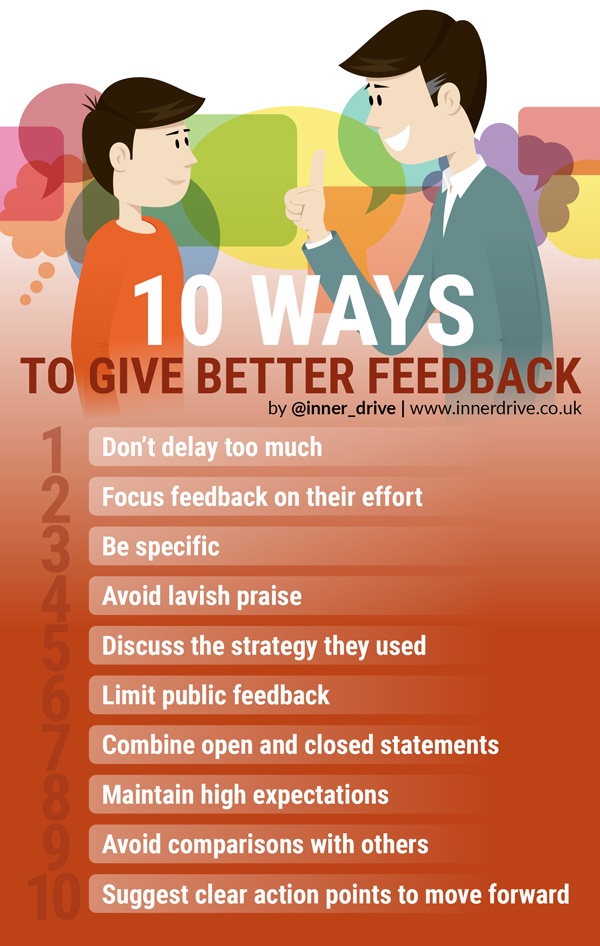
Here are ten tips on how to give better feedback:

Don’t delay too much– An interesting review on when to give feedback found something quite curious. The researchers discovered that in experiments conducted in a laboratory, delayed feedback were more helpful; however, in a real world setting, especially in classrooms, immediate feedback was more beneficial. This makes sense when you think about it: the real world is messy and complicated; leave things too long and things get forgotten; memories get distorted; other pressing events crop up.

It is not always possible or practical to give immediate feedback. This is especially true if emotions are running high. The trick is to give timely feedback in a way that doesn’t smother people (too much too soon can be just as bad), but early enough that the event is still fresh in their mind. As with all things in psychology, there are some caveats to the rules.

Research suggests that in some situations, delaying feedback may actually be better. These may include when the task is simple and when there is plenty of time available (giving the other person enough time to try several different strategies)

Be specific – When you say ‘good’, the assumption is that the person will know exactly what was good. This is not always the case. It is easy for people to misunderstand what you mean. This is especially true when giving feedback to teenagers, who as a result of their brain restructuring, can find it harder to understand someone else’s perspective and thought process. The more detailed and specific the better. This will remove any ambiguity. It is far better to say, ‘The way you did X was really good.’

Focus feedback on their process, not their natural ability– Praising someone’s effort (instead of their intelligence) will help them to develop a growth mindset. This impact has been found in even very young children, with the type of praise given to 1-3 years old impacting on if they have fixed or growth mindset up to 5 years later.

Praising someone’s effort increases their intrinsic motivation and provides a template for them to follow next time. A separate study found that the type of praise children receive actually drives the type of feedback they then seek out themselves post task. In this study, 86% of children who had been praised for their natural ability asked for information about how their peers did on the same task. Only 23% of children who had been praised for effort asked for this type of feedback, with the vast majority of them asking for feedback about how they could do better.

Avoid lavish praise – When someone has repeatedly struggled, it is tempting to heap lots of praise on them when they achieve some level of success, no matter how small. This can actually do more harm than good. Insincere praise is very easy to detect. Too much praise can convey a sense of low expectation and, as a result, be demotivating.

Limit public feedback – Teenagers care a lot about what their peers think of them. Public feedback, even if well intended, can easily be interpreted as a public attack on them and their ability. This can quickly lead to a fear of failure. This can result in teenagers putting on a front, accompanied with bundles of bravado.

A nice way to overcome this is what author Doug Lemov calls ‘Private Individual Correction’. This limits the publicness of the feedback, whilst still getting the message across clearly. This is similar to the technique he calls ‘The Whisper Correction’, which although done in public, the pitch and tone of voice is done to limit everyone else’s attention to the individual feedback.

Combine open and closed statements – A closed question is one where the answer is ‘yes’ or ‘no’ (i.e. ‘Were you nervous before the exam?’). The problem with these questions is that if the answer is no, the conversation can grind to a halt. You may find out that they weren’t nervous, but you won’t find out what they were actively feeling (sad, angry, not bothered, tired etc.). An open question, such as ‘how were you feeling in the morning?’, encourages someone to tell their story.

A combination of open and closed questions and statements can help when it comes to giving feedback. Closed statements help you to convey the information you want and can potentially save time and keep the conversation focused. Open questions allow for a good two-way conversation and can help students develop a sense of ownership of the situation.

Avoid comparisons with others – It is far better to focus your feedback on their individual development and improvement instead of in comparison with others. A recent study found that being positively compared to someone else can lead to narcissistic behaviour. This sort of comparison can also reduce someone’s intrinsic motivation, which has been associated with lower confidence, emotional control, academic performance and increased anxiety.

Discuss the strategy they used – This can help them identify helpful thought processes so that they can do the same again next time. Psychologists call this ‘metacognition’. Put simply, metacognition is the awareness and control of your thought process. This is a very valuable skill and has been found to significantly help students improve their grades.

Maintain high expectations – A famous study, conducted almost fifty years ago, found that high expectations can have a powerful effect. Teachers were falsely told that some of their students had been identified as potential high achievers; they were expected to bloom over the course of the year. Several months later, when compared to the rest of their classmates, these students had in fact made significantly more progress. What drove this change? The teachers’ increased expectation for these students.

This is known as the Pygmalion Effect (named after the mythical Greek sculptor who loved his statue so much that it actually came to life). Have high standards and people will often up their game in order to match them. Sometimes students need someone to believe in them before they can believe in themselves.

Suggest clear action points to move forward – This is one of the key points from the ‘What Makes Great Teaching Report’. Feedback that doesn’t lead to behaviour change is redundant. There must be a point to it. What do you want them to do differently? What are they going to do after this conversation to improve? The more detailed and specific the action points the better.

FINAL THOUGHT

Giving feedback isn’t easy. If done right, however, it has the ability to transform someone’s learning and performance. If done wrong, it can actually do more harm than good. So don’t delay, focus on their effort, be specific, avoid lavish praise, limit public feedback, use both open and closed questions,  avoid comparisons with others, and suggest clear action points moving forward.

Interested in student workshops? Find out more

This article was first published on The Guardian website on 10.11.16. You can read it, alongside all of our other Guardian blogs here: https://www.theguardian.com/profile/bradley-busch


About Inner Drive

InnerDrive is a mental skills training company coveing the traditional areas of sports psychology and mindset training.

Their work covers the traditional areas of performance psychology, sports psychology and neuroscience. They work with over 120 schools in England and last year worked with over 25,000 students, teachers and parents.

The company is led by Edward Watson, a retired Army major and Bradley Busch, a HCPC registered psychologist.


Filed Under: Professional Development

Characteristics of a Coach of Excellence

January 24, 2017 by

These characteristics of coaches of excellence were posted on Bob Starkey’s Coaching Blog, hoopthoughts.blogspot.com. He is an assistant women’s Coach at Texas A & M University.

Editors’ note from Brian: Even though these concepts came from a very successful NFL executive, most of the thoughts can be applied to any level of coaching for any sport. To my knowledge, there has never been a female NFL coach, so it was written from his experience of only interviewing male candidates. My purpose in publishing these articles is that lessons learned can be applied to all coaching situations, even if it is a different level, sport, or gender than you coach. I strive to provide a service to the coaching community, and in no way is it stated or implied that only men can be coaches of excellence, nor is it meant as a forum for those types of discussions.

Bill Polian was one of NFL’s best General Managers.  He has a proven formula of success and that has transcended from one organization to the next.  Hired as the Buffalo Bills GM following a 2-14 season, he soon had the franchise going to three straight Super Bowls.  From there he became the GM of the Carolina Panthers where he had the team in the NFC Championship Game in only their second year of existence.  From there he took over the Colts organization and one of his first moves was to draft Peyton Manning who would ultimately guide the team to a Super Bowl Championship.

Each spring I’m honored to be a part of Felicia Hall Allen’s A Step Up Assistant Coaching Symposium,”which is a unique format to help assistant coaches become better at their craft.  Obviously, one of the topics each year is moving  into the head coaching position.  Felicia brings in a wide variety of people to help paint the picture they need to move up.  One of the obvious speaker choices new head coaches that have just made the jump.  But she also brings in Athletic Directors, Search Firms and Head Hunters to give us a unique look at what the people doing the hiring are looking for.

I think sometimes as coaches we tend to lean on other coaches maybe too much for information instead of stepping outside our comfort zone and meeting with the true “decision makers.”  Have you met with your Athletic Director and discussed what he/she looks for in a candidate?  Do you have the courage to ask that AD what your deficiencies are and what you should look for?

Polian has an outstanding book that I’ve read a couple of times titled “The Game Plan: The Art of Building a Winning Football Team.”  For those interested in becoming a head coach, Chapter 2: Deciding on the Decision Maker is worth the price of the book alone as Polion gives great insight to what he is looking for.  Below, is a brief look in to what he views important.

  1. Organization. That ranges from how he organizes his playbook to his practice plans, from year-round staff assignments to his off-season program.  Each of those areas and many more must be laid out in writing and explained completely, step by step, especially with a candidate who has never been a head coach before.

Today, every coaching candidate shows up for an interview with a “book” detailing all aspects of his program.  But the book is only as good as the person reading it.

  1. Leadership. Does he have the philosophical approach, verbal skills, physical presence, stability, and courage to lead and motivate the coaching staff, the players, and the support staff?
  1. Communication. Does he have good verbal skills?  Does he listen?  Does he respond to questions in a thoughtful way, or does he just tell people what to do?  Is he open to suggestions? Can he interact with ownership, management, and other departments on their terms?

Can he sell his program to all of the team’s stakeholders?  Does he care and communicate that care to others or are they just numbers to him?

Can he teach or is he a lecturer?  A teacher gets everyone involved.  He is able to illustrate his lessons with real-life examples and sometimes funny parables.  He gets his students invested and involved in what he’s teaching.  A lecturer just stands at the podium and spits out notes.

  1. Emotional Stability.  Can he function well under pressure from players, staff, ownership, fans and the press?  Does he remain cool on the sidelines?  Does he remain composed, organized, and does he take the lead at halftime?  Doe he use genuine anger as a motivational tool or does he come apart when he’s frustrated?

Is he coherent in his remarks to the players, staff, ownership, and the press after a loss?  Does a loss stay with him too long?  Can he keep everyone in the program, including the general manager focused by his own leadership when the “roof is falling down?”

  1. Vision.  This is the most important quality of them all.  Does he have a clear picture of how he wants his team to look and play?  Can he articulate it verbally and in writing?

Can he make long-term decisions in order to implement his vision when pressure is great for him to make a short-term, quick-fix decision?  Has he organized the program in such a way as to implement his long-term plan?

  1. Strategy.  Is he mentally prepared to make decisions on the sideline or does he react?  Does he have direct responsibility for key strategic decisions?  I other words, is he the guy making them or is he going to lean on somebody else?  He’s got to be the one to decide whether to go for it on fourth-and-goal.  He’s got to be the guy to decide whether he’s going to kick a field goal or go for a touchdown.

As Marv Levy always used to say, “If we’re penalized for having 12 men on the field, that’s my responsibility.

  1. Flexibility.  Can he adjust to changing trends and rules, personnel, opponent schemes, personality or culture of players?  And then I ask two rhetorical questions.  First, can he change the nuts and bolts of his program to adjust to circumstances without changing his approach to the fundamentals?

Secondly, can he be flexible and take advantage of circumstances or does he buy someone else’s program, lock, stock and barrel?  I other words, does he say, “Oh, gee, Pittsburgh won using a 3-4; let’s switch to a 3-4?”

  1. Ability to judge talent. He’s got to be able to see potential rather than just saying, “This is college player A and this is college player B.”  He’s got to be able to see what the potential of college player A is versus college player B.
  1. Public relations. Essentially, it boils down to, can he handle himself well in this media maelstrom that he’s forced to endure these days?
  1. Player respect. Does his knowledge, leadership, teaching ability, approach to squad morale and discipline, and his personal habits and dignity earn player respect? Do they look up to him?

Is his approach to discipline fair?  Do his personal bearing, conduct, and dignity — which encompasses work ethic, temperament, personal habits, etc. — generate respect from the players?  Not liking, but respect.

  1. Character.  It boils down to one thing: do you want this man as a standard-bearer for your franchise.

If interested in finding out more about the book, you can click the image of the cover below to the left.


Filed Under: Professional Development

Getting Better at Getting Better

January 23, 2017 by

These are some of the notes presented by Mike Neighbors at this past spring’s PGC/Glazier Basketball coaching Clinic in Chicago. Mike is the Head Women’s Basketball Coach at the University of Washington.

I believe that these thoughts are applicable to all sports and to any coaching situation

Getting Better at Getting Better

  • You have to take the time to consciously think about and consciously plan how every important aspect of your program is going to get better.
  • Getting Better does not happen on its own without a coaching staff being intentional about it.
  • To achieve your potential, you must have a 5:1 ratio of practices to games.
  • For every minute you spend in practice/meetings, it takes 2 minutes to prepare and plan.
  • Practice makes permanent, not perfect, so as coaches, we must set up systems so that our players are practicing the right way.
  •  

  • What do you care about?
  • Can your players verbalize what you care about?
  • If you ask our players about how we do things, they should be able to tell you those two things.
  • You either coach it or you tolerate it.
  •  

  • Be good at the things that you do a lot in your system.
  • For those important precision skills, we employ a coaching technique called “Front of the line, back of the line.
  • We require that a player executes a skill exactly as we teach it in a drill, with zero error every time.
  • If the skill is executed perfectly, the player goes to the back of the line in the drill and the drill continues with the next player up.
  •  

  • If they did not do it perfectly, the next player in line goes and the player who just went goes to the front of the line for some instruction from the coach who is running the drill.
  • After the first week of practice, the players decide if the performance is front of the line or back of the line.  You will find that the players are harder on each other than you are on them.
  • We quickly saw marked improvement in all our PRECISION SKILLS employing this method. It also evolves quickly into a peer situation of players being the critics and pointing their teammates to the front or the back. They are actually tougher on each other than most coaches!!
  • You can see a more detailed description of Coach Neighbors front of the line/back of the line concept at this link:  Front of the line/Back of the Line
  •  

  • Keep in mind at the start of each season, you have not taught until your players have learned it.  You know your entire system.  It will be new to new players on your team and your veterans will not know it as well as you.  Take the time to re-teach until they learn!
  • Properly prepare so you don’t have to repair.
  • Players cannot access the creative side of their brain unless they are comfortable with what is going on.
  • It takes your best players 5 seconds to reconnect their concentration to the action when you yell their names.  It takes average players 10 to 15 seconds to reconnect.
  •  

  • Washington coaches only talk during dead balls.
  • Exercise in helping players to develop  the next play mentality.  When Kelsey Plum was a freshman, and made a mistake in practice, Coach Neighbors could tell that her mind would be on that mistake for the next several possessions.  To help her learn, he started a stopwatch as soon as she made a mistake and stopped it once she had refocused.  It showed 2 minutes and 36 seconds.  He took her out of the scrimmage, called her over and showed her the time on the stopwatch.  She asked him what the represented.  He said it was the amount of time that it took you to get you concentration back after you made a mistake.  He told her that he would need to take her out of the game every time that she made a mistake for 2 minutes and 36 seconds so that she could regain her focus unless she was able to improve that on her own.  The improvement  in her next play mentality over the next few days of practice was remarkable.
  •  

  • Find ways to help narrow your players’ focus in practice.
  • Send the players home with 3 bright spots and 1 deficiency to work on.
  • Feedback is huge for today’s players.  Make it immediate, honest, and actionable.
  • During practice, he has an assistant coach taking iphone videos and then emailing them to players when there are specific teaching points so that the players have them right after practice and can see themselves doing or not doing the teaching point.

Many of these concepts came from a book called “Practice Perfect” You can find out a little more about the book (and read a part of it and/or listen to a segment by clicking on the image to the left:

Here are a few more concepts from the book:

Never mistake activity for achievement–John Wooden
A high rate of activity isn’t enough–coaches must be intentional about what their athletes do.
Practice isn’t only worth re-engineering when it is bad, it is also worth re-engineering when it is merely good.
To be significantly better, you need to be significantly more productive for every minute you practice.
“Even relatively small, but significant changes, can increase the rate at which people develop by a striking degree”


Filed Under: Professional Development

  • « Previous Page
  • 1
  • …
  • 7
  • 8
  • 9
  • 10
  • 11
  • …
  • 18
  • Next Page »

© Copyright 2026 Athletic Performance Toolbox

Design by BuzzworthyBasketballMarketing.com

Privacy Policy