Coaches Toolbox

  • Home
  • Mental Toughness
  • Leadership
  • Motivation
  • Staff Development
  • Program Building
  • Archives
  • Sport Specific Sites
    • Athletic Performance Coaching
    • Basketball Coaching
    • Football Coaching
    • Soccer Coaching
    • Track and Field Coaching
    • Volleyball Coaching

Engaging Your Athletes

February 2, 2016 by

Introduction:

A USADA study of the general U.S. population found that coaches are the leading positive influencers on today’s youth. According to the study, “[Coaches] are closest to youth sport participants (both proximally and emotionally) and are generally perceived as having a positive influence on young people.”

Was it the number of wins or championships that made coaches so influential? More likely, it was relationships with athletes that drove the study’s findings. It may have been a coach’s ability to teach, motivate or instill values that helped their athletes down the road—both in and out of competition—that made the greatest impact.

At the heart of each of these experiences is engaging an athlete. A coach’s ability to engage his or her athletes is what makes them influential, positive, or “good”. A better program and more success often just happen to follow.

So, how do you engage your athletes even better? Coachestoolbox set out to find the best of the best tools available today.


A Multi-Solution Engagement App

One particular coaches’ tool that rose to the top in our testing was Programax. Programax is a web-based app that offers robust features and a wide range of functions designed to help coaches to engage, motivate, track and plan across their entire program.

To help shed a little light on why we found Programax to be so effective for coaches, we’ll highlight just a few of its many features and benefits here.


Skill and Strength Workouts

A key component of engagement is motivating athletes and driving performance improvement within your program. For many coaches, getting athletes to make the most of their time in the off-season is a significant challenge.

With this in mind, we love the way Programax harnesses technology to drive performance improvement. The app makes it simple for coaches to create their own custom video library of the skill drills and strength-building exercises they want athletes to execute. These activities can be combined into tailor-made workouts that provide a long-term plan for improving athlete performance.

The athletes are engaged when they access the activities through their own Programax accounts via their smartphones or any web-enabled device. There they view and execute the activities as instructed, and record their performance. Results are posted in real time on program-wide leaderboards, permitting coaches and other athletes to see the “personal bests” of the athlete’s workout in a live environment. The accountability and competition driven by the leaderboards is just one of many benefits that make this one of the best training apps out there.

Click the play arrow below for a video on the Activities Feature

For more information on Programax activities or to sign up for a demo, visit www.Programax.org/performance


Messaging

Want to engage your athletes? It begins and ends with communication. We love that Programax makes it easy for coaches to connect with coaches, athletes and even parents in seconds via text or email. The contact information for all of your program’s participants is stored within the app and is at your fingertips whenever you need it.

Staying in touch with your program’s stakeholders is made even easier by Programax’s “Groups” functionality. Create custom groups containing those you message most—maybe assistant coaches, captains or individual classes—and save yourself even more time as you distribute important information.

Click the play arrow below for more about the Messaging Feature

See it in action and sign up for a demo www.Programax.org/communication


Calendar & Scheduling

The Calendar functionality in the Programax app is nothing flashy—just the same type of intuitive scheduling system you might find on your mobile phone. But does it help coaches with athlete engagement? Absolutely!

What we really liked about the Programax Calendar is how it allows coaches to create distinct, color-coded schedules for all of the different types of events or groups within their programs. These schedules only appear on the calendars of those they impact (as set by the coach or administrator), and can be synched to personal calendars on mobile phones, or within Outlook or Gmail. In the end, Programax provides a simple yet thoughtful approach to this important feature.

Click the play arrow below for a Calendar Feature Overview:

For more information on Programax sign up for a live demo, visit www.Programax.org/scheduling


Camp Sign-Ups

Camps and events can be a great opportunity for coaches to engage athletes. They can also be a lot of work. The Programax Event Management feature allows coaches to spend less time on sign-ups and admin, and to focus more on the camp curriculum and the athletes themselves.

Coaches can create an event, market the camp through the app and collect registration fees all within the app. The tool’s real time roster of sign-ups and key information on those individuals is a huge timesaver for coaches as well.

Click the play arrow below for a short video on Programax Events Feature:

Learn more about even signups wit Programax at www.Programax.org/scheduling


Coaching Your Coaches

Within many programs, head coaches aren’t the only ones engaging athletes. Assistant and lower level coaches can also be instrumental in leading players and building a better program. Programax provides a unique solution called “Coaches Corner” that helps build consistency across programs.

The app allows you to share materials amongst your staff, including upload video, PDF or image files, which they can view or download directly from their personal Programax accounts. In essence, it allows you to “coach your coaches” on precisely how you want them to lead. In the opinion of Coachestoolbox, Coaches Corner is a thoughtful addition to an already useful app.

For more information on this and other Programax features, visit www.Programax.org/coaches-corner

In Conclusion

Athlete engagement is a key component of building a successful program. In our opinion, Programax is a tremendous tool for helping coaches “do” engagement better.

Each of the app’s many features prove to be robust and powerful in their own right; from powerful messaging and scheduling tools to an advanced training platform that stands up to the best training apps out there. Just one of these could make a coaches’ life easier. When you consider that all of these and more are included in one intuitive app, that’s a potential game-changer. For these reasons, we recommend you check out Programax for your own program.

To see Programax in action or learn how you can use it in your own program, visit www.programax.org.


Filed Under: Program Building

Where is Your Team on the Grit Scale?

January 30, 2016 by

Living with a 99% Effort

I got this list from entrepreneur and business author Harvey Mackay’s book “Dig Your Well Before You’re Thirsty.” (If you click on the name of the book, you can see a portion of the book from Amazon) In the book, he gives credit to Armond Bouchie for using this list in his job application portfolio.

If we had to live with 99% effort, we would have:

One hour of unsafe drinking water every month,

Two unsafe plane landings per day at Chicago’s O’Hare Airport,

16,000 pieces of lost mail every hour,

22 checks deducted from the wrong bank account every week,

500 incorrect surgical operations every week,

12 babies given to the wrong parents every day,

20,000 incorrect drug prescriptions each year, and

800,000 credit cards with incorrect information.

A 100% effort makes sense.


This next portion of the post contains some of my takeaways from Texas A&M Women’s Assistant Bob Starkey’s Coaching Blog Hoop Thoughts Blog

HOW DO YOU MEASURE ON THE “GRIT” SCALE?

Mitch Cole

Some educational researchers have defined GRIT as “passion and perseverance to achieve long term goals”. When struggles come, do you get more DEJECTED or more DETERMINED?

Studies have shown that the attribute of GRIT, is one of the most powerful indicators of success. The most GRITTY people usually succeed on and off the playing field or court.

Teams can become selfish during good times and turn on each other during tough times. Teams that stay together can resist the temptation to be selfish, can withstand tough times, and even conquer insurmountable odds.

Most people can appreciate a team or athletes that refuse to give up no matter what the circumstance. Resilience is the ability to bounce back from difficulty and in some cases, be better than before. This can happen when the other team goes on a run and things look most bleak, or even within a season. Teams that “Fight” and show tremendous Resilience over and over again have the best chance for sustained success.

When winners get knocked down, they get up, champions get up a little faster.

“Being relentless means constantly working for that result, not just when drama is on the line. Clutch is about the last minute. Relentless is about every minute.” -Tim Grover From “Relentless: From Good to Great to Unstoppable”

U of Penn Duckworth Lab study found that “grit” (passion & perseverance for long-term goals) is best predictor of success. “Grit is unrelated w/ talent.”

The Duckworth Lab focuses on two traits that predict success in life: grit and self-control. Grit is the tendency to sustain interest in and effort toward very long-term goals. Self-control is the voluntary regulation of behavioral, emotional, and attentional impulses in the presence of momentarily gratifying temptations or diversions. On average, individuals who are gritty are more self-controlled, but the correlation between these two traits is not perfect: some individuals are paragons of grit but not self-control, and some exceptionally well-regulated individuals are not especially gritty. While we haven’t fully worked out how these two traits are related, it seems that an important distinction has to do with timescale: As Galton suggested, the inclination to pursue especially challenging aims over months, years, and even decades is distinct from the capacity to resist “the hourly temptations,” pursuits which bring momentary pleasure but are immediately regretted.

In terms of Big Five personality, grit and self-control both load on the conscientiousness factor, which also encompasses dependability, punctuality, and orderliness, among other facets.

Some educators typically prefer the umbrella term “social and emotional learning,” whereas many other educators, as well as philosophers and positive psychologists, embrace the moral connotations of “character” and “virtue.” So, grit and self-control are facets of Big Five conscientiousness, but are also conceptualized as dimensions of human character, social and emotional competency, and non-cognitive human capital.

That Extra Effort

For another angle on the importance of a 100% effort, click on the image below for a very inspirational video:

think you are really going to like this video that shows us that there is not a lot of physical difference between top performers and also rans. The big difference is in their mental strength and persistence! Click on the icon to see the video.


Filed Under: Motivation

Developing Leadership Capacity in Athletes

January 26, 2016 by

Developing Leadership Capacity

The Context and Culture Make a Difference in Developing Your Team Leaders

By Cory Dobbs, Ed.D., The Academy for Sport Leadership

It didn’t dawn on me that there might be anxieties and risk involved in team learning until I put a few work teams at a Fortune 100 company under a microscope. To say the very least, what I observed was a wide-range of defensive and protective processes which ultimately closed off the team’s members from learning and instead created a variety of dysfunctions anchoring the team’s collective efforts in the harbor of mediocrity.

As a result of this work I decided to take a closer look at how student-athletes learn in a team setting, and in particular how the context influences the perceived risk involved in learning to lead one’s teammates. Upon closer inspection it became obvious that many of the risks involved in team learning in the corporate world are mirrored in the athletic world. Likewise, learning to lead in a team environment is risky business.

So, how do you get student-athletes to learn together? There are no simple answers. However, knowing that the context greatly affects learning is a step in the right direction if you’re serious about your players learning how to lead.

Leadership Development and Psychological Safety

When a student-athlete takes on a leadership role it’s important to understand that he or she will learn primarily through trial and error (which is why I firmly believe in deliberate practice—scrimmage—as a way to reduce perceived risks). If a student is learning physical geography he or she will learn in private with no one else aware of his or her mistakes. However, learning to lead in a team setting requires learning by trial and error in interpersonal interactions. Learning this way is certainly not learning in private and the consequences of actions always involve one’s teammates. Therefore, team leaders perceive risk in appearing ignorant and or incompetent in front of their peers.

Because most student-athletes have little experience at leading, which includes making mistakes in front of teammates, such fears as embarrassment and rejection are always present. And many student-athletes are reluctant to take actions or to speak up or speak out for fear that their actions may be held against them by teammates. To neutralize such fears it’s in your best interest to create a psychologically safe environment.

Let’s start with what I mean by psychological safety. It is a shared belief by all team members that the team is an environment where everyone has a sense of confidence that others will not embarrass, disrespect, disregard, or punish someone for taking action or speaking up or speaking out. All members understand that a supportive learning environment is necessary to build a psychologically safe team context.

The central idea is that a psychologically safe team environment will produce higher performing team learning and team leadership. Expressed as a formula it looks like this:

formula

At the heart of the growth of a team leader is the leader as a learner, the learning process, and the context which together form the cornerstone of leadership development. Always keep in mind that the team leader is engaging in learning a new mind-set as well as a new skill-set. That is, the student-athlete as a team leader is undergoing a tremendous transformation and that is why creating a psychologically safe environment is necessary.

Creating a Psychologically Safe Learning Environment

Years ago, during a seminar the late Peter Drucker asked an elite group of executives “How many of you have deadwood in your organization?” referring to those employees that had retired on the job. The hands of every one of the high-profile CEOs went skyward. He then asked “Were they that way when you brought them into your organization?” The implication was obvious, if they were then the leader was at fault for hiring them, and if they weren’t then something inside the organization “caused” the employee to basically give up on improving and become organizational deadwood. The point is that the context has a much more profound effect on how people behave than most leaders
realize.

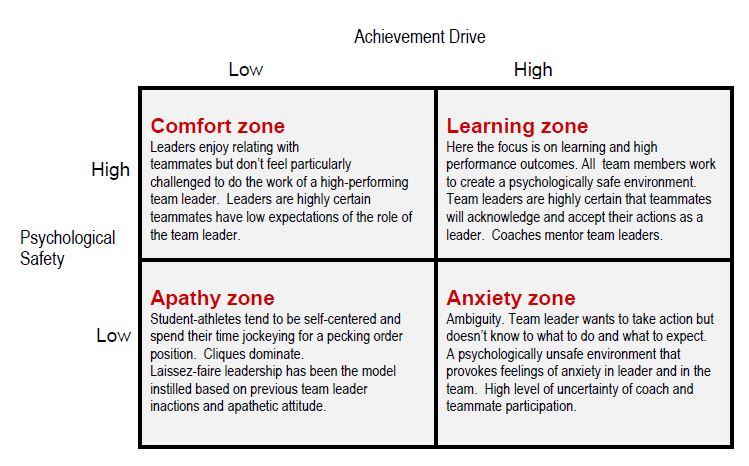
The question, then, is what can you do to create a psychologically safe environment for team leaders learning to lead? The first step is to understand your team environment as it is and how it interacts with the internal achievement drive of your team leaders. To do this, use the model below.

matrix

Hopefully the matrix above can provide a window into your current team context and how it is affecting the development of your team leaders. Psychological safety is an important component of creating an effective learning space for you and your team. The purpose of this brief article is to provide an introduction into the practice of developing a team leader’s capacity to lead through the process of team learning. When you involve all members of the team in the learning of leadership you’re more likely to create an effective learning environment.

Let me issue a quick reminder that leadership is a social influence process in which team leaders work to motivate or persuade teammates to achieve specific individual and team goals. As such, the norms, beliefs, and values that emerge from team member interactions will create team dynamics that will influence the social structure and social processes that will either enhance or inhibit team learning. Your goal as the chief architect of the environment should be to create a psychologically safe learning zone.

Ultimately, you have more to do with a team leader’s learning to lead—or not learning—than you probably thought you did. If you’re not growing team leaders, then it’s likely the problem is not the seed, it’s the soil.

To find out more about and order Sport Leadership Books authored by Dr. Dobbs including Coaching for Leadership, click this link: The Academy for Sport Leadership Books

About the Author

A former basketball coach, Cory’s coaching background includes experience at the NCAA DII, NJCAA, and high school levels of competition. While coaching, he researched and developed the transformative Becoming a Team Leader program for student-athletes. Cory has worked with professional athletes, collegiate athletic programs and high schools teaching leadership as a part of the sports experience and education process. Cory cut his teeth as a corporate leader with Fortune 500 member, The Dial Corp. As a consultant and trainer Dr. Dobbs has worked with such organizations as American Express, Honeywell, and Avnet.

Cory has taught a variety of courses on leadership and change for the following universities:

Northern Arizona University (Graduate Schools of Business and Education)

Ohio University (Graduate School of Education / Management and Leadership in Sport)

Grand Canyon University (Sports Marketing and Sports Management in the Colangelo School of Sports Business)

Visit www.corydobbs.com to read Cory’s leadership blog.


Filed Under: Leadership

The Great Leadership Challenge

January 21, 2016 by

from Jim Rohn:

If  you want to be a leader who attracts quality people, the key is to become a  person of quality yourself. Leadership is the ability to attract someone to the  gifts, skills, and opportunities you offer as an owner, as a manager, as a  parent. What’s important in leadership is refining your skills. All great leaders  keep working on themselves until they become effective.

Here are some specifics:

Learn to be strong but not impolite. It is an extra step you must take to become a  powerful, capable leader with a wide range of reach. Some people mistake rudeness for strength. It’s not even a good substitute.

Next, learn to be kind but not weak. We must not mistake weakness for kindness.  Kindness isn’t weak. Kindness is a certain type of strength. We must be kind  enough to tell someone the truth. We must be kind enough and considerate enough  to lay it on the line. We must be kind enough to tell it like it is and not  deal in delusion.

Next,  learn to be bold but not a bully. It takes boldness to win the day. To build  your influence, you’ve got to walk in front of your group. You’ve got to be  willing to take the first arrow, tackle the first problem, discover the first  sign of trouble. Like the farmer, if you want any rewards at harvest time, you  have got to be bold and face the weeds and the rain and the bugs straight on.  You’ve got to seize the moment.

Here’s  the next step. You’ve got to learn to be humble but not timid. You can’t get to  the high life by being timid. Some people mistake timidity for humility. But  humility is a virtue; timidity is a disease. It’s an affliction. It can be  cured, but it is a problem.

Humility  is almost a God-like word. A sense of awe. A sense of wonder. An awareness of  the human soul and spirit. An understanding that there is something unique  about the human drama versus the rest of life. Humility is a grasp of the  distance between us and the stars, yet having the feeling that we’re part of  the stars.

Here’s  a good tip: Learn to be proud but not arrogant. It takes pride to build your  ambitions. It takes pride in your community. It takes pride in a cause, in  accomplishment. But the key to becoming a good leader is to be proud without  being arrogant.

Do  you know the worst kind of arrogance? Arrogance from ignorance. It’s  intolerable. If someone is smart and arrogant, we can tolerate that. But if  someone is ignorant and arrogant, that’s just too much to take.

The  next step is learning to develop humor without folly. In leadership, we learn  that it’s okay to be witty but not silly; fun but not foolish.

Next,  deal in realities. Deal in truth. Save yourself the agony of delusion. Just  accept life as it is. Life is unique. The whole drama of life is unique. It’s  fascinating.

Life  is unique. Leadership is unique. The skills that work well for one leader may  not work at all for another. However, the fundamental skills of leadership can  be adopted to work well for just about everyone: at work, in the community, and  at home.


Filed Under: Leadership

Leadership Notes for Coaches

January 5, 2016 by

Sharing some notes that I have taken recently from some of my favorite leadership sources. Some of them, I hope you can use for yourself and your staff, others for your athletes, and most of them for both groups!

As with all of my posts, I am sure that you won’t agree with everything that is listed here and will probably find some that you either can use as is or that you can modify to meet your needs.

Kevin Eastman

Twitter: @KevinEastman

The mind & the attitude can have a major impact on how far one can go. The mind has to be “clutter free” and the attitude has to be “all in”!

Understand that trust has eyes & ears. It evaluates the consistency & authenticity of what it sees & hears. It takes its time to evaluate you!

Make sure the “give-get” percentages favor the “give”. Giving should be part of our make up. We all truly do have things to give & share!

As much as we like to tell people what we think it’s even more important to put thought to what we say. Hard to take words back!

Just as you work out physically, you must also get your repetitions in mentally. Challenge yourself with heavier mental reps as well. Stretch yourself!

Every so often a great exercise is to get away & just think about or remind yourself what you TRULY BELIEVE in; things that are non negotiable!!

Give yourself a chance to succeed. Success is about investment; adjustment; & commitment. Determine which, if any, you need to improve on!

To be a true teammate: must hold yourself accountable to everything you hold others accountable to. The one thing a true team is not: self centered!

Everyone says communication is so important-then why are we not as good at listening? It’s critical to success. We ALL need work on this SKILL!

To be a great teammate your pride will take a hit at times and your pride can never take precedent over the success of the team!

Being a good teammate is still doing your part when things are going bad for you. Being a good team is helping that Individual get out of it!

Consistency is a direct result of doing the right things the right way–now. Focus on the execution of now & discipline to do this every day!

A team will always have challenges and issues. That is where the strength of a team must show up: using everyone in anyway to get through them!

John Carrier

These notes were reposted with permission by John Carrier from his coaching blog. Here is a link to the blog: www.johncarrier.blogspot.com

I am currently reading Phil Jackson’s book, Eleven Rings. One gem I’ve pulled out in the first 100 pages is the “Bullseye Test” he uses with his players.

The Bulls eye Test is simple, yet insightful. Give each player a three ring bulls eye. Have them write where they feel that they are in terms of their connection to the rest of their teammates. Don’t give them any more than that. You can read a little more from the inside of the book at Amazon by clicking the cover of the book at the left, or you can click on this link: Eleven Rings: The Soul of Success

You then look at their bulls eyes and see how connected each person feels to our group. It also gives you a handle on how connected the team feels as a group. If they are very connected they are in the middle, if they feel kind of connected their name will be in the second ring, and if they don’t feel connected they write their name on the last ring or outside the rings. A lot of times it comes down to playing time – the more they play the closer to the middle they write their name. So you have to account for that a little bit when looking at them.

Once you’ve done the exercise, you can use them to have individual talks with your players. Ask lots of questions about why they feel that way, and if they are outside the middle how can we move them closer (without adjusting playing time of course). It will also help you determine if how to proceed with team bonding activities during the season. It’s something we will definitely use this season.

The following are some other notes he osted

John Tauer – St. Thomas University – Motivation

People are mostly motivated by three things:

  1. Autonomy
    Choice in life.
    Give athletes choices in what drills you do inpractice (within reason).
    Even one or two choices per practice can be powerful. 
  2. Togetherness
    Individuals need to belong to something bigger than themselves and have a more powerful purpose.
    Keep your finger on the pulse
    Team building
  3. Competence
    Being good at things.
    How can you put your athletes in positions to find success?

TJ Rosene – Emmanuel College/PGC – Building a Culture

Greatest Teammate Exercise
-Have players close their eyes and imagine the greatest teammate they ever had.
-Call on players to share the characteristics of that teammate.
-Make a team list of the traits of great teammates.
-Turn it around on them – why can’t EVERYONE on this team be a great teammate?
-Make the list into a “commitment list” that everyone is going to commit to (coaches included) and everyone will be held accountable to for the year.

Rocking Chair Statement
-As a coach, write a statement about what you want athletes to remember about you when you are old in a rocking chair on your front porch!

The Best At What They Know
-Everyone is the best at what they know.
-If you’ve got a problem athlete, they are likely exhibiting that behavior because that’s what they know.

Communication Must Haves
-Truth, Love, Transparency
-N.I.T.E
+Name, Information, Tone, Eye Contact
+Simple but effective

Open Mic Monday
-Do this as a team
-Players can stand up and say ANYTHING that is on their mind, especially things they are frustrated with.
-They can also ASK ANYTHING of teammates and coaches and will receive an honest answer.
-You must speak it in love and not anger.
*This is a GREAT WAY to make sure that issues stay in house and don’t ever boil over.

Lion vs. Sparrow
-Lion is content and confident. He doesn’t worry about anything he can’t control.
-The sparrow is always frantic.
-Lions play through bad calls, band bounces, etc without emotion.
-Sparrows constantly wine and complain
*Might change it to wolf and squirrel to fit Minnesota.


Filed Under: Leadership

  • « Previous Page
  • 1
  • …
  • 48
  • 49
  • 50
  • 51
  • 52
  • …
  • 63
  • Next Page »

© Copyright 2026 Athletic Performance Toolbox

Design by BuzzworthyBasketballMarketing.com

Privacy Policy