Coaches Toolbox

  • Home
  • Mental Toughness
  • Leadership
  • Motivation
  • Staff Development
  • Program Building
  • Archives
  • Sport Specific Sites
    • Athletic Performance Coaching
    • Basketball Coaching
    • Football Coaching
    • Soccer Coaching
    • Track and Field Coaching
    • Volleyball Coaching

Leadership Nuggets for Coaches

May 11, 2015 by

Kevin Eastman is a Worldwide Speaker on Leadership & Team Building. The lessons he teaches are applicable everywhere. These area few of his tweets. You can follow him at https://twitter.com/#!/kevineastman

  • Part of leadership is motivating those you lead. So you must know what actually motivates each person. The critical part is tapping into that!
  • What you “expect” is not often what you get. What you “earn” is certainly more apt to get you going in that direction. Earning trumps expecting!
  • DO you ever think: why him or her? My thought is “if them; then why not me”. Put it on yourself to make it YOU – not THEM (or anyone else)!
  • What you do; how you do it; and who you associate with on a daily basis will determine your image and your impact!
  • The most important list you need to make: the list of things you need to do to become what you want to become…. Get the paper out now!
  •  

  • It’s ok to be at a loss of words, but we should never be at a loss of ideas or vision of ourselves!
  • Decisions to make on your problems: make excuses for them; feel sorry for yourself; or work to solve them????
  • A great weekend personal assignment: read as much as you can this weekend. See how much you can learn. Then apply it in this upcoming week!
  • The most successful people in life control the controllable things in their life. Those that stay on top of these have a chance to be on top!
  • Learn from life by evaluating backwards (what happened); progress with life by living life forward (what can happen)! Don’t live in past!
  •  

  • Today is always a great day to get something done that you DO NOT FEEL LIKE DOING. Usually this leads to great momentum on other things!
  • Observing & absorbing: so important to be a keen observer. But equally important to absorb what you learn. Need both steps to succeed!
  • One of the best qualities we can possess is the ability to “bring energy” every day. Energy is a multiplier – it pulls others in.
  • Looking for excuses is easy because there are lots of them out there. Fighting through challenges is hard — BUT: it usually leads to success!
  • Successful people have a willingness to dig in when times are tough. The alternative is to give in-definitely much easier but never successful!
  •  

  • Do what you do best; do it that way all the time; continue to learn–and accept nothing less of yourself. This is how you continue to climb.
  • Everyone need to understand that talent is a “gift”; but attitude, focus, spirit, discipline, and character are “choices”!
  • Potential or production? Best teams & companies love potential but value & need production. Potential must become production at some point!
  • Best organizations in sports or business have: the resources needed; the environment that fosters success; people w/ character/team mindset!
  • Seeking counsel from those who came before you is on of the most intelligent things you can do for your future success. Find those people!
  •  

  • Leadership begins as a title but the best leaders turn it into a position of nurturing, guiding, helping, encouraging, changing, & creating!
  • Two groups you must pay 100% attention to: 1) the group of people (your circle) you travel in; 2) the group of thoughts you allow into your mind!
  • An important question I as myself: what do I want to become? My answer drives me each day. “Becoming”, to me, is very, very powerful!
  • What if you said: I’m going to do this religiously for 10 days & begin the habit forming process. Think how many habits you could create in a year!
  • Mistakes are always going to be made. It’s simply a part of many things we are trying to do. The key is to make “new” mistakes.
  •  

  • What you say as a leader has the power to strengthen or weaken those you lead. There is power in words. Leaders must use them wisely!
  • When times are most tough and your self doubt may be kicking in: that is when you have to rely on your mind/work/spirit–knowing you have invested all 3!
  • People ask me all the time what’s the single most important thing I do every day. It’s actually 2 things: 1) I read —- 2) I think. A must!
  • Introspection is the key ingredient of growth, development, and improvement. But true introspection takes well thought out questions!
  • So often we all come to a point where we can’t seem to make a final decision. That is the time where we have to get away & just think.
  • What you put on paper is most powerful when you put it in front of you on a daily basis. Seeing it makes it become a part of you everyday.
Filed Under: Archives, Leadership

Great Teams vs. Destructive Teams

May 6, 2015 by

Some thoughts to share with your athletes…

Great Teams

“Prepare for every game/meet/match like you just lost your last game.”

There is a difference between readiness and preparation; readiness doesn’t get it done. You must prepare – Marine boot camp philosophy

“Treat people nice, even when they don’t deserve it.”

Have Positive Captains

– Work hard
– Take care of things on the floor/field
– Let the coaches take care of everything else

Have Great Team Attitudes

– Listen to each other
– Are courteous
– Say what they feel, but watch how they say it.
– Don’t talk behind each others back
– Don’t put each other down

Have players and coaches who accept and appreciate their roles on the team.

Work on improving their skills

Share ownership in both victory and defeat.

We before Me Attitude

– Trustworthy
– Disciplined
– Unselfish
– Help teammates up
– Know roles

Push each other in practice to better prepare each other for the next game.

Self Destructive Teams

Your Four Toughest Opponents

– Negative attitudes in your program
– Injuries
– Illness
– Ineligibility

“What is your attitude?”

“What do others perceive as your attitude?”

Have lost the love of the sport.

Are not willing to practice every day, especially when times are tough.

Lose track of their short term and long term goals. – What are the team’s goals?

Are more concerned with individual goals than the team goals.

– Who is starting?
– Whose name is in the paper?
– Who gets more playing time?

Lack leaders who will lead by example.
– “Can talk the talk but WON’T walk the walk”

Criticize teammates ”Run each other down rather than lift each other up”

Are not coachable

When you are not getting better each day, you are telling your teammates that you don’t care OUR team.


Filed Under: Program Building

Mental Toughness and Clutch Performance

May 3, 2015 by

These thoughts on clutch performance are from Spencer Wood Icebox Athlete Sports Performance Resources. Click that link to see his Mental Toughness Edge website. There are some articles on mental training and other resources as well.

According to a study based on professional athletes in the NBA, NFL, and NHL, the following eight traits were found to constitute the ultimate athlete:

  1. Ability to work hard and sustain intensity.
  2. Competitiveness.
  3. Athletic ability.
  4. Sacrifice for the team.
  5. Coping with criticism, failure, and success.
  6. Clutch performance, poise, and focus.
  7. Ability to execute game strategy.Passion
  8. for the sport and commitment to excellence.

Five of the above traits are mainly mental attributes.

There isn’t a coach in America who would say that mental skills and toughness isn’t critical to clutch performance. But how many coaches devote fifty percent of their time developing mental skills?

Misconception that mental skill and toughness only need to be worked on if there’s something wrong.

We must give our athletes an actual skill set to work on. A crisp definition of what is expected.

Mental Toughness = The Four C’s:

  1. Composure.
  2. Concentration.
  3. Confidence.
  4. Commitment.

What happens to the brain under stress?

Perceived threat leads to a fight or flight reaction.

  1. It’s important for our athletes to realize that this process is common.
  2. Not too many athletes are going to acknowledge they’re nervous.
  3. Take time to talk with your athletes about what happens to your mind and body in clutch situations.

Four things occur in clutch situations:

  1. Heart rate changes.
  2. Breathing pattern changes.
  3. Digestive system breaks down – blood from digestive system is rerouted to the prime movers of the body in preparation for fight or flight.
  4. Muscular tension – effects fine motor skills (e.g. shooting).

How does this effect performance?

  1. 8% differential between practice free-throw percentage and game free-throw percentage in NCAA.
  2. 13.6% difference in free-throw percentage between regular season and playoff NBA games.

Fight or flight is not all bad.

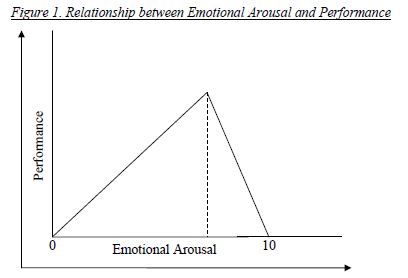
  1. There is a direct relationship between emotional arousal and performance.

Emotion Arousal (EA):

  1. Coming out of the locker room before a game, or coming out of a key timeout in a clutch situation, an athlete’s emotional arousal level increases.
  2. As emotional arousal increases, performance potential increases. However at a certain level, emotional arousal reaches a level where performance potential is maxed (as identified by the dotted line in figure 1).
  3. Once this level of optimum emotional arousal is passed, performance potential tanks.

basketball practice

  1. Different players may perform best at different levels of emotional arousal.
  2. Some young coaches pride themselves on their ability to jack up their team without knowing that two of their studs may play better at a level two or three of emotional arousal.
  3. Ray Allen for example seems to perform best at a very low emotional arousal level. You could have a player with an emotional arousal level of three who looks like they don’t even care.
  4. There is nothing on Earth that you should let take you out of your optimal arousal zone.

Determining a player’s optimal EA level:

  1. It is critical to ask the athlete what EA level they think they perform best at.
  2. Ask your athletes to think back to the three or four best games of their career, and there will be some continuity to the level of arousal they were at during those performances.
  3. Also challenge your players in practice. Manipulate their arousal levels and see at what level they perform the best.
  4. Don’t confuse arousal level and intensity. Intensity must always remain high for optimal performance.

Maintaining optimal emotional arousal

  1. There is a big difference between finding a players emotional arousal level and maintaining that level.
  2. Once an athlete has identified their level, teammates and coaches can help the player reach that level before a game
  3. It is up to the athlete to not let anything take them out of their optimal emotional arousal zone.

Mistake Management:

  1. You can tell a lot about a players emotional arousal level by how they react to mistakes.
  2. Train your athletes on how to react to mistakes.
  3. Great athletes aren’t great because they are perfect. They are great because they have the perfect reaction to their mistakes.
  4. Screaming after a miss is the ego saying I usually make that. However it reveals a level of frustration to our opponents.
  5. The external reaction of screaming is nothing compared to what is going on under the surface.

Take out the trash:

  1. With every single mistake made on the court, take out the trash.
  2. Remove the mistake from the mind of the athlete.
  3. There has to be a cognitive process to remove the mistake from the mind. Otherwise it remains with players, erodes confidence and kills clutch consistency.

Two step process:

  1. Take out the trash (erase the mistake from the mind like burning a photograph).
  2. Visualize the correct image.

When you see an image in your mind, whether it is real or imagined, you have a greater chance of reciprocating that image.
Three rules for using imagery before a game to improve a young person’s skill level:

  1. A goal has to be set.
  2. Visualize from an inside out view.
  3. Activate all five senses in the visualization (smell the popcorn vendors, hear the sound of sneakers squeaking on the floor, see the colors of the jerseys).

There is a huge difference between an outside-in view and inside-out view

  1. Outside-in view is like visualizing the action as if you were watching from the stands.
  2. Inside-out view is as if you are the one performing in the competition.

Self Vocalization:

  1. Positive self speak.
  2. We need to put the right words and images together.
  3. There are words that we can use that will help us perform at our best.

If we took a mediocre NCAA basketball player, and one of the greatest players in NCAA history and a mediocre player, and compared their self speak, would there be much of a difference? Yes the difference would be immediately apparent.

The inner voice of the mediocre athlete is like this:

  1. “Oh no this is a big one,” “don’t screw up now,” “don’t you choke,” and “I can’t miss this one, my contract is on the line here.”

The elite athlete’s self speak is like:

  1. “Oh yeah, I’m at my best when it counts the most,” “I’m one of the best players in the league,” and “I am so consistent in the clutch.”

If you could take down everything Michael Jordan said to himself during a game it would be owe inspiring.

There is a process to marry the right words and the right images to enhance clutch performance.

1. Set the goals.
2. Keep the statement positive and realistic:

    1. “I never miss in the clutch” – negative and unrealistic.
    2. “I always make free-throws in the clutch” – positive but unrealistic.
    3. “I am so consistent in the clutch” – positive and realistic.

Law of Dominant Thought:

  1. Mind doesn’t always distinguish between do and don’t do.
  2. Important to keep this in mind when we’re coming up with these key sentences for our internal script.
  3. “I never a miss a free-throw in the clutch” vs. “I always make my clutch free-throws. The first is negative, the second is positive.
  4. It may seem complicated to come up with the right words and the right sentences, but once an athlete devises a script, and practices it, it will be with him forever.

Channel Selection for Focus:

  1. There are seven different things that we can focus on.
  2. The first five are our senses (hearing, vision, touch, taste, smell).
  3. The 6th channel is our imagination – our ability to see images from the past and the future.
  4. The 7th channel is our inner voice.
  5. You can only effectively focus on one channel at one point in time.
  6. Our mind oscillates between these channels.
  7. If we just focus on one channel that sense is heightened.
  8. Most sports success is played in the visual channel.
  9. 90% of success played in the visual channel.

With a mediocre player, focus switches between channels more often in clutch situations than an elite level performer.

In timeouts get the players to switch to their audio channel.

Is it alright during a timeout to say: “If we make the free-throw we’re in this, if we miss the free-throw we’re in that?”

  1. Absolutely, you have to scenario plan, players need to have instruction. However understand the difference between giving these instructions during the timeout, and a player focusing on the worse case scenario while attempting clutch free-throws.

Have you ever seen a player use negativity to fuel a better performance?

  1. Negative motivation can have just as much positive effect on performance on gross motor skill output as positive motion.
  2. However for fine motor skill coordination there is a huge disparity between positive motivation and negative motivation.
  1. Choking has nothing to do with the outcome.
  2. If you lose one or more of the 4 C’s of performance you have choked.
  3. It’s not possible to determine if someone has choked without knowing what went on in their mind. It could be a physical breakdown.

Clutch attitude – Fear of failure / choking vs. focus on important cues:

  1. Focusing on outcome brings you that much closer to losing,
  2. Focusing on the variables responsible for success (The 4 C’s) will bring you that much closer to winning.
  3. Define what choking is and what it is not with your athletes.
  4. Focus should be on the present and not the future (ramifications of winning / losing).
  5. Build a team culture of “STEPPING UP.”

Educating your athlete on what choking is puts them in a different mindset when it comes to taking that final shot.

The question now is not whether I’m the G.O.A.T. or not if I miss this, the whole focus is on maintaining the 4 C’s which will in turn increase the probability of success.


Filed Under: Mental Toughness

37 Tips for Assistant Coaches

April 29, 2015 by

Coach Bob Starkey is an assistant Women’s Coach at Texas A & M. He has an outstanding coaching blog that you should definitely add to your regular reading list: Hoop Thoughts. This post was originally posted on that blog.

High School coaches won’t be able to apply all of the points, but will still have some takeaways.

Tips for Assistant Coaches

by Bob Starkey

Two of my favorite people in the world of coaching (and two of the people in my coaching circle of influence) are Felicia Hall Allen and Greg Brown. Felicia has been a game changer for our profession with the development of A Step Up Assistant Coaching Symposium for men and women’s basketball coaches. She also is an amazing motivational speaker and excellent team builder. We utilized her at LSU and she made such an impact in our program that we annually voted her a recipient of our Final Four rings. Greg Brown is someone I have know for years in large part because of my relationship with Don Meyer who Greg worked for. In fact, I often tell people that Greg worked for Coach Meyer and Pat Summitt when they were the winningest coaches in all of college basketball. Greg is an excellent teacher and continual learner.

The two of them combined for this post this morning. Greg had sent this list from an article he read to Felicia and she then emailed out to her contact list. It is an outstanding list and I wanted to share it on our blog:

TIPS FOR ASSISTANT COACHES

1. Ultimately, your job is to make your head coach look good. Being a head coach is much more about being a CEO than an Xs and Os strategist. Yes, the head coach will get most of the credit, but they will also get all of the blame. Their job is to win, have a detailed vision and to be the leader. Your job is to help them execute their vision. It’s not your show, it’s the head coach’s show.

2. Understand and teach the game inside and out. Know how to attack opponent weaknesses, win with the players you’ve got, teach fundamentals and research and teach the best drills to prepare your position group.

3. Traits head coaches are looking for in assistant coaches: loyal, hard-working, reliable and trust-worthy. Being a great recruiter can help you get and keep a job.

4. Not everyone on the staff will get along—there will always be jealousy, personal differences, age differences but in order to win you must be able to put that aside to work with each other!

5. Coaching is a family—build your network. Outside of your head-to-head competitions, consider other coaches as your co-workers, not enemies. Build a strong network. You will rely on them heavily throughout career.

6. Best way to move up from where you are today into a new position? Be the best at your current position! Treat your role and current school as your dream job, and work like it’s where you’ve always dreamed to be.

7. Assistant coaches on your staff (or your opponents) can be in the position to hire you one day—you are building a track record with not just your head coach, but assistant coaches and opponents. Keep it professional and courteous.

8. Always bring a great attitude to work, even if you are having down days. Keep your personal issues to yourself, the team would never accomplish anything if every coach and player brought their personal issues to the facility or complained about all of their problems. Manage your personal life, address problems, get counseling if you need to!

9. Your players will mirror you. You want them to do it right and pay attention to detail—you must take the lead and see that you take the little details serious, too. Do what you say you will do. Follow through!

10. It’s never “I,” “me” or “mine,” instead use “we,” “us,” and “our.”

11. No detail is too minor for the head coach. If they want to be kept up-to-date on an issue, keep them in constant communication with a quick text, call or email.

12. Your position group, recruiting efforts and off-field responsibilities need to be your top priority. Do not get distracted by the fluff that goes along with the job. Focus on what you are being paid to do: develop players, graduate players, win games, represent the university and sign new players. If you feel like you can handle it, ask to take on additional responsibilities or create a new job responsibility that falls into one of those categories that will ultimately help your team win.

13. Become a great evaluator of talent—you need to learn how to find the hidden gems who aren’t gracing every recruiting Top 100 list. You need to be able to “find” great players before every other coach. Find the players who fit your needs, who have raw talent, who can be developed reasonably quickly, and who have great attitudes and toughness.

14. Remember—you are ALWAYS representing your boss and university.

15. Understand and value that EVERYONE in program has a role. Everyone has different strengths, everyone can contribute something different and critical: coaches, players, trainers, doctors, academic counselors, marketing staff, interns, students, boosters, maintenance staff, housing.

16. Think ahead, anticipate what’s next. What will your head coach need today/this week?

17. Self-evaluate and scout your team and position group. What weaknesses are returning? Evaluate top teams at those skills—how and why are they successful? What do they do exceptionally better? What drills can you use to help your players improve?

18. When evaluating players it’s critical you rule out players who will be a waste of time in terms of leading you on a wild goose hunt. Don’t spend all of your time recruiting players who will never get enrolled into your university, who won’t finish, who won’t be happy too far away from home, etc. If you know problems will arise down the road, it’s best to find other players who have less off-field issues. The risk isn’t often worth the reward.

19. Nothing is beneath you—all hands on deck. Be wise with your time and put most urgent priorities first! Develop players, graduate players, win games, sign new players.

20. Appearance is important—never know who you will run into. Your days will be long, the stress will be high—being in shape will help you fight the mental and physical battles. Be well groomed, well dressed and energetic.

21. How can you separate yourself—what value can you add to a staff? What can you become indispensable at? Scouting, recruiting, relationships with prep coaches, developing players, leadership?

22. Scout opponents as if your job depends on it—at some point, it will! The smallest of details can make the biggest of difference when it comes to game planning and having your players prepared.

23. Keep a daily to-do list with the same key areas that need your daily attention: situations to monitor (class attendance/study hall/grades of your players), things to do, people to call. Repeat, repeat, repeat with the attention that you expect of your players with their fundamentals.

24. Be organized—organization brings direction to chaos! A prepared player never flinches, nor do prepared coaches!

25. If needed, help communicate for your head coach. You may have to return calls for them, take on delegated responsibilities. Remember—your job is to make their job easier and to make them look good.

26. With recruiting—it’s not about what YOU want in a player, it’s about what your boss wants in a player. Can the recruit play for and be successful under this head coach? Will they clash or flourish? Recruit players who will fit your head coach’s personality and style.

27. If you lack experience or talent, you can overcome your weaknesses by being hardest worker who brings relentless energy—in the same way that you teach your players that “Hard work beats talent when talent doesn’t work hard.”

28. Be who you are and believe in who you work for.

29. Never doubt the head coach in front of players or other members of the staff. When the negative talk begins internally everyone’s job is in trouble. If there is an issue with the head coach, approach them directly.

30. Most head coaches are excellent in three areas—on-field teaching, off-field preparations and recruiting. Most assistant coaches are only good at one or two of these areas, sometimes just masters of one. You must develop strong skills in all three areas to become a successful head coach.

31. Help your players do something that’s never been done before, even if it’s a small accomplishment. Bigger accomplishments will come after you begin achieving smaller, more manageable goals.

32. Develop a good relationship with your player’s parents—communicate! They need to be your allies, not your enemies! Deal with issues before they become unmanageable.

33. Have a ‘no gossip’ policy with your spouse—they shouldn’t be the town gossip about team issues. Like you tell your players, ‘What happens in the locker room stays in the locker room.’ If they can’t keep issues quiet, limit what you share with them.

34. No money talk amongst other coaches—your salary is what you have agreed to and signed for. It is a cancer to constantly discuss money with other coaches on staff.

35. What would a scouting report on your own team/unit look like? Be brutally honest with yourself on which weaknesses your players need to improve on. Build on what they are really good at, show them how to get better!

36. Get to know your Athletic Director and Associate/Assistant Athletic Directors, they could be in position to hire you one day or give you a key recommendation.

37. Get to know athletic department staff—at some point you will need their help, they are ambassadors for your program! Their jobs are important, get to know everyone and let them know you appreciate them.


Filed Under: Professional Development

Action Steps for Team Leaders

April 27, 2015 by

Some good thoughts to share with your team’s leaders or with the entire team.

These two handouts were taken from Ryan Renquist’s “The Notebook of Champions” Building Success One Victory at a Time (Sixth Edition)

What is a Leader?

A LEADER, LEADS BY EXAMPLE: A leader must be a positive role model at all times. Every word spoken has to be a positive word. Every act he does must be a positive act. A leader can never be negative. He must be a shining example of what it takes to be great.

A LEADER BRINGS OUT THE BEST IN OTHERS: A leader must be the type of person that others want to be like. He has to inspire his teammates to be their very best.

A LEADER IS AN EXTENSION OF THE COACH: Most players are well behaved when the coach is around. However, when the coach is not around, negative things can occur. Any type of negative talk, about the team or another player, is detrimental to the team. A leader does not try to cut corners in any way. He knows what the team and school rules are and does not break them himself, or allow others to break them.

A LEADER IS A HARD WORKER: A leader must enjoy serving others. He must want to do the things that are necessary for a team to have success. A leader is always trying to think of ways he can help improve the team.

A LEADER PUTS THE TEAM FIRST: It is easy to come up with excuses why we can’t get a task done. I hear those excuses all the time. If you want to do something, you can almost always do it. If you don’t want to do something, you can almost always find an excuse so that you don’t have to do it. I want people who I can count on to be there. I want people who are committed to basketball all year – not just during the season.

A LEADER TRULY WANTS TO BE A SERVANT: You can’t fake it, you either want to be a positive servant to your team, or you don’t. The leaders of this team do not have to be the best players. In fact, I think it is neat when someone who isn’t a great player steps up and takes on a leadership role. Your job as a member of this team is to find some way to make a positive contribution to the team. For some that contribution may be providing leadership.

Leading by Helping Others:

If you think it ever was about you as a leader, you are wrong. Leadership is about others. Great leaders love and care about others more than themselves.

Here are four tips to help you love and care about those you lead. However, let me preface these tips by saying that the most important thing you need to do is not fake caring. Either you really love those you lead or you don’t. If don’t feel it, don’t fake it. Faking it will erode your trust as a leader very quickly. People know when leaders are genuine and when they are not.

1. Serve. There is a positive correlation between serving others and love. The more you serve others, the more you will care for and love them. The more you care and love, the greater desire you will have to serve. It can be as easy as sending a heartfelt card during a tender time in an employee’s life, or doing something nice for their family. There are many opportunities to serve those we lead, we just need to be aware and look for them.

2. Be empathetic. See those you lead as people with needs just like you. I was talking to a colleague of mine the other day who has an employee with a very sick father who lives clear across the country. She can’t afford an airline ticket to see him. This kind and generous leader is going to buy her a ticket so she can see her father, and he is doing it anonymously. He has truly seen those he leads as people just like him that he can reach out and serve.

3. See the positive. Everybody has good in them. The more you think and speak positively of others the more you will care. If you are always seeing the negative; it is difficult to care because those feelings are in direct conflict with caring. Some of you might be saying, “well, that is fine and dandy, but there is negative, and I have to address that too.” And I agree. But look for the positive first and then address the negative because you love that person, not because you are upset or angry.

4. Express it. Now, you don’t need to say “I love you.” That could be construed as something different than what you are trying convey. But telling those you lead that you really do care about them; that you appreciate them, and feeling it as you say it, will increase your love for them. There is a real connection that occurs when you express how you feel genuinely to others.


Filed Under: Leadership, Program Building

  • « Previous Page
  • 1
  • …
  • 55
  • 56
  • 57
  • 58
  • 59
  • …
  • 63
  • Next Page »

© Copyright 2026 Athletic Performance Toolbox

Design by BuzzworthyBasketballMarketing.com

Privacy Policy