Coaches Toolbox

  • Home
  • Mental Toughness
  • Leadership
  • Motivation
  • Staff Development
  • Program Building
  • Archives
  • Sport Specific Sites
    • Athletic Performance Coaching
    • Basketball Coaching
    • Football Coaching
    • Soccer Coaching
    • Track and Field Coaching
    • Volleyball Coaching

Defining What it Means to Compete

August 15, 2017 by

This post was contributed by Youth Ice Hockey Coach Karl Norton.

These are Coach Norton’s comments:

We will also be combining this (His 3 on ice objectives for his team) with our culture and compete objectives that we will ask the players to develop. I attended a coaching conference in June hosted by The Way of Champions and Changing the Game Project. There were about 60 coaches involved with a wide range of experience. This was one of my biggest take-aways and I’m looking forward to combining these ideas with my focused goals. The other element is the inclusion of the parents in the team culture so that they know what to support and encourage. This will be quite a challenge!

The intent of the process is to end up with 3 main points for Culture and Compete. A lot of words and phrases are synonymous so they will lend themselves to grouping of key ideas. The really big point is that it comes from the players!

I want to acknowledge where the underlying ideas come from. James Leath, Dr. Jerry Lynch, John O’Sullivan, and Reed Maltbie, as well as many others have been a major influence on my thought process. My own thoughts have melded with those who have ideas that I am attracted to!

Team Culture

At the start of the season, when we have all the players together, I would like to start working with the them on developing their Team Culture and their goals for competition.  What is important to them?  How do they want to play?

Objective #1: Players establish a set of team values.  What is important for your team?  What do you want to be known for?

Divide the players into 2 groups and ask each group to list 5-10 specific things that are important to how they want their team to be.  Combine the groups, discuss the ideas, and establish their team values.

Core values should be inspiring, believable, hold everyone accountable, things that will be rewarded daily in practices and games.

Words that describe great teammates and culture:

Grateful
Team player
Caring
Giving – what can I give for the team effort
Encouraging
Helpful
Good Sportsmanship
Supportive
Respectful
Great attitude
Fearless
Communicator
Positive
Focused
Kind
Gives all-out effort
Loyal
Listener
Trusting
Never gives up
Never loses confidence
Is never defeated – the other team cannot take away their mission


 Objective #2: Players define what it means to Compete.

Establish a Warrior Culture

Internal focus – not immediate outcomes
Process driven
Self-less attitude
All effort
Every day excellence
“When you compete, you’re difficult to beat.”

Divide the players into 2 groups and ask each group to list 5-10 specific ways that, when executed, demonstrate what it means to compete.  Don’t focus on winning, focus on competing “like crazy with your hair on fire!”  Combine the groups, discuss the ideas, and establish how they wish to compete.  This is their Mission.  The “exceptional execution of extraordinary excellence”.

For example:

Scrap for puck
Sprint hard on back checks
Play In-Your-Face tenacious defense
Be “present” on defense
Defend together
Attack together
Identify your man
Head up, feet moving
Communicate
Reaction to mistakes – move on quickly
Work hard
 

All tasks that are controllable, doable and easy to accomplish.

Combine groups and create a master list “This is how we will compete!”

Show up to compete!

Focus on competition – do the little things brilliantly

Controllable
Calm, Relaxed
Focused
Extraordinary performance


Filed Under: Team Building

How To Receive Feedback Effectively

August 14, 2017 by

This article was provided by InnerDrive, a mental skills training company

Editor’s note from Brian: I hope that you can use this whether you are a head coach receiving feedback from your administrator, an assistant receiving feedback from your head coach, or to help players as you coach them.

How To Receive Feedback Effectively

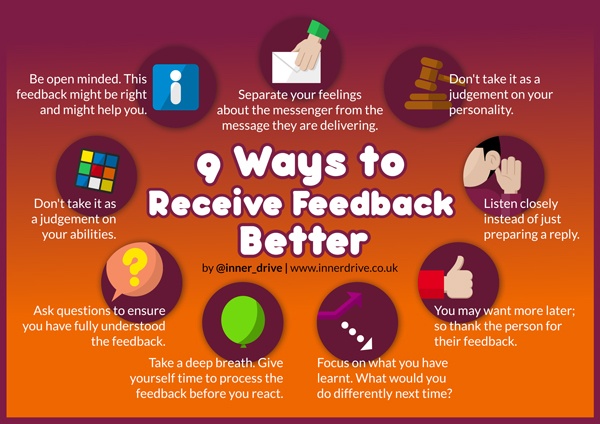
So what advice can we give? How can we help people learn to receive feedback better?

Be Open Minded – The feedback you are being given might be right and might help you. Countless learning opportunities are lost by people entering the situation with a very fixed and closed mind. Being open to possibilities and difference of opinions is a good launch pad for learning.

Distinguish Between The Message and The Messenger – It is important to separate your feelings about who is giving you the feedback from the message that they are actually delivering. Just because you like someone doesn’t mean their feedback is helpful. Likewise, just because you dislike them doesn’t mean the feedback is redundant. Focus on the point, not the person.

It is Not a Judgement – The feedback you are being given is not a judgement on your personality or on your future ability. See it for what it is, which is advice on how to get a bit better. This is one of the cornerstones that growth mindset theory is built on. Once you start to see feedback on a task as a judgement on our self-identity, it can lead to rejecting the feedback and lead to a fear of failure.

Listen Closely – There is a titanic difference between listening intently and being silent whilst preparing a reply. By focusing more on your reply, you are disregarding some of the feedback. If you have asked someone for feedback, and if they have taken the time to offer you advice, you should maximise your time with them by listening carefully.

Check For Understanding – The person giving you the feedback may think they have been very clear on what they have said. You may be pretty sure you have understood them. However, it is easy for misunderstanding and miscommunication to occur. Asking them one or two questions to check for understanding may take 1 minute longer, but can save you much more time in the long run.

Take a Deep Breath – This gives yourself time to process the feedback before reacting. This can really help, especially if things are tense or you feel under pressure. Chances are, your emotional response is unlikely to the best one and you don’t want to make a permanent decision off a temporary feeling.

Focus on What You Have Learnt – Feedback that doesn’t result in anything changing is as effective as not having received any feedback at all. Asking yourself ‘what would I do differently next time?’ is a great way to ensure you have learnt something.

Say Thank You – Even if you don’t agree with the feedback on this occasion, you may want more later. And it’s just good manners.


Filed Under: Professional Development

Help Your Captains Lead with Integrity

August 8, 2017 by

By Dawn Redd-Kelly.

“The most effective form of leadership is supportive. It is collaborative. It is never assigning a task, role or function to another that we ourselves would not be willing to perform. For all practical purposes, leading well is as simple as remembering to remain others-centered instead of self-centered.”—Great Leadership Isn’t About You

Teaching our athletes to lead is a big job.  Failing to set the ground rules for what you want leadership to look like can lead to hazing, “mean girl” tactics, cliques, and ultimately ineffective performances. We can’t expect our athletes to know what we want if we haven’t explicitly laid it out for them.  In the absence of a coach’s direction, the athletes are going to fill in the gap and I’m sure we can all agree that that probably won’t go well!

I believe our team leaders want to be taught and I know our teams want to be led by captains who make it easy to follow them.  What leaders are easy to follow? The author listed some characteristics in the quotation at the beginning…those are a good start:

  • I rely on my captains to be a go-between. They work closely with the team as well as the coaching staff.  Ideally, they understand that they perform an important role in the team’s success.  They should be close enough to their teammates that they know when things are going a bit sideways and they need to tell the coaches.  But they should also know when not to tell the coaching staff.  My most effective team captains squashed issues before I even knew what was going on!
  • Our teams are faced with the conundrum of needing to be both collaborative and competitive.  If you’ve got two players who play the same position, they will both benefit from in-practice competition, but surely they know that once the whistle blows at game time, they’re expected to support the team…whether or not they’re on the court.  Collaboration should be built into our team cultures, our captains should always be looking to take advantage of opportunities to collaborate.  Asking the younger players questions and not creating a “captain clique” will help create those collaborative feelings on the team.
  • In the trenches. I don’t want captains who say, “Freshmen always do ________ (insert task here).” Freshmen (or newbies) shouldn’t always carry stuff, be expected to defer to upperclassmen, or be treated in a second-rate manner.  That kind of behavior signals insecurity in the leader.  It’s hard for players to follow a captain that lacks confidence and tries to raise themselves up by pushing their teammates down.  Everyone pitching in helps to create good feelings among the players, regardless of how long they’ve been with the team.
  • Other-centered. I’ve had captains who would stay after practice with a lesser skilled teammate and help them with skill work…that’s great.  I’ve had captains who’ve told me about a teammate who beyond-the-norm homesick…that type of concern is necessary.  And we’ve had captains who, after I’ve announced that perhaps an extended conditioning session would be more productive than working on skills, gather the team together to figuratively whip them into shape.

Of course I’ve had ineffective captains as well, but that’s not what this post is about!  It’s about giving our team leaders the necessary skills that make them easy for their teammates to follow.  If we set the standards high for our captains, they will rise to the challenge.


Are you tired of walking into practice and seeing lackluster effort from your players?  Have you had it with trying to get your female athletes to care about the team as much as you do??

Click here to find out more about Coach Dawn’s eBook: Motivating Female Athletes

Comes with a FREE PowerPoint presentation called Guarantee Your Success: Using John Wooden’s Pyramid of Success To Increase Your Team’s Cohesion.


Filed Under: Leadership

How to Perform Under Pressure

August 1, 2017 by

This article was provided by InnerDrive, a mental skills training company


What is the hallmark of a champion? Big players perform their best in big matches and at the most important competitions. Think the likes of Tom Brady at Super Bowl 2017 and Laura Kenny at London 2012 and Rio 2016. But what do these type of athletes do that allow them to raise their game when the situation requires it? Can students employ the same techniques in their exams?

Researchers have been investigating why some people flourish and why some wilt under pressure. The answer seems to be around if you can get yourself into a ‘challenge state’ (characterised by feeling supported, believing you have the abilities to meet the task and remembering previous successful performance). The opposite is a ‘threat state’ which is when athletes don’t feel in control, feel isolated and dwell on uncertainty.

A new study has just been released that adds to our understanding. It is on ‘psychological state that underlie clutch performances’. ‘Clutch’ performances is the term used to describe “superior performances that occur under pressure circumstances”. It is delivering your best when it matters the most. We had the pleasure of speaking to one of the researchers, Christian Swann about his paper. He detailed the 10 characteristics of performing brilliantly under pressure:


  • Complete and deliberate focus – concentrating on the task at hand
  • Intense effort- 100% commitment and work rate
  • Heightened Awareness – to both your surroundings and your own mental state
  • Being Up For It – being pumped up for the moment
  • Absence of Negative Thoughts – focusing on what you want, not what you don’t want
  • Fully Absorbed – immersing yourself in the performance
  • Confidence – believing you will achieve
  • Control – focusing on what you can control (your thoughts, feelings and reactions)
  • Increased Motivation – being determined to succeed
  • Enjoyment – fully embracing the challenge


This research compliments existing literature on the psychology of Olympic Champions, with work-rate, confidence, positivity and the ability to block out distractions featuring in both. What is encouraging is that these are skills that can be learnt and developed. They are not set in stone. If athletes and students can master these skills, they give themselves the best chances of success when it matters the most.


Filed Under: Mental Toughness

Go in Reverse When Trying to Break a Losing Streak

July 31, 2017 by

Coach Mike Schauer begins his presentation by starting off explaining the ups and downs of trying to turn a losing program around. Coach explains the first step in addressing the problem is to first evaluate your coaching and approach and evaluate if you can change course and improve. Secondly coach shares his thoughts on the fact the problem isn’t always discipline problems or no athletes. Coach gives a great explanation for when you don’t know how to fix and get your program turned around. Whenever turning a losing program around you must be able to confront existing problems and the possibility when problems can’t be corrected without changing personnel. This is an excellent presentation for coaches looking for possible answers and solutions for turning losing programs around.

This video is provided by Glazier Clinics’ Head Coach Academy

You can also checkout more videos like this one at the Glazier Clinics Online Learning Vault

Please make sure that your sound is on and click on the video to play.

PUT YOUR CURSOR OVER THE LOWER RIGHT CORNER OF THE VIDEO AND CLICK (IMAGE LOOKS LIKE THIS) TO WATCH THE VIDEO ON FULL SCREEN TO BE ABLE SEE LARGER DIAGRAMS AND VIDEOS

Click the play arrow to view the video.


Filed Under: Professional Development

  • « Previous Page
  • 1
  • …
  • 20
  • 21
  • 22
  • 23
  • 24
  • …
  • 63
  • Next Page »

© Copyright 2026 Athletic Performance Toolbox

Design by BuzzworthyBasketballMarketing.com

Privacy Policy