Coaches Toolbox

  • Home
  • Mental Toughness
  • Leadership
  • Motivation
  • Staff Development
  • Program Building
  • Archives
  • Sport Specific Sites
    • Athletic Performance Coaching
    • Basketball Coaching
    • Football Coaching
    • Soccer Coaching
    • Track and Field Coaching
    • Volleyball Coaching

Unlock Your Coaching Potential

July 19, 2017 by

by Dr. Cory Dobbs, President, The Academy for Sport Leadership, a national leader in providing leadership resources for coaches and student-athletes. The most recent resources include Coaching for Leadership and Teamwork Intelligence: a workbook for the student-athlete along with a facilitator’s guide for the coach.

Excerpt from “Coaching for Leadership”


Are you a talented coach on the rise? Do you want to be an “A‐Level” coach? Are you interested in becoming an elite leader? Think deeply about these three questions before moving on.

Instead of assuming leaders are born with the “right stuff” to lead, I start with the assertion that leadership is a talent. If that talent is to be advanced the coach needs a context that supports the development, get the experiences they need to cultivate their leadership ability and possess the drive to master learning to lead.

Let me make another claim: talented people want to be challenged, not coddled. As a coach to coaches I know this to be true. And as a coach I’m sure you will agree success isn’t something you simply hope happens. It is high achievement accomplished by consistent, deliberate, and intense preparation and commitment to a goal with a daily plan of action based on choices you make.

If you really want to stand out, lift your performance to its peak, break into the small circle of elite performers, then accept that life is not a do‐it‐yourself project.[/perfectpullquote]

In your version of reality you may have “high potential” stamped on your forehead and be successful in your own mind. All this may be true, but don’t be deluded. Odds are you’re nowhere near where you want to go and who you want to be. If you really want to stand out, lift your performance to its peak, break into the small circle of elite performers, then accept that life is not a do‐it‐yourself project. If you surround yourself with winners—or are fortunate enough to have a skilled and caring mentor in your corner—you are likely on a winning path toward the success you covet. We all need people who help us look at situations from a different perspective.

Today, top athletes, actors, musicians and corporate leaders have begun to use performance coaches to help them reach their potential. They’ve chosen coaching as a way to shorten their path to sustained success. What they know is that good coaching will get them where they want to go, help them achieve what they want to achieve, and transform them into who they want to be.

REALITY BITES
Here’s your first bite of reality. As determined as you are, you might never get to where you want to go. You ask; why is this?

The answer: blind spots. All coaches have blind spots. Yes, we all have blind spots, but this is about you.
[thrive_leads id=’3019′]
I know how badly you want to be good—no great! So it’s important for me to let you know that blind spots are real and really capable of derailing your efforts to reach your potential.

You’ve spent most of your life committed to particular ways of thinking, doing, and being, and that’s a good thing; and a bad thing. It guarantees blind spots. Don’t checkout yet. Let me be clear about this: it is never easy to bring about a mindset change. But that’s not enough. Another bite of reality is that it’s more difficult to replace a simple way of thinking with a more complex way; which of course, is likely necessary to become an elite coach.

So, what is a blind spot? A blind spot is a weakness that other people see but we don’t. The crazy thing is, because a blind spot is not known to us, we simply don’t know what we’re doing wrong and what we can do to get better outcomes. We have no idea how a certain coaching behavior of ours is coming across to our stakeholders—players, parents, coaches, and administrators—but it is. A blind spot is an outer reality. That is, it exists outside of us, yet inside of others.

[perfectpullquote align=”right” cite=”” link=”” color=”” class=”” size=””]A behavioral blind spot is the unproductive or destructive behavior that undermines or erodes interpersonal influence and the building of durable and enduring relationships.[/perfectpullquote]

There are various sorts of blind spots that can lead to ineffective coaching to some degree or another, but one particular form holds many coaches back from great success. That is, a behavioral blind spot. A behavioral blind spot is the unproductive or destructive behavior that undermines or erodes interpersonal influence and the building of durable and enduring relationships.

To ease into the idea of blind spots think of it as something similar to the blind spots we encounter when driving a vehicle. Several years ago while driving a large truck I bumped up against a car in the other lane, hidden in my blind spot, without knowing it. The car sped up to get alongside me. I spotted a crazy man pumping his arms and screaming at me. I pulled over and, sure enough, unbeknownst to me I had sideswiped the driver‐side door of the crazy guy’s car. Yes, I failed to use the tool built for reducing blind spots—the mirror.

Getting a grip on reality requires a heavy dose of reality. Here’s a start: Deep changes in how people think, what they believe, and how they see the world are difficult to achieve. Experts will tell you such change is downright impossible to bring about through compliance. You’ve got to want to change.

THE EDGE OF REALITY
Self‐awareness has limits. Taken in isolation, the problem with self‐awareness is that what others think of our behavior takes place outside of our awareness. The built in constraint is that self-awareness only reveals what we can see as what we can know, not what we can’t see and not know. We are essentially disconnected from the effects of our behavior; we are blind to the internal reality of the other. All this makes it difficult to know there’s a need to change our behavior. I think this is what author and psychologist R.D. Laing meant when he said, “The range of what we think and do is limited by what we fail to notice. And because we fail to notice that we fail to notice, there is little we can do to change; until we notice how failing to notice shapes our thoughts and deeds.”

Because people don’t know blinds spots exist, they aren’t searching to understand how others’ experience them. Consequently, if someone tries to bring a blind spot to one’s attention, it’s likely to be brushed off. The message will be disregarded and discarded. Let’s be clear, if someone told you that you are behaving in a way that is having a negative impact on others, your initial reaction will be to take a defensive posture.

Our ability to confront ourselves is crucial to building insight and understanding and tackling the truth of our blind spots. Our willingness to venture out of our comfort zone and see things from others’ perspectives is vital to achieving peak performance. This takes courage but offers great rewards.

Reality demands change. The biggest threat, the most resistant barrier, to personal change is you. Please do not take this to mean that you’re not motivated or talented. You wouldn’t be where you are, in position to get to the peak of your mountain, if that were the case. It’s just that desire and motivation aren’t enough. The reality is that the ability to initiate and persist with deep change is often exasperatingly elusive for most of us. Grasp that reality!

Yet, as the world maddeningly changes, so must we. The greatest power we have is the ability to envision our own fate and to action to change ourselves. However, the unavoidable question is can you do it by yourself?

[perfectpullquote align=”left cite=”” link=”” color=”” class=”” size=””]A team is a human community. It is a living system, like a plant. So, all teams are made up of people. And people are emotional. When engaged emotionally people easily lose perspective.[/perfectpullquote]

REALITY CHECK
Like the rest of the world—government, medicine, education, and business— sports has relied on the doctrine of scientific management: the theory that any task process can be broken down to its component parts and then reassembled in an efficient “scientific” manner. That sort of thinking, a mechanistic view of management, fostered assembly lines and military hierarchies. And it’s fostered a social preference in which building relationships is not as important as task accomplishment—winning trumps all.

Today, we still have many assembly lines (such as schools) and hierarchies are still a favored organizational structure. However, more frequently these industrial age artifacts are adapting to and changing how the individual, the organization, and society interrelate. Change invariably reveals blind spots, and blind spots are deep and difficult impediments to growth.

Let me step onto thin ice. Every coach utilizes “constructive yelling” (my quotes) under the theory that if a player can’t survive a spirited “talking to,” the opponent will kill her. This idea may work, sometimes. And other times it might not. Rather, it’s simply a taken‐for‐granted coaching behavior, a “coaching style,” a way of “motivating” athletes. But until we have the courage to explore such coaching behaviors from a variety of frameworks—certainly to include the athlete’s perspective—we might just be feeding a blind spot.

Here’s how it happens. A team is a human community. It is a living system, like a plant. So, all teams are made up of people. And people are emotional. When engaged emotionally people easily lose perspective. Because people are emotional and lose perspective things are not always as they seem. In a nut shell, to lead effectively involves the need to recognize and acknowledge the importance of dealing with both one’s own feelings and emotions and those of the others in an interaction.

Now, stay with me. Every relationship involves reciprocal relational dynamics such as trust or distrust, respect or disrespect, liking or disliking, and dominance or autonomy. Consequently, these dynamics either reinforce relational growth processes or introduce limiting forces that impede the development of a durable relationship.

Here’s a reality check. Without recognizing how certain behaviors negatively impact others, you won’t be able to change your unproductive and destructive behaviors. Most of us fall into this trap, thinking we are always acting in the best interests of the student‐athletes. That’s just not true. Unfortunately, we continue unaware of the negative impact our behaviors create. The causal chain is clear: the fastest way to cause cohesion and morale to erode is to deny that a behavioral blind spot exists or to ignore it.

Discipline and determination are necessary, but it is the discovery of behavioral blind spots that is essential to unlocking your coaching potential. The better you know your strengths and weaknesses, your likes and dislikes—the better you know where you’ve been, where you want to go and what it will take to get you there—the better you can set your goals and craft a plan to get there. However, if you have a faulty behavioral blind spot you are destined to limit your growth and development into the great coach you want to become.

To find out more about and order Sport Leadership Books authored by Dr. Dobbs including Coaching for Leadership, click this link: The Academy for Sport Leadership Books

Click here to read Part 2

About the Author

Cory Dobbs is the founder and president of The Academy for Sport Leadership, a national leader in research‐based curriculum for coaches and student‐athletes. Dr. Dobbs is a college educator, a coach to successful coaches (helping coaches attain a higher level of success), and an accomplished human performance specialist whose expertise is in the field of leadership, team building, and creating a high‐performance culture in the arena of team sports. Cory blends social‐personality, psychology, and applied social psychology, which means he studies how people’s thoughts, behaviors, and preferences are influenced by both who they are and the situations they’re in. He uses Teamwork IntelligenceTM to help teams explore how the mix of perspectives brought by their individual members influences their work together.

What to do: Contact Cory directly. Start a conversation on how you can reach your coaching potential.
Dr. Cory Dobbs
(623) 330.3831 (call or text)


Filed Under: Professional Development

Making a Coaching “Not to Do” List

July 12, 2017 by

By Mandy Green

Mandy is the Head Soccer Coach at The University of South Dakota. She is also an Author, Speaker, Trainer and Consultant. She has posted many useful tools for coaches on her site Busy.Coach

I’m sure you have either had or will have shortly a conversation with your staff about your priorities and what you want to accomplish for the season.  I just did this recently by myself and my list ended up being about 25 things that I wanted to work on.

After jotting down my initial list, I then met with my staff to review the list and we circled the top five that were most important to us for this season. As I expected, we initially struggled to narrow down everything, and it took some time to make a decision on what our top 5 would be.

Finally, when we decided on our top five, we next needed to ask “Now what are we going to do with the other 20 things on our list?”

Hesitantly, my assistants responded: “Well, the top five things are our primary focus. The other 20 things are not as urgent, but we can still plan to work them into our practices.”

Sounds like a reasonable answer right?

What I said next surprised them.

“I believe that is a mistake that we have made in the past. I think that everything we didn’t circle just became our ‘avoid at all cost’ list.”

We all have so many things in our coaching life that we want to do and accomplish. Who wouldn’t want to succeed at 25 different things? I learned the hard way that when we chase after 25 things at once with our team, we run the risk becoming a jack-of-all trades, but a master of none.

Items 6-25 on your list are probably all very important things, and things that could make your team better. But when it comes to Items 1-5, Items 6-25 are a distraction.

As James Clear writes, “Spending time on secondary priorities is the reason you have 20 half-finished projects instead of 5 completed ones.”

In my study of high performers over these last few years, avoiding distractions to focus on what matters has been a HUGE key to their success.

What sets apart high achievers is not the number of ambitious things they plan to get done, it’s the ability to avoid distractions in order to focus on accomplishing the things that matter.

“People think focus means saying yes to the thing you’ve got to focus on. But that’s not what it means at all. It means saying no to the hundred other good ideas that there are. Innovation is saying no to 1,000 things.” — Steve Jobs

Creating a NOT To-Do List
We’ve all familiar with creating a to-do list to increase our productivity and that is the first list I want you to create. The 2nd type of list that will jump start our productivity is the not-do list – things we shouldn’t do. By being conscious of what to avoid, it’ll automatically channels our energy into things that we want to do. Doing both hand in hand will maximize our performance.

HOW TO CREATE YOUR OWN “NOT TO DO” LIST

Put away your phone, your planner, your to do list apps, and your timers. Instead, take out a sheet of paper and go through this exercise which will help you make your own Not To Do List.

The steps are easy:

  1. Write down your top 25 goals for this upcoming season.
  2. Circle your top 5 goals
  3. Avoid working on any goal that is NOT circled at all costs

Once you have your two lists, focus all your efforts on dominating your top 5 goals and ruthlessly eliminate the 20 less important goals.

It couldn’t be simpler than that.

Whether you’re looking to bring about progress into your program or you’re seeking a way to simplify your coaching life. Creating a Not To-Do List will help you focus on the projects that matter.

Seeing through on your do-not-do list ultimately may take sheer force of will. Like everything, you will get better with practice.  Jim Collins writes, “The real question is… do you have the discipline to do the right thing and, equally important, to stop doing the wrong things?”

When you get stuck on your not-to-do list, you waste time and end the day frustrated because you didn’t progress on your important top 5 goals.  Make your list and post it where you can always see it to remind yourself of what you should not be doing.  Enlist the support of co-workers to help keep you on track.  If you find yourself doing something on your do-not-do list, get up, walk around, refocus, and then get back after your important to-do list items.  Good luck!

I’d love to hear what makes your list!  Please email me your list at [email protected]


Filed Under: Professional Development

Developing Your Leadership Program

July 12, 2017 by

The information presented here was provided to me by another coach and I know how important it is to develop our young athletes into leaders not only for the present but also for the future wanted to share this with you because it says so much that can help assist in developing a leadership academy in anyone’s athletic program.

Editor’s Note from Brian: The purpose of this post is not to say that you should copy this program as is.  It has some aspects that are sport specific, but I feel there are many ideas that can be applied to any sport. You should take the ideas that you like and adapt them to fit what you think is best.  It also can be scheduled when you are able to do it.  The post is to give you ideas, not necessarily a blueprint.

Leadership Academy Purpose:

1. Raise awareness of the importance of quality leadership
2. Increase Leadership skills of athletes
3. Share the leadership workload
4. Develop the character of athletes

Value

Coaches often pin success on superb leadership; therefore, teams should not wait for leadership to cycle in on it’s own. Instead, like developing technique, strength, or speed, coaches should implement a plan for teaching and developing leadership skills in their players. Since captains and leaders spend much more time interacting with teammates than coaches, they can significantly impact the performance of a team. Thus, strong leadership will increase team production. Moreover, many competitions will create stressful situations for athletes. Building emotional and mental resiliency in athletes will help them to perform at their best despite high pressure situations. Finally, developing character and leadership in the school and in the community will improve the quality of life for all. Students, recognizing the virtue of high character, will be more apt to make ethical choices. Teachers will be better able to focus on teaching rather than behavior management, and coaches can worry less about losing players for conduct violations.

Meeting Schedules

The Leadership Academy will meet every two weeks for dinner, from 6:00pm to 7:30pm, at various players and coaches’ houses. The meeting day will vary in order to work around basketball, hokcey and track practices / competitions. Meetings will begin the second week of January and last until the last week in May. At these meetings, participants will discuss readings from Jeff Janssen’s Team Captain’s Leadership Manual, and also identify leadership and character weaknesses that the team should improve. From May to August, the Leadership group will meet once a month to discuss team issues or progress toward goals. During the season, they will meet once a week to discuss team moral, personnel issues, and logistical matters.

Curriculum

Week 1
The group will explore the concepts of leadership. By defining leadership, discussing the risks and
rewards of leadership positions, and reflecting on effective and ineffective leaders in the past, the group will establish a context from which to build new skills. In addition, players will self-evaluate their leadership as indicated by their commitment, confidence, composure, and character, as well as their ability to function as a servant, confidence builder, refocuser, team-builder and enforcer.

Week 2
The group will examine ways to motivate themselves. Participants will evaluate their own commitment level based on Janssen’s “Commitment Continuum” (Janssen, 29), as well as asses every team mate’s commitment level. The group will discuss why they placed each player at that place on the continuum and brainstorm ways to motivate players at the “resistant-reluctant-existent” (Janssen, 29) level.

Week 3
The group will explore the concept of confidence. Participants will look at confidence’s relationship with sense of self and the want to perform under pressure. We will discuss the four sources of confidence: preparation, strengths, past success, and praise, and also discuss ways to be resilient to events that threaten confidence.

Week 4
The group will learn to how maintain composure in pressure situations. Using a “traffic light analogy” (Janssen, 52), players will learn to recognize emotional states. In addition, we will discuss refocusing strategies like slowing the pace of play, controlling the controllable, and focusing on the present, the positive, and the process.

Week 5
The group will explore the concept of character. By discussing the importance of exhibiting character in the sport, in the classroom, in social life, and in the community, participants will raise their awareness of how their character establishes their credibility as leaders.

Week 6
The group will examine ways to function as servant leaders. In order to prevent leaders from becoming overbearing, we will discuss how helping younger players, preventing hazing, and completing day to day work creates a healthier team dynamic.

Week 7
The group will explore ways in which they can build the confidence of their team mates. Each squad leader will complete a “mental game assessment” (Janssen, 91) form on the players in their squad. As a group, we will discuss strategies for increasing the confidence and mental resilience of players. For example, leaders can let them know what to expect, remind them of their strengths, remind them of past successes, establish perspective, and encourage their teammates (Janssen, 93-94).

Week 8
The group will learn ways to refocus their teammates when faces with adversity. In essence, we will revisit the concepts from week 4, and discuss ways to teach others how to refocus.

Week 9
This week will focus in strategies for team building. We will revisit the team’s vision and mission statement, “clarify the commitments and standards” (Janssen, 112) necessary to achieve this vision, and discuss ways to help teammates accept their roles. In addition, we will brainstorm and create a teambuilding calendar to schedule events like an intersquad basketball tournament, a softball game, whitewater rafting trips, and team BBQ’s.

Week 10
This week will cover strategies for serving as the enforcer. We will address the reality that conflict is inevitable and that leaders must be prepared to handle it effectively. We will discuss approaches like encouraging first, then reminding and refocusing, then drawing the line, and, finally, involving the coach (Jansses, 126-127).

Squads

Purpose for squads:
1. Shared leadership amongst several instead of few. Share the load.
2. Provide more efficient methods of communication
3. Build stronger team relationships
4. Create healthy competition
5. Establish accountability for each other

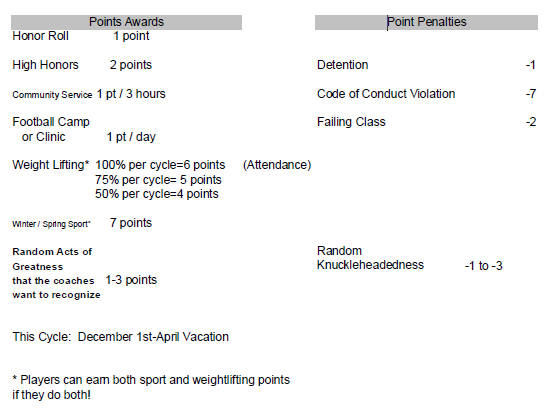
Ways to earn points:
1. Successfully completing task (earning passing grades on quizzes, selling gold-cards, achieving set and measurable goals)
2. Winning competitions (Relay race, newspaper article, etc)
3. Citizenship (Community service…approved by one of the coaches)
4. Work ethic (Strength gain, measurable speed increase)

Ways to lose points: (and $1’s!)
1. Not completing required tasks (Team assignments, locker room cleanup) -1
2. Tardy -1
3. Unexcused absence -2
4. Violation of code of conduct -10

At the end of the season, the winning squad will finance a meal of their choice. The last place team will serve it to them!!

About the Author of this post:

Jerry Campbell has over 30 years of high school and college coaching experience. He has experience as a head coach, offensive coordinator, and various position coaches. He has written numerous football coaching articles in various publications, is the author of over 30 books on coaching football, and has produced 12 coaching video series. Additionally, he is a nationally sought after speaker on the coaching clinic circuit.


Filed Under: Leadership

Four Items for Your Coaching Toolbox

June 26, 2017 by

 
By Dawn Redd-Kelly.

Folks who are fixer uppers or tinkerers know that the key to handling any situation is having a nice toolbox.  Whether its needle nosed pliers or a power saw or cordless drill…these things will prove to be essential for any job that needs to be completed.  And it’s the same with coaching!  We need to have a toolbox that is stocked so that we’re able to deal with the disgruntled player, the starter whose spot is about to be taken, as well as the athletic director that wants you to fundraise a ridiculous amount of money each year.

Here’s four things that every coach should have in their toolbox:

Mentors

When I took my first head coaching job at age 24, my toolbox only had a hammer and a couple of nails clanking around in it…not nearly enough for the repair project I’d taken on!  I was certainly enthusiastic, but that needed to be combined with knowledge…and I was a bit short on that.  Enter our men’s basketball coach who was a legend in his field and had a head full of coaching genius that he was willing to share.  So I’d haul my butt up to his office about once a week and we’d chat.  Sometimes about my team, sometimes about his, but each and every time I learned something from this man.

Peers

Here’s one thing I know: coaches love talking about coaching.  Once you find folks with a similar philosophy, make it a point to talk to them and pick their brains.  I truly believe that coaching is coaching so it doesn’t matter if you talk to the football coach or the soccer coach…if you share the same philosophical foundation, you’ve set yourself up for fun and challenging conversations about coaching.

Seminars/Conventions

Be a coaching nerd!  Go to your sport’s convention…and attend the sessions (not just the social stuff) and hang out after it’s over and chat with the presenter.  Go to local clinics even if you don’t think you’ll learn something new…you certainly won’t if you don’t go!  Plus other coaches will be there and maybe you’ll be able to chat them up and get a different viewpoint on an old problem.  This will help keep you current in your field.

Books

I read a lot of books.  I read books for myself in order to grow in my leadership and influence.  I also read books that I think will be good for my team to read during the season.  Sometimes they’re sports books, sometimes they’re business oriented, and other times they’re faith-based…but what they all share in common is that I think that they’ll make me a better coach.


Filed Under: Professional Development

Characteristics of Highly Successful Coaches

June 20, 2017 by

John McCarthy
Author / Speaker
Former College Head Coach, Former College Athletic Director, and NAIA administrator

This presentation provides excellent insight on the characteristics of successful coaches from around the country. This presentation provides motivation and insight for what successful coaches have in common with each other. John McCarthy also shares his thoughts and insight on the inter-self and the reasons we coach and the why’s for integrating life experiences in coaching. John McCarty also shares how values become an integral part in a coaches Character and how our athletes gauge what our character is really like to them. Mr. McCarthy also gives a detailed and defined meaning of success which he measures by the content of our character, leadership and contribution to the betterment of our families, communities, and the world. This is an excellent presentation on the insight for developing character and leadership both for coaches and athletes.

This video is provided by Head Coach Academy Clinics.

You can also checkout more videos like this one at the Glazier Clinics Online Learning Vault

Please make sure that your sound is on and click on the video to play.

PUT YOUR CURSOR OVER THE LOWER RIGHT CORNER OF THE VIDEO AND CLICK (IMAGE LOOKS LIKE THIS) TO WATCH THE VIDEO ON FULL SCREEN TO BE ABLE SEE LARGER DIAGRAMS AND VIDEOS

Click the play arrow to view the video.


Filed Under: Leadership

  • « Previous Page
  • 1
  • …
  • 21
  • 22
  • 23
  • 24
  • 25
  • …
  • 63
  • Next Page »

© Copyright 2026 Athletic Performance Toolbox

Design by BuzzworthyBasketballMarketing.com

Privacy Policy