Coaches Toolbox

  • Home
  • Mental Toughness
  • Leadership
  • Motivation
  • Staff Development
  • Program Building
  • Archives
  • Sport Specific Sites
    • Athletic Performance Coaching
    • Basketball Coaching
    • Football Coaching
    • Soccer Coaching
    • Track and Field Coaching
    • Volleyball Coaching

Know Your Coaching Personality

May 23, 2017 by

By Dawn Redd-Kelly

I think personality assessment should be a must for every team. Why? Because I think the cause of most conflict is expecting others to act like you do. I’d written before about the DiSC assessment I use, focusing on your team’s interactions with one another. Now I want to talk about coach-player interaction. Even though most people are a mixture of more than one letter type, see if you can find your top one or two personality types here. I believe it will help you as you work with your student-athletes.

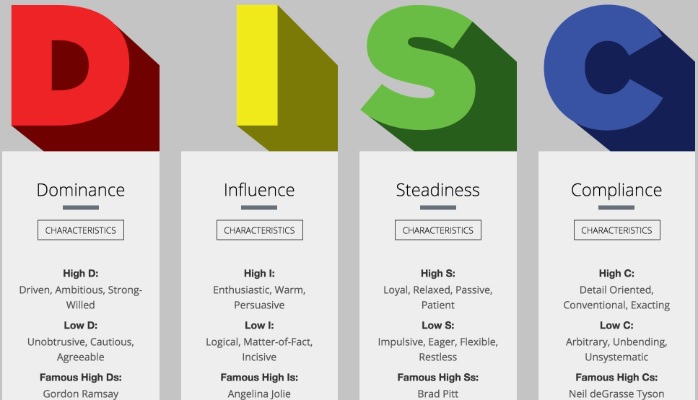
The 4 DiSC personality types and how they impact your coaching style

D’s are dominant and like to be in charge. I’d hazard a guess that a lot of coaches are D’s. On the positive side, D’s enjoy solving problems and trust their ability to produce results. At their best, D’s can mobilize teams to solve a problem or achieve a goal. That sounds awesome right? As Newton said though, for every action there is an equal and opposite reaction. D’s can be blunt to the point of being rude and may make rash and reckless decisions. At their worst, D’s can be bullies, loud mouths, and tyrants.

What to do: Understand that not everyone thinks as quickly as you do…give them time to mull things over. D’s could do well to build bridges and relationships rather than expecting people to comply just because they say so. I mean, your team will comply because you’re the boss. But if you want your team to play for you and not in spite of you, D’s should see the value of cooperation.

I’s are influential and the life of the party. These are your extroverted folks who love to be around people. I’s are charming, optimistic, and outgoing…those we’d call a “people person”. At their best, I’s can be inspirational and communicate a vision or goal in a manner that motivates others to work toward it. I’s see the best in others and help them to believe in their abilities. Sounds like an awesome coach, huh? On the other side of the coin, I’s dislike details and can seem scattered. I’s can sometimes lack follow-through, rarely finishing what they begin…they overpromise and underdeliver.

What to do: Understand that you can get folks super fired up with your words…so that means that you’ve got to deliver on those promises. You don’t want to have a group of ten freshmen who you told would be starters…and your sport only starts five! I’s should try to listen more and talk less.

S’s are the steady Eddy’s out there. S’s are loyal, friendly, and supportive…they are team players. At their best, S’s can calm tensions and stabilize unsettled situations. S’s work hard to create stable and harmonious environments. Does this sound like you, Coach? Well, on the flip side, S’s are too hard on themselves and take criticism other their work very personally. Creatures of habit, S’s enjoy their daily routines and are resistant to change.

What to do: Understand that flexibility is the name of the game. It’s great that S’s will have a routine and a to-do list prepared for each day…you’ve just got to be prepared for things to go sideways every now and then. One of your players might get sick (on the day where she’s a big part of your practice plan!) or it may rain when you were planning on taking your team outside. S’s can have their beloved plans…just be willing to adjust it.

C’s are conscientious and careful. If you’re a C, you like to be right and are a stickler for details. You have very high standards for yourself…and those around you. Where I’s are outgoing and boisterous, C’s are quiet, reserved, and business-like. C’s are fair and objective and will always maintain high standards, even when asked to compromise. That’s pretty good, right? At their worst, C’s can get bogged down in details…some would call them a nit picker. C’s prefer to work alone and need to analyze all available options before making a decision.

What to do: C’s should understand that some decisions have a timeline and need quick action. Your assistants understand that you’ve charted stats for all practices during the season and the numbers say that you’ve got the right lineup out there. But right now it’s not working and you’ve got to make a change. C’s are cautious by nature, so you should surround yourself with folks who are more adventurous.

Each season, we try to create team chemistry among our athletes and help them to get to know one another, but it’s just as important that the coach knows their personality type…and how it’ll interact with each player.
source


Filed Under: Professional Development

Engineering Your Culture: 5 Keys to Team Excellence

May 17, 2017 by

By Ralph Isernia, Head Football Coach, Rensselaer Polytechnic Institute (RPI)

I would like to thank you for inviting me to share an article with the readers. It is extremely humbling after 27 years of coaching and 8 different teams, someone is asking for advice in building a team. This article contains some of the keys that I believe are key components in building ‘Championship Culture and Team Excellence.’

“Excellence is an art won by training and habituation. We do not act rightly because we have virtue or excellence, but we rather have those because we have acted rightly. We are what we repeatedly do. Excellence, therefore, is not an act but a habit.” – Aristotle

All coaches know about the importance of creating a dynamic culture for their football team. In order to understand what it is we are trying to develop, start at the beginning and define what culture is, how we can develop it and how it can produce team excellence. I define culture in four aspects:

* The ideals that a particular group values as an expression of who they are.

* How the group implements and upholds those ideals.

* How the group works in concert with those ideals to achieve their ultimate goals.

* How those ideals and their importance are passed along to succeeding groups.

Coaches know the importance of team development as it is reflected in discipline, work ethic, competition, accountability, teamwork, trust, togetherness and love. As coaches, it is our responsibility to establish and develop the culture of our teams. We “engineer” that culture – as it refers to designing or building something, such as a machine or a structure. Our team culture is a living, breathing organism. It is a machine that grows and changes as our team’s dynamic changes. The five keys described here help engineer your culture to develop team excellence.

1) Start with You

If you follow the advice of sports psychologists and performance coaches, they would tell you to “start with the end in mind.” Examine yourself from another’s perspective. If your life were to end today, what would others say about you? How would you be rememberd? What impact would you have had on others’ lives? It is a morbid thought, for sure, but

one that deserves attention. If we desire a life that is fulfilling, rewarding, in the service to others, one that is dedicated to the ideals that we hold dear, then we need to live with intentionality and integrity in serving those ideals. So, start with you. Get clear with your vision. Your ultimate vision will forever drive you and your entire program. Once you have uncovered that vision, everything else will begin to fall into place. But first, get real with yourself.

Pursue the best version of yourself that you will ever be. Maslow said, “What a man can be, he must be.” So, you might as well do what you love, love what you do and do it your way. Stick to your vision, for it was forged from your character – who you truly are. Your character is the result of your values being habituated.

Self-discovery and introspection may take some time and deep reflection, but the results will be uniquely yours and deeply meaningful. What is your identity? What is your vision? Who are you and what are you here to do? Develop your Plan for Success – your 3 P’s: Purpose, Passion and Principles.

* Purpose: Who are you and what are you here to do?

* Passion: What are you excited about and why?

* Principles: What do you truly value in your life?

If you want more, you must become more. You must discover and define your Purpose, Passion and Principles in order to live a life of integrity; one that is in harmony with your true principles and values. Only then can you fully actualize your life. Start with “I” statements and just write, don’t over-think. Fire, ready, aim. Just get it down on paper, then refine and revise. Ultimately, you are asking yourself the questions, “What kind of coach do I want to be and what will it take to get there?” The answers will drive your philosophy and shape the culture of your program.

2) Mission Statement

The Mission Statement is the ultimate structure of your organization. It is derived from your vision and personal plan for success. Remember to lead within your style and beliefs because a team will always take on the personality of their coach.

Your mission statement will characterize how your plan for Success drives the fundamental core of your program. Be deliberate and detailed with the characteristics or your program. Do not ask your team to do that which you would not otherwise do yourself. Direct the behaviors that you want your team members to exhibit. It must be MEAN-ingful:

* M: Memorable

* E: Easy to teach & learn

* A: Accountability is demanded

* N: Never let up

I have found that a Mission Statement of 1-3 sentences is most effective. A 5-7 sentence statement can be used as long as there is some rhyme or rhythm to the text. This statement is a fundamental of your program. Just like football fundamental skills, it must be practiced over and over again. Demand commitment until automaticity. Team members and coaches should eventually be able to recite your statement on command. Memorize it, believe in it, and own it. Remember, thoughts become things and constant repetition and deliberate practice will ingrain the fundamentals of your program. Be deliberate with your teachings, direct your team and demand full accountability.

3) Buy-in

The “Buy-in” stage is the most important component of building your culture. It involves more moving parts than the previous ones. The members of your organization (players and coaches) must completely commit to the direction of the program. You will encounter three groups of people when implementing your plan:

* “One Guys”: They are with you from day one, they are your elite leaders, they yearn for change, committed to the cause, they want the discipline, structure and commitment. They believe in your vision and are aligned with your values.

* “Some Guys”: They will side with the view that is most popular or can give them the greatest reward, they are swaying with the breeze, they dare not go against the breeze for fear that they may break, so they bend to the side that has the least resistance. This may be the largest group, so the coaches and Bunker guys must get them to buy-in because it is right.

* “Un Guys”: Un-interested, un-reliable and un-caring. Use ultimatums, commit or quit. There may be some skilled players in this group or guys that could really help your team. One bad apple can spoil the whole bunch. You cannot compromise everything you believe in for short-term success. Committed members will see right through your intentions and view you and your ideals as a fraud. Remember, character counts.

Once your team is formed and full commitment is established, you must train every day. Ask the question, “What type of player do you want to be and what will it take to get there?” You have provided a blueprint for their success. All you need is their commitment to the team. Everyone must be speaking the same language in order for you to accomplish your goals. Members will feel that they are making sacrifices for the team. Get them to understand that they are making choice instead of sacrifices.

The result of their collective “buy-in” will be a force greater than any one individual alone. Synergy, where 1 + 1 = 3. The sum is greater than its parts. Where one board is strong by itself, two boards together are exponentially stronger. In engineering terms,

they are not only sharing the load, they are supporting each other at the same time. Synergy is hard to calculate or quantify, but you know it when you see it in your team.

4) Relationships

Your team will never care what you know until they know that you care. So, sail the right ships – relationships. Never overlook the opportunity for a “teaching moment.” This could be anywhere, on the field, in the office or in the hallway. Sometimes the most-meaningful interactions are the ones that are unexpected, unintentional and unscripted. Embrace positive coaching that emphasizes discipline, character, grit and togetherness. Coach and teach within your personality and your genuine care and love for your individual team members will shine through.

* What do you value in a player?

* How do you recognize it?

* How do you drill it?

* How do you reward it?

* Reward the behavior you want.

Every member of your organization has value and a voice. No one person is bigger than your program. Provide constant communication, evaluation and feedback. Be honest and compassionate. Give them a plan where they can see themselves having success. You must trust them and they must trust you. Trust is a must. Help them plan out their goals and ways they can strategically take small steps to achieve them. Help them cultivate willpower and determination knowing that their achievements will take time. Small, smart choices done consistently over time will produce amazing results. In order to become a vehicle of excellence, they must become a machine of routine.

5) Evolution

Every day, you are either growing or dying. You must evolve as a coach, teacher and mentor. Adopt a growth mindset, constantly learning new systems, paradigms, and dynamics that will enhance your program. If you grow, your team and players will grow with you. Understand that where your focus goes, your performance and energy go. As you keep moving forward, remember you can only control what you can control:

Your…

* Attitude: Solutions-based not problem-based. Proactive not reactive.

* Actions: Be true to yourself.

* Preparation: Have a plan, work the plan. The Process.

* Performance: Demand your best.

* Energy: “Bring it” every day. People will feed off your energy.

* Effort: If you are not working on culture every day, then you do not have one.

* Determination: “Unwavering commitment to finish the job, stay the course and never, ever quit.” – Mark Devine

We attend clinics, visit coaches, learn new schemes and examine football systems to win on the football field. We read books from Lombardi, Wooden, Bryant, Summit, Auriema, Sabah, Carroll, Meyer, Belicheck, Walsh, Dungy and Parcells. These people are icons in the coaching profession and we can glean a wealth of knowledge from their experiences. To help us grow in our relationships, build our teams and understand how to help others, we should study the works of Maslow, Erickson, Cuddy, Duckworth, Galloway, Dweck, Canfield, Locke, Hardy, Covey, Kight and Cain, among others. The lessons learned from these experts can help us grow as individuals and fully engineer our success.


Filed Under: Program Building

A Leader in Every Locker

May 8, 2017 by

The End of Yesterday
By Dr. Cory Dobbs
The Academy for Sport Leadership

Excerpt from A Leader in Every Locker (2016)

“I’m not used to supposing. I’m just a working man. My boss does the supposing . . .”

This quote is a line from the classic movie 12 Angry Men. During the opening dialogue among jury members, each feeling out their place and role in the deliberation of the fate of a young man’s life, a blue‐collar working man makes this declaration of powerlessness. The implication is that all the power—at least that of “supposing” rests in the hands of his superior. Just a movie? Hardly.

It’s been the rule for over a century in team sports to install a hierarchical leadership structure. This is accomplished by appointing a couple of players as team captains (as well as modeled by the hierarchy of the coaching staff). Surely everybody knows that on any sports team only a few players are able to really perform peer leadership. This is the team captain axiom, the basic axiom of traditional team leadership.

An axiom, of course, is a truth so self‐evident it doesn’t need to be proved. After all, everybody knows an axiom is accurate and correct. So then, it’s indisputable that you need a pecking order in order to get things done.

Not too fast, things are not what they always seem to be on the surface. The bad news is that far too often our intuitive ways of thinking about the world are wrong. Yes, axioms can be wrong. The good news is that it’s possible to set them right.

What’s self‐evident, what’s obvious, what everybody knows, has deep roots and of course isn’t in need of change. Yet, paradoxically that which is self‐evident hides something–covers over what might be a deeper truth. Axioms, by their nature, are anti‐learning. Nobody ever questions an axiom. Nobody ever discusses an axiom (save for a few propeller heads). It’s just taken as a given. And nobody ever talks about the possible counterproductive consequences of what everybody knows. The fish, after all, never questions the water he lives in.
[thrive_leads id=’3019′]
Then, all of a sudden, someone comes along with a breakthrough idea and turns the old axiom upside down. The taken‐for‐granted truth, it turns out, wasn’t really the truth after all. “The world is flat,” was the truth people lived by for thousands of years. Then, along comes Nicolas Copernicus who proves to the world the old axiom to be wrong.

Twenty years ago, to choose a different model of team leadership was unthinkable. In elaborating on the end of two decades as a premier athlete Kobe Bryant had much to say when asked the question, if he could go back in time and offer advice to himself as a rookie, what would he say? His response: “It’s hard to tell somebody ‐‐ a player at that age ‐‐ to understand compassion and empathy, but that would be my advice.”

Why of all things would Bryant endorse caring, compassion, and empathy? “Well,” Bryant continued, “because that’s the biggest thing about being a leader, I think, and winning a championship is understanding how to put yourself in other people’s shoes.” “That’s really the most important thing. It’s not necessarily the individual skill you possess. It’s about understanding others and what they may be going through. And then, in turn, when you understand that, you can communicate with them a little bit better and bring out the best in them. Bringing out the best in people isn’t passing them the ball and giving them open shots. It’s about how to connect with them, how to communicate with them so that they can navigate through whatever issues they may be facing. That’s a very, very hard thing to do.”

I’ve never been a fan of Kobe Bryant, and I seldom look to professional sports for deep insights and understanding on leadership, but it appears that the wisdom in Bryant’s words fit hand‐inglove with today’s call for a more heartfelt approach to coaching and leading. So what’s the way forward in this brave new world?

Don’t worry. While you’ve been trapped in the axiom of team captaincy, I’ve been turning over rocks to find a better way of designing a high‐performing team, its culture, and of course, leadership. I’m not done yet. It might be another decade or so before I’m finished. But this workshop workbook is a start.

So, What is Leadership?

There has been a long running debate in scholarly circles about whether people learn to lead from their experiences or if leadership is something a person is born with. Today, however, most academics agree that leadership is best considered as a set of skills and qualities that can be learned and developed along within a wide‐range of personal styles. It’s widely agreed that all people have the potential to develop leadership skills. I point this out because it is also clear that leadership is viewed and valued differently by various fields, disciplines, and cultures.

So then, what is leadership? This is the big question that every person, group, team, organization, community and society seeks to answer. Our American culture, which of course includes a heavy dose of sporting influence, exalts the lone ranger, the hero, the charismatic leader. We see this in the election and glorifying of politicians, the deifying of business tycoons, and the adoration and idolization of great coaches and athletes. This notion falls in line with the traditional ideas of leadership—that it is the make‐ up of the leader that makes all the difference. Individual determinism has been and will continue to be an easy and favored explanation of things. But traits such as self‐confidence, intelligence, and a can‐do attitude—favored qualities of a leader—do not always predict the effectiveness of a leader; rather, they can be very misleading.

However permeable the traditional mental model of leadership seems, it does not provide a path to sustainable effectiveness as it leaves out the detail and nuance of the context in which a leader takes action. It also ignores the fact that it tends to reduce followers to passive participants; resulting in deliberate apathy and often conscious withdrawal from the leadership provided by one’s peer. Careful examination of this aspect of team captaincy suggests it may promote the discounting or dismissing of the potential of all members of the team to learn and perform in a leadership role.

Both the context and followers are foundational to leadership and are central to The Academy for Sport Leadership’s search for a new conceptualization of team leadership. The leader in every locker approach to team leadership is, no doubt, a paradigm shift. Paradigms, as you know, are the common patterns and ways of looking at things in order to make sense out of them. Leadership has long been presented as an elusive phenomenon available to only a select few. It is my contention, however, that understanding the relational nature of leadership and followership opens a team up to an immensely practical and dramatically richer form of team
member involvement.

The basic foundation of any leadership process is relational. As leadership expert Margaret Wheatley notes, “None of us exists independent of our relationships with others.” At the core, it is a relationship which comes into existence because of some sense of commitment by people to a common purpose. Thus, the ASL framework for answering the question “What is leadership?” begins by grounding it in the following core assumptions:

1. Conventional views of leadership are changing. Leadership is not limited to a chosen few; it is an educational component of participation in student‐athletics and must contribute to the growth and development of all athletes. A leader in every locker embraces the potential of all student‐athletes to take on leadership roles now and in the future.

2. Leadership is a relational process. That is, leadership is a socially constructed phenomenon consisting of student‐athletes working together to accomplish something.

3. Team leadership is distributed. Leadership is not the sole responsibility of the coach, coaching staff, or selected team captains. The best team leadership results from the actions and activities of those best positioned to provide leadership contingent on the context.

4. Leadership is a process to create change. Leadership is about making things happen; transforming people and programs. Effective leadership accelerates change. Change is necessary for growth, development, and improvement in performance.

5. Leadership growth and development is personal. There is no time frame related to progressing through stages of development. It’s also recognized that all potential leaders begin at a different starting point. Leaders grow and develop through deliberate practice, informal practice, roles, reflection, and the observation of role models.

6. Leadership is a process that involves followership. All coaches and student‐athletes participating in a leader in every locker understand and embrace both roles—leading and following. Followership implies a relationship to the leader, but does not imply one that places the follower in a less important position.

7. Leadership develops over time. There is no one way to lead. The practice of leadership involves the continual practice of finding the best way to lead with the particular capabilities that the student‐athlete possesses at a specific time, while constantly working to improve and expand those capabilities.


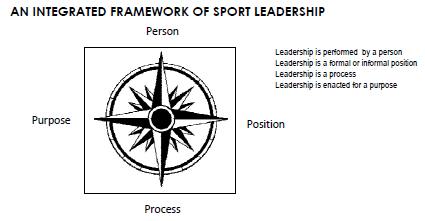
Embedded in the seven assumptions above are the four P’s of team leadership. The framework highlights the integration of the four key domains of leadership. The framework answers the question What is Leadership? Leadership is a position, it is a process, and it is performed by a person for a purpose.

Too often leadership is narrowly defined exclusively as a person. Conceptually this leads us back to a focus on the leader, her traits and disposition. But leadership is more than the idiosyncratic actions taken by a chosen person. It is a process. A process is simply a
coordinated way of doing things. Can student‐athletes, including those that don’t possess the so‐called necessary traits, learn a process for doing leadership things? Of course they can.

Leadership is also a position. In The Academy for Sport Leadership’s way of doing things we suggest giving each student‐athlete a “role” to on‐board them into the leadership team building development process. You’ll see this later when I introduce you to my 8 Roles of Teamwork. A leader’s words and deeds provide purpose, a compelling vision of the future. Effective team leadership answers, for all team members, the questions, “why am I doing this?”

The four P’s, like the compass that they form, are only a tool for answering the question “What is leadership.” Each student‐athlete (and coach too) brings his or her own unique values, skills, experiences, and personality to the leader role; and each student‐athlete has his or her own personal way of making change happen. The compass is a simple model that represents the key domains of an effective leadership development program.

To find out more about and order Sport Leadership Books authored by Dr. Dobbs including Coaching for Leadership, click this link: The Academy for Sport Leadership Books

If you would like to learn more about the book that this excerpt came from click: A Leader in Every Locker


Filed Under: Leadership

3 Inspirational Poems

May 3, 2017 by

These were written long enough again that they are framed in the masculine gender, but I hope there are good messages for ALL athletes and coaches.

Little Eyes

Author Unknown

There are little eyes upon you
And they’re watching night and day;
There are little ears that quickly
Take in every word you say;
There are little hands all eager
To do anything you do;
And a little boy who’s dreaming
Of the day he’ll be like you.
You’re the little fellow’s idol,
You’re the wisest of the wise.
In his little mind about you
No suspicions ever rise.
He believes in you devoutly,
Hold all that you say and do;
He will say and do in your way
When he’s a grown-up like you.
There’s a wide-eyed little fellow
Who believes you’re always right
And his ears are always open
And he watches day and night.
You are setting an example
Every day in all you do,
For the little boy who’s waiting
To grow up to be like you.

The Man in the Glass

Author–Dale Wimbrow

When you get what you want in your struggle for self
And the world makes you king for a day,
Just go to a mirror and look at yourself,
And see what THAT man has to say.

For it isn’t your father or mother or wife
Whose judgment upon you must pass;
The fellow whose verdict counts most in your life
Is the one staring back from the glass.

You may be like Jack Horner and chisel a plum
And think you’re a wonderful guy,
But the man in the glass says you’re only a bum
If you can’t look him straight in the eye.

He’s the fellow to please, never mind all the rest,
For he’s with you clear up to the end,
And you’ve passed your most dangerous, difficult test
If the man in the glass is your friend.

You may fool the whole world down the pathway of years
And get pats on the back as you pass,
But your final reward will be heartaches and tears
If you’ve cheated the man in the glass.

The Man on the Bench

Author Unknown

The man on the bench is the man for me
He’s not the star, but he’s the key .
Without his aid and help each day,
I doubt if there would be a play.
Every run by a team on “big game” day
He holds the dummy and shows the way when
The other team runs that certain play.
When not being clocked, he’s chasing punts.
Or shagging fly balls, and fielding bunts,
Or a hundred and one other useful stunts.
He’s always the “skins” against the “shirts”,
And the night of the game he sits and hurts,
He helps with equipment, and picks up balls.
Sets up the hurdles, and takes the falls,
But is always ready when some coach calls.
He’s not on the sports page every time
When a “dollar” is waiting, he’s the “dime”

He comes to the banquet with a little prayer,
Hoping this year the “letter” is there.
As he squirms wishfully in his chair.
And he suffers a little along with his coach,
As the names are read and no approach
Is made to him there is a wrench
In his heart. But his teeth will clench,
As he says, “next year”, this man on the bench.
What happens to all the men like these.
Who seem, all elbows, thumbs, and knees.
Don’t feel sorry for their frustrations,
They are the men who head corporations,
And sit on the councils of great nations.

They learn the value of raw sheer grit,
The determination that won’t say quit.
The value of facing rugged strife
To face the gun with just a knife,
They learn how to make a fight in life.
To the man on the bench I give my hand
With the greatest respect, ’cause he’s my man,
Please don’t worry, he’ll go far
Be it jet propulison or motor car,
Somewhere in life, he will be a star.


Filed Under: Motivation

9 Requirements of Success

April 26, 2017 by

By Dawn Redd-Kelly.

Sometimes social media gets a bad rap for being a time sucker, which it can be. But most times, I find good stuff there.  Whether it be a good leadership article, a timely motivational quote, or (like this time) a great tweet from team building expert Jeff Janssen.

How can we be successful coaches?  Or maybe a better way to put it is how can we measure, at the end of the season or school year, that we’ve been successful?  Janssen has some ideas.

9 requirements of success:

  1. Purpose: Why do you coach? As I mentioned in my another post, loving the sport isn’t your purpose (it’s your passion)…why do you coach? Why do you have player meetings?  And stress about your practice plans? Why do you watch so much film? What is my why?  I believe that athletics creates better humans (I’m biased, I know) and I believe us coaches equip our athletes with the tools they’ll need to make the world a better place and I’m honored to have a part in it.
  2. Passion: Do you love your sport? Is there a fire in your bones for it?  Then that will translate over to your players and they’ll be infected by your zeal.
  3. Perspiration: I feel like this is obvious, but you should be working hard, Coach. Like, really hard.  You’ve got to work hard to create relationships with your players.  You’ve got to work hard to know the different personalities on your team and how to motivate them.  You’ve got to work hard to keep your team chemistry balanced.
  4. Plan: How will you handle the inevitable quarrels between teammates? How will you handle having to bench a starter?  How will you prepare your team to be clutch at the end of a competition?  How will you make sure they’re ready for post-season?
  5. Patience: Can you wait for your “potential player” to bloom? Can you try different ways of teaching your leaders how to lead? Can you trust the process?
  6. Persistence: I think it’s a great idea to write down your coaching goals. That way, when you hit the inevitable speed bump, you won’t be moved.
  7. People: Coaches don’t succeed alone. We need mentors and assistants.  We need recruits to buy into what we’re saying.  We need families who support the coaching staff in the background.  We need an administration who’ll advocate for us.
  8. Principles: Do you want to be a win-at-all-costs coach? Do you want to sacrifice your values in order to win more games?  I think a coach’s goal should be to win with honor.
  9. Perspective: My guess is our definition of success will change as we grow as coaches, as we gain a bit more life experience, and as we’re humbled by our profession.

It’s hard to feel successful.  It requires a lot of work.  Let’s get ready to put the effort in so that we can be whatever our version of success looks like!

And, here is a second post from Coach Dawn…

Creating Brave Players

Fear is the reason today is like yesterday.”—Leadership Freak

That quotation sucker punched me!  Our goal as coaches is to create an atmosphere where our athletes feel comfortable taking risks and are brave in the face of fear.  Those who aren’t involved in athletics may scoff, but the fear is real when the bases are loaded and coach doesn’t have another pitcher warming up.  The fear is real when it’s game point and the server is walking back to the endline in volleyball.  And the fear is real when the fourth runner in a relay receives the baton at the same time as an opponent.

Here are three things we can do right now to crush fear on our teams:

  1. Stop saying crunch time is the same as the beginning of a competition. One of the reasons we believe certain players are “clutch” is that they execute late in the game, in pressure filled situations.  Yet we, as coaches, continue to say things like: the scoreboard doesn’t matter.  Yet…it does! Our players are watching time tick away and their heartrates are increasing.  Our players are watching the opponent create a bigger and bigger gap in the score…and it’s starting to feel like the game is getting away from them.  I think it’s better to acknowledge that pressure and not be afraid of it, but welcome it and give your athletes tools to handle what the scoreboard is saying to them.
  2. Celebrate effort. Each day we have an opportunity to fill our athlete’s reserves with success.  I know Yoda says, “do or do not, there is no try”, but I believe in applauding the process, not necessarily the result.  So if a player hustles to close a block or dig a ball—even if they aren’t successful in their attempt—I’m going to get fired up about the effort.  It’s risky to go all out (what if they fail?), so we need to cheer those players who are willing to flop…because they believe they’ll eventually succeed.
  3. Be intentional about making our yesterdays. Today is tomorrow’s yesterday.  What are you going to do today to put your athletes in a position to draw on their bravery reserves?  Decide what your focus of the day/week/month is going to be and make it happen!  If your focus is tangible (we need to convert more turnovers into points), then devote the majority of practice time to it.  If your focus is intangible (your team needs to be teamier), then design drills that bring that skill to the forefront.

I can’t think of a sport that doesn’t require its athletes to be willing to take risks. Those risks could be failing in front of their friends and family, it could be letting their teammates down…but it could also be succeeding when they weren’t entirely confident they would.  There’s a saying that says, “fortune favors the brave”.  Sure, our athletes could fail, but they certainly won’t succeed if they’re unwilling to be brave and take a risk.


Filed Under: Professional Development

  • « Previous Page
  • 1
  • …
  • 23
  • 24
  • 25
  • 26
  • 27
  • …
  • 63
  • Next Page »

© Copyright 2026 Athletic Performance Toolbox

Design by BuzzworthyBasketballMarketing.com

Privacy Policy