Coaches Toolbox

  • Home
  • Mental Toughness
  • Leadership
  • Motivation
  • Staff Development
  • Program Building
  • Archives
  • Sport Specific Sites
    • Athletic Performance Coaching
    • Basketball Coaching
    • Football Coaching
    • Soccer Coaching
    • Track and Field Coaching
    • Volleyball Coaching

Getting Better at Getting Better

January 23, 2017 by

These are some of the notes presented by Mike Neighbors at this past spring’s PGC/Glazier Basketball coaching Clinic in Chicago. Mike is the Head Women’s Basketball Coach at the University of Washington.

I believe that these thoughts are applicable to all sports and to any coaching situation

Getting Better at Getting Better

  • You have to take the time to consciously think about and consciously plan how every important aspect of your program is going to get better.
  • Getting Better does not happen on its own without a coaching staff being intentional about it.
  • To achieve your potential, you must have a 5:1 ratio of practices to games.
  • For every minute you spend in practice/meetings, it takes 2 minutes to prepare and plan.
  • Practice makes permanent, not perfect, so as coaches, we must set up systems so that our players are practicing the right way.
  •  

  • What do you care about?
  • Can your players verbalize what you care about?
  • If you ask our players about how we do things, they should be able to tell you those two things.
  • You either coach it or you tolerate it.
  •  

  • Be good at the things that you do a lot in your system.
  • For those important precision skills, we employ a coaching technique called “Front of the line, back of the line.
  • We require that a player executes a skill exactly as we teach it in a drill, with zero error every time.
  • If the skill is executed perfectly, the player goes to the back of the line in the drill and the drill continues with the next player up.
  •  

  • If they did not do it perfectly, the next player in line goes and the player who just went goes to the front of the line for some instruction from the coach who is running the drill.
  • After the first week of practice, the players decide if the performance is front of the line or back of the line.  You will find that the players are harder on each other than you are on them.
  • We quickly saw marked improvement in all our PRECISION SKILLS employing this method. It also evolves quickly into a peer situation of players being the critics and pointing their teammates to the front or the back. They are actually tougher on each other than most coaches!!
  • You can see a more detailed description of Coach Neighbors front of the line/back of the line concept at this link:  Front of the line/Back of the Line
  •  

  • Keep in mind at the start of each season, you have not taught until your players have learned it.  You know your entire system.  It will be new to new players on your team and your veterans will not know it as well as you.  Take the time to re-teach until they learn!
  • Properly prepare so you don’t have to repair.
  • Players cannot access the creative side of their brain unless they are comfortable with what is going on.
  • It takes your best players 5 seconds to reconnect their concentration to the action when you yell their names.  It takes average players 10 to 15 seconds to reconnect.
  •  

  • Washington coaches only talk during dead balls.
  • Exercise in helping players to develop  the next play mentality.  When Kelsey Plum was a freshman, and made a mistake in practice, Coach Neighbors could tell that her mind would be on that mistake for the next several possessions.  To help her learn, he started a stopwatch as soon as she made a mistake and stopped it once she had refocused.  It showed 2 minutes and 36 seconds.  He took her out of the scrimmage, called her over and showed her the time on the stopwatch.  She asked him what the represented.  He said it was the amount of time that it took you to get you concentration back after you made a mistake.  He told her that he would need to take her out of the game every time that she made a mistake for 2 minutes and 36 seconds so that she could regain her focus unless she was able to improve that on her own.  The improvement  in her next play mentality over the next few days of practice was remarkable.
  •  

  • Find ways to help narrow your players’ focus in practice.
  • Send the players home with 3 bright spots and 1 deficiency to work on.
  • Feedback is huge for today’s players.  Make it immediate, honest, and actionable.
  • During practice, he has an assistant coach taking iphone videos and then emailing them to players when there are specific teaching points so that the players have them right after practice and can see themselves doing or not doing the teaching point.

Many of these concepts came from a book called “Practice Perfect” You can find out a little more about the book (and read a part of it and/or listen to a segment by clicking on the image to the left:

Here are a few more concepts from the book:

Never mistake activity for achievement–John Wooden
A high rate of activity isn’t enough–coaches must be intentional about what their athletes do.
Practice isn’t only worth re-engineering when it is bad, it is also worth re-engineering when it is merely good.
To be significantly better, you need to be significantly more productive for every minute you practice.
“Even relatively small, but significant changes, can increase the rate at which people develop by a striking degree”

Filed Under: Professional Development

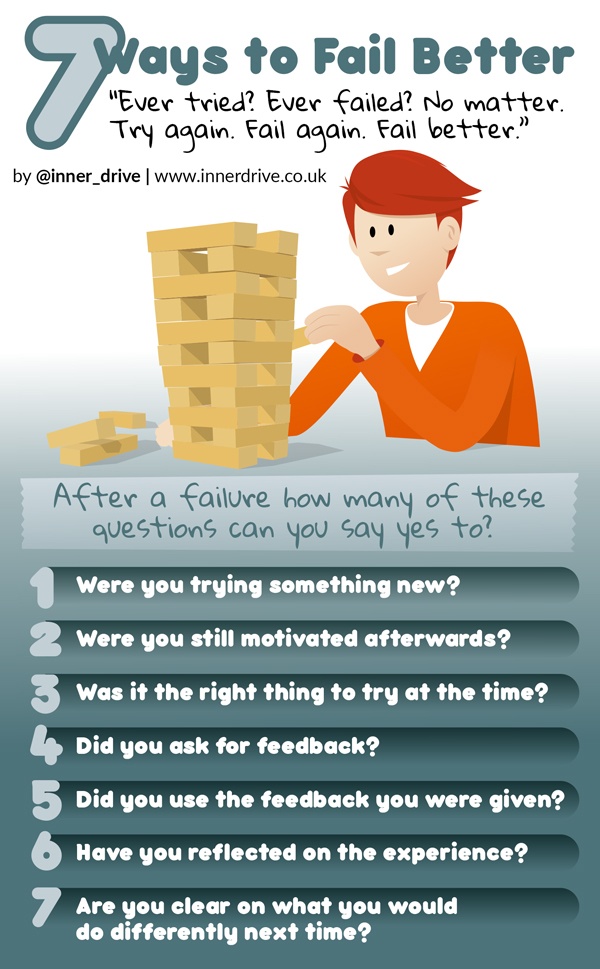
7 Ways to Fail Better

January 13, 2017 by

This post was syndicated from the Inner Drive blog.

Editor’s Note from Brian: I believe that these 7 lessons apply in athletics when athletes are working to acquire new skills or improve existing ones as well as in academics.

How well do your students fail? Poet Samuel Beckett once said, “Ever tried. Ever failed. No matter. Try Again. Fail again. Fail better.” Turns out he was sort of right, as research by psychologists over the past two decades has found that the way you explain your failures can have a profound impact on your future behaviour.

Research from sport suggests that if athletes attribute failure to permanent causes instead of temporary ones, and if they overgeneralise instead of being specific, it can lead to them feeling less confident, more anxious and performing worse in the future.

Could this be applied in schools? Students have many highs and lows over the course of the year. Failure at some stage is inevitable.  Some students see their failures as permanent (“I will never be good at art” vs. “I am struggling in art at the moment”), and they overgeneralise (“I don’t like maths” vs. “I don’t like algebra”).

To combat this, some schools have started running a ‘failure week’ to help promote the importance of taking risks, learning from mistakes, and reducing students’ fear of failure.  Others are incorporating these principles regularly into PHSE lessons and enrichment days.

HOW TO FAIL BETTER

So how can we help students fail better? It is important to note that failing better is different from aiming to fail. The former focuses on learning and development; the latter suggests low expectations and lack of effort (which is the opposite mindset of what we promote). Students ‘fail better’ if they can answer yes to these questions…

Were they trying something new?

Being open and enthusiastic about new and challenging situations is a key characteristic of having a growth mindset. We want to help students shift away from focusing on ‘proving myself’ and more towards ‘improving myself’.

The teenage years offer a unique window of self-discovery and improving self-awareness. It can be when people discover what they are passionate about. Part of this process is trying new things, experimenting, and finding out what one’s strengths/weaknesses might be. Failures are integral to this. Helping students understand this can help aid their learning and development.

Were they still motivated after the setback?

Research on teenagers has found that those who are motivated by learning and mastering a subject, compared to those who are extrinsically motivated by rewards, display higher levels of emotional control before an exam, have higher levels of confidence, and achieve better academic performance.

Doing well at school is more akin to a marathon, rather than a sprint. Motivation needs to be robust and durable in order to aid resilience. Focusing on improvement, on learning, and on getting better should ensure that this happens.

Was it the right thing to try at the time?

It is easy for students to judge how good their decisions are based on the outcome (i.e. if it ended up well, it was a good decision; if it ended up badly, it was a bad one). This is a mistake, as sometimes the result may be down to randomness, luck, or a million other factors. This can lead to people throwing the baby out with the bath water.

Statistician Nate Silver, the only man in America who correctly predicted how each of the 50 states would vote in the 2012 Presidential election, states that instead of judging decisions based on the eventual outcome, it is far better to judge them based on the information you had at the time.

If students make the best decision possible from the information available, then perhaps the mistake was down to execution of the skill and not the thought process going into it. This is an important distinction to make, as it can help identify which part of the process to target for improvement next time.

Did they ask for feedback (and then use it)?

There is a great quote that says, “Real failure is a man who has blundered, but not cashed in on the experience.” If students are going to suffer from setbacks (and it is a certainty that they will at some stage), then there is a three-part way to ensure they learn the most from it.

First is the act of asking for feedback. This is a great behaviour to praise, as it is the behaviour you want them repeat after future failures. Second is being open to the feedback. This is a fundamental part of learning. If students feel that they are being judged or attacked, it is unlikely that they will heed the feedback, no matter how helpful. Third is getting them to action the feedback. It is not enough to have good intentions; behaviour change comes from doing, not just thinking about it.

Did they reflect on the experience and know what they would do differently?

Setbacks can aid the learning process, but only if the person experiencing it takes the time to reflect on what has happened and as a result, is clear on what they would do differently next time. Otherwise, it is likely that they will repeat the same mistakes again and again in the future. It is ok to make mistakes. To keep making the same one is criminal.

Having students ask themselves ‘what would I do differently next time?’ is a great question for two reasons. First, it stops them dwelling on the past, which can reduce student stress. Second, it gives them a sense of control over the situation, which will help boost their confidence and motivation when moving forward into the future.

FINAL THOUGHT

We all want the students we work with to be successful; however, it would be foolish to think that they will never fail. We don’t want students to fail more, but if (and when) some of them do fail, we want them to fail better. Helping them fail better isn’t negative; if anything, it may be one of the most positive skills we could teach them.

About Inner Drive

InnerDrive is a mental skills training company coveing the traditional areas of sports psychology and mindset training.

Their work covers the traditional areas of performance psychology, sports psychology and neuroscience. They work with over 120 schools in England and last year worked with over 25,000 students, teachers and parents.

The company is led by Edward Watson, a retired Army major and Bradley Busch, a HCPC registered psychologist.


Filed Under: Motivation

14 Ways Our Athletes Can Build Their Mental Strength

January 12, 2017 by

The following post was written by Coach Dawn Redd.

Coaches ask for a simple, but very hard, thing from our athletes: complete focus for a couple of hours each day. I think this is a difficult mental task for our players to manage…I also think it requires practice. I don’t know if it’s fair of us to ask our players to do these things without giving them the space to practice these mental skills. Here are fourteen ways our athletes can break “focus” down and take control of their mental headspace:

14 powerful ways our teams can build their mental strength

  1. Perspective.  A great mental challenge of being on a team is putting the team’s goals first…even when those goals are in opposition to a player’s personal aspirations.
  2. Readiness for change. Athletes and coaches have to be nimble, flexible, and adaptable…that’s the only way to beat a savvy opponent.
  3. Detachment.  This is a call to not take things personally, but to focus on what they can accomplish, not any perceived slights from the coaching staff.
  4. Strength under stress. This one is the name of the game, right? Competition is stressful and, ideally, we’ve equipped our athletes with the tools to manage themselves so that they can shine under the bright lights.
  5. Preparation for challenges. No season is without twists and turns, use the good times to prepare for the inevitable downturn.
  6. The right attitude toward setbacks. I want my athletes to embrace their personal setbacks, because that means they’ve tried to get better. If they never experience frustration/failure/setbacks, then they’re not pushing hard enough.
  7. Self-validation. Many times, I tell my players that only they know how hard they’re working. I can come up with tough workouts, but it’s up to them to make them as challenging as possible. Working hard is a mental exercise and it’s their opportunity to push when perhaps they could get away with not pushing.
  8. Patience. Every player on every team at every school wants to win on the first day of practice. Special players and teams have the patience to work every day over the course of a long season.
  9. Control.  Is your athlete grumpy because you corrected them in practice? Are they disappointed they’re not playing with the first team? It’s our job as their coach to remind them that they, and only they, are in charge of the attitude they present at practice.
  10. Endurance in the face of failure. Quite honestly, our athletes’ goal should be to fail every day. I want my players operating at the outer edges of their ability—where failure is more likely—because I want them to challenge themselves to do what they didn’t think they could do.
  11. Unwavering positivity. We have to encourage our players to be a positive light on the team. There is always a Negative Nelly on the team, hopefully our athletes will have the guts to stop them in their tracks.
  12. Tenacity.  Never give up. Come in early, stay late…be relentless about getting better.
  13. A strong inner compass. This is a great locker room skill. When others may be grumbling, this athlete challenges themselves to do the right thing and support the direction the coach is taking the program.
  14. Uncompromising standards. The standard is the standard, regardless of how hot it is, or how many injured players your team has, or how well other teams are doing. Our athletes shouldn’t bring the standard down, but rather rise up to the standard.

What if we challenged our teams to do a few of these each day? What if, when presented with a mental challenge, we reminded our athletes that this was getting them mentally tougher for a future opponent? What if we posted this up wherever we practice so that our teams have a powerful reminder of what is required of them…beyond the skill they’re trying to master? What if we framed our disappointment with their lack of engagement/focus/whatever with an opportunity to be mentally better than our opponent?

Check out this Inc. article, which served as inspiration for this post.


Are you tired of walking into practice and seeing lackluster effort from your players?  Have you had it with trying to get your female athletes to care about the team as much as you do??

Click here to find out more about Coach Dawn’s eBook: Motivating Female Athletes

Comes with a FREE PowerPoint presentation called Guarantee Your Success: Using John Wooden’s Pyramid of Success To Increase Your Team’s Cohesion.

About the Author of this Post

Dawn Redd-Kelly is the head volleyball coach at Beloit College.  Her volleyball teams have earned the best winning percentage in school history.  She has coached at the high school, club, Division I and III levels…taking my first collegiate head coaching job at age 24 with the University of Rochester.  She played volleyball at the University of Wisconsin-Madison. Coach Dawn Says: “I believe in the power of sport to teach winning and losing with grace, to inspire its participants to excel, and to create a common goal for the greater good.”


Filed Under: Mental Toughness

Cracking the Code to Building an Elite Team

January 3, 2017 by

Cracking the Code to Building an Elite Team

By Cory Dobbs, Ed.D.

“A team is not just a collection of individuals.  When everyone clicks into place, a team is truly a community, a tightly knit fellowship.” 

Many coaches are expert tacticians, strategists, and teachers of techniques.   Few are adept at building teams.  I mean high-performing teams.  Think Seal Team Six.  The elite fighting force, the team that captured Osama Bin Laden.  Sure, your team may master an offense or a defense, but it’s a fact that most teams don’t reach an elite level of teamwork.  To do so requires a deliberate and intense effort to building the team.  As a researcher I’ve studied hundreds of teams and can only conclude few teams, won-loss records aside, ever achieve an elite level.  Study after study of elite teams, like Seal Team Six, continue to reveal it’s not the personnel but processes that lead to an elite level team.

Take a moment and re-read the quote above.  I’ve purposefully left off the name of the author.  I did so out of respect for his work, but I do find this quote to be lacking in terms of action-ability.   Most coaches and players unknowingly live by a “click or clash” framework of relationship building.  That is, some people just click together while others clash with one another.  And it’s rarely explicit, but very implicit—teammates prefer to go along to get along.  Not in elite teams.

At its most dynamic level a team is a system, a network of interdependent components that work together to try to accomplish the aim of the system architects.  This differs from the most basic level of a team as a collection of players.  When the process of team building becomes more strategic, the calculus changes.  A laissez-faire approach changes to a more direct and deliberate approach.  Relationship building becomes the central focus.  Relationship is everything.  When you see the process of team building as social system, then the integrity of every interpersonal interaction is essential to developing an intensive teaming capability.

I’ve uncovered, through wide-ranging research and practice, twenty principles and concepts and isolated eight “roles” that are necessary for building elite teams.  Yes, I’ve cracked the code to building high-performance teams.  High-performing teams make deliberate teamwork their focus.

The Teamwork Intelligence approach is a disciplined way of thinking about and building a high-performing team; it involves discussing teamwork as both a system and a set of processes.  This allows us to explore the context in which teamwork occurs, the characteristics of the coaches and players, individual and team values, experience, the timing of events, the history in which teamwork is embedded, and how teamwork intelligence plays a role in individual and collective successes and failures.   Teamwork intelligence delves into team work as a process and as a way to understand the person (both players and coaches) embedded within a system.

To think about teamwork as a system, we need to consider the inputs, such as training for teamwork intelligence, the process, which we can describe as the system and the context in which the players and coaches interact, and the outcomes, which are the levels of motivation, performance, and well-being of players and coaches.   To leverage the process of teamwork intelligence I have designed five building blocks that must be operationalized:  (1) the four dimensions of team building and the associated eight roles of teamwork; (2) the three mindsets of a team player; (3) the three layers of a team player; (4) the five core concerns of every team member, and (5) the five forces of performance-enhancing relationships.  By optimizing these five components—the teamwork intelligence system—we are able to enhance each individual’s vital force and, in turn, the collective force of the team.

SO, WHAT IS TEAMWORK INTELLIGENCE?                   

Teamwork Intelligence is the purposeful and intentional relational process of team members together raising one another to higher levels of motivation, collaboration, compassion, and performance.  It’s deceptively simple: in order to build a high-performing team you have to create the conditions for team members to commit and unify—to coalesce into a single organism.  Such oneness is not inevitable; it is forged methodically and deliberately.
WHY IS TEAMWORK INTELLIGENCE THE SMART THING TO DO?

A significant aspect of teamwork intelligence is knowing the expectations one should have of one’s teammates.  One of the most significant expectations is that of high-level ownership with the purpose of each player investing in the development of a high-performing team.  Through expectations and collective achievements, identification, loyalty, and trust are built.  The goal and expected outcome is the development of the team’s full potential.

Extreme Ownership is a central concept of Teamwork Intelligence.  Teamwork Intelligence is not only about teaching student-athletes how to comply with a set of rules and procedures; it is about recognizing the profound difference between compliance-based behavior and values-based performance.  Extreme Ownership is about creating a culture in which every team member is committed to performance excellence and team member wellness based on personal commitment to the best interests of the team.  Extreme Ownership occurs when student-athletes own their personal learning and performance as well as team learning and performance.

Teamwork Intelligence generates higher levels of autonomy, extra effort, commitment, performance, and satisfaction.  High performance is what the student-athlete wants to do, not because it brings personal glory, but because they feel a sense of extreme ownership of the team.  The extreme owner is all in as a team player and willingly goes all out for the team.

I’ve seen enough to validate the claim that knowing what to do can lead to higher levels of doing.  However, I’ve also observed far too frequently a high degree of learned helplessness.  Student-athletes have, for the most part, grown up in a sport system in which they prefer to wait for the coach to take corrective action, to “instill” motive and values, and basically avoid taking responsibility for the building of the team.  This is why elite teams are emphatic about deliberately building a team and insistent on teamwork intelligence.

Teamwork Intelligence provides a framework for seeing interrelationships of the elements of the team system rather than static “snapshots” that tend to distort the differences between a mediocre team and a high-performing team.   Teamwork Intelligence provides a set of principles and includes a set of specific tools and techniques (such as role clarification provided by The Eight Roles of Teamwork) for building a high-performance team.  Investing in the development of relationships will pay off.

Okay, so are you willing to invest time, energy, and resources into developing an elite team?  If so, get started as soon as possible.   Explore the principles and practices The Academy for Sport Leadership has discovered and developed and teach in our Teamwork Intelligence Workshop.


To find out more about and order Sport Leadership Books authored by Dr. Dobbs including Coaching for Leadership, click this link: The Academy for Sport Leadership Books
About Cory Dobbs, Ed.D.

Cory Dobbs is the founder of The Academy for Sport Leadership and a nationally recognized thought leader in the areas of leadership and team building.  Cory is an accomplished researcher of human experience. Cory engages in naturalistic inquiry seeking in-depth understanding of social phenomena within their natural setting (visit www.aleaderineverylocker.com).

A former basketball coach, Cory’s coaching background includes experience at the NCAA DII, NJCAA, and high school levels of competition.  After a decade of research and development Cory unleashed the groundbreaking Teamwork Intelligence program for student-athletics. Teamwork Intelligence illuminates the process of designing an elite team by using the 20 principles and concepts along with the 8 roles of a team player he’s uncovered while performing research.

Cory has worked with professional athletes, collegiate athletic programs, and high schools teaching leadership and team building as a part of the sports experience and education process.  As a consultant and trainer Dr. Dobbs has worked with Fortune 500 organizations such as American Express, Honeywell, and Avnet, as well as medium and small businesses.

Dr. Dobbs has taught leadership and organizational change at Northern Arizona University, Ohio University, and Grand Canyon University.


Filed Under: Program Building

Learning from Other Coaches in Your School

December 30, 2016 by

The article was provided by Coaches Network

By Dr. David Hoch, CMAA, CIC

To bolster their professional development, coaches have long attended clinics and conferences, read books, viewed videos, and taken classes. All of these methods are excellent, beneficial, and should be used. But there’s one more avenue for improving your coaching that is right under your nose—learning from peers in your own school.

Even though someone may coach another sport, this doesn’t mean that you won’t be able to learn a great deal from this person. Obviously you won’t pick up exact drills to improve sport-specific skills and strategy, but there are many other aspects of coaching that you can discuss. And the best part is that these individuals are right there in your building!

What can you learn from good, experienced coaches in your school regardless of the sport that they coach? Here are a few things:

Practice planning. While you might know the skills and strategies involved in your sport, perhaps your practice sessions could be a little more organized. An experienced coach can provide ideas for the placement of the various segments and drills during a practice session, how much time should be allotted, and understanding the concept of scheduling a hard drill followed by an easier one to help with recovery.

Communicating with parents. Nothing is more critical and perhaps more difficult for many coaches than effectively communicating with parents. Seek out coaches at your school who do this well and ask them for advice. How do they keep parents well-informed? How do they deter parent complaints? How do they get parent buy-in? How do they deal with a very difficult parent?

Working with the media. Making off-the-cuff comments, using inappropriate language, or making emotional statements after a game can cause major problems. Guidance and help from experienced coaches can be invaluable to avoid these missteps.

Being tough but supportive. To be an effective coach, it is important to understand young people and to treat them with respect, care, and compassion. Good coaches are positive, encouraging, and nurturing. It can be extremely helpful to attend practice sessions of exemplary coaches and watch how they can be both demanding and supportive during the course of the same practice session. Outstanding coaches place the growth and development of their athletes at the top of their priorities, and you can learn this through observation.

Motivating athletes. It is also important to understand that members of your team are all unique and respond differently to motivational efforts. To get the most out of each team member, you can’t use one, cookie-cutter approach. Experienced coaches can share new and different techniques that work to reach a diverse group of individuals.

Work-life balance. Coaching is demanding and can be totally consuming, which means you may have to work extremely hard to maintain a good family life. Ideas and suggestions from others can be invaluable and may end up extending your coaching lifespan.


David Hoch retired in 2010 after a 41-year career as a high school athletic director and coach.  In 2009, Dr. Hoch was honored as the Eastern District Athletic Director of the Year by the Nastional Association for Sport and Physical Education.  He was also presented with the National Interscholastic Athletic Administrators Association Distinguished Service Award, and in 2000 he was named the Maryland State Athletic Director Association’s Athletic Director of the Year.  Dr. Hoch has authored over 460 professional articles and made more than 70 presentations around the country.


Filed Under: Professional Development

  • « Previous Page
  • 1
  • …
  • 28
  • 29
  • 30
  • 31
  • 32
  • …
  • 63
  • Next Page »

© Copyright 2026 Athletic Performance Toolbox

Design by BuzzworthyBasketballMarketing.com

Privacy Policy