Coaches Toolbox

  • Home
  • Mental Toughness
  • Leadership
  • Motivation
  • Staff Development
  • Program Building
  • Archives
  • Sport Specific Sites
    • Athletic Performance Coaching
    • Basketball Coaching
    • Football Coaching
    • Soccer Coaching
    • Track and Field Coaching
    • Volleyball Coaching

Earn the Right to Win

April 19, 2016 by

This post was written by Bert DeSalvo on his Coaching Blog,

Earn the Right to Win

Tom Coughlin

Notes taken by Bert DeSalvo, @CoachDeSalvo

Introduction – Prepare to Win

“Achieving any goal begins with through preparation.” (p. 2)

“Having a structure to rely on means that when my teams have reached our goal, we can look back at the steps we took along the way to get there. And do it again.” (p. 3)

  • Can repeat the process!
  • Schedules, lists (lists of lists)
  • Systematic approach to success

“Preparation creates confidence.” (p. 6)

“Details count.” (p. 9)

“There is no discussion about methods. The team is my responsibility.” (p. 10)

  • Nobody is above the team – Follow the rules
  • Rules provide a framework

Chapter 1 – Build the Structure

A. Set a Goal

“My basic philosophy has always been simple and direct: Create an environment and provide the direction necessary to allow our players to perform to the best of their ability, which will lead directly to success.” (p. 17)

“Creating a structure in which winning is the expectation rather than the hope is a long-term proposition.” (p.17)

“The important thing is to make progress, recognize these needs that have to be addressed, and make a plan to do that.” (p. 17)

“Once you establish your goal you can’t take your focus off of your objective.” (p. 18)

  • Sends wrong message
  • Competition

B. Know What You Have to Work With

“The best place to begin your preparation is to honestly assess the existing situation: How deep in the mud are you? What is the current status of your organization?” (p. 21)

  • Starts with critical self-appraisal; Don’t blame others – “We can’t improve without realistic self-appraisal.” (p. 22)
  • What’s your situation?
    – RIT/Jax – Blank Slates
    – Boston College/NY Giants – Losing Teams
  • Coughlin saw NYG as a loss of pride
    – His goal was to restore pride “by being firm, fair, honest and demanding and by paying close attention to our preparation.” (p. 24)

C. Create a Structure

  • Establish priorities (Coaching, staff, roster, etc.)
  • “Create an overall culture that would govern everything.” (p. 24)
    – Philosophy ensures consistency of purpose and action  “Allows us to move forward together.” (p. 24)

Coughlin’s Philosophy:

“Structure and organized. A program in which everyone knows their responsibilities and that they will be held accountable for the job they were hired to do. It isn’t complicated; it’s pretty much black and white: This is how things are going to be done, and if you can’t do it this way, we’re going to find somebody who can.” (p. 26)

“Consistency, reliability, and determination guarantee progress.”

  • Need buy–Consistency provides this
  • Know expectations–Explain them clearly
  • Have confidence–Structure will not change

“The Structure is a statement: This is who we are, this is what we do, and this is the way we do it.” (p. 27)

“Once you’ve set up a system with clear goals you also have to make a commitment to consistency.” (p. 27)

  • Stick to it – Even under duress
  • To make it work you must stay the course (after setting a goal, assessing the situation and building a system)

D. Establish the Rules and Enforce Them

“The culture of an organization is defined by its rules.” (p. 32)

  • Must be sensible, realistic and timely
  • Clearly stated–No gray areas – “Everything needs to be spelled out, with no room for interpretation.” (p. 33)
  • Have other purposes too
    – “Designed to bring the team together, create a professional atmosphere/environment in which we can get all of our work done with a minimum of distraction, and help develop pride in the organization.” (p. 33)
  • Setting rules helps you find out who is committed to the program and who isn’t

Examples of Coughlin’s Rules:

  1. Be on time every time
  2. Know your assignments of the field
  3. Conduct yourself like a professional on and off the field
  4. Demonstrate pride in our organization
  5. Respect your teammates
  6. Pay complete attention in our meetings

“When I set the rules I always felt it was better to start out with a firm set, and then, if the situation warranted it, make the necessary adjustments.” (p. 34)

“As a leader, your credibility depends completely on the way you enforce the rules you’ve made. For them to have any value, they have to apply equally to everyone.” (p. 37)

“The day you don’t enforce your rules you might as well just do away with them.” (p. 38)

“When you don’t enforce the rules, people begin to lose respect for you.” (p. 38)

“If you are in a leadership position in any organization, in any job, and you compromise principles the first time you face adversity, you’ll lose all your credibility.” (p. 40)

“Once again, ‘earning the right to win’ means making a difficult or even unpopular decision and sticking to it.” (p. 40)

“The principles and values that form the cornerstone of our beliefs cannot be compromised.” (p. 40)

E. Be Resilient

“There will be times when we all have to overcome adversity – but we believe adversity makes us stronger.” (p. 41) (i.e. injuries = ‘next man up’)

“If you manage to overcome that many obstacles to your goal, you have earned the right to win.” (p. 45)

F. Build an Organization with Character

“The key to building a system that functions smoothly is to find people who share your vision, hire them, and allow them to do their job.” (p. 45)

  • Have to hire people who will carry out your vision/philosophy
  • The better your people, the better the organization will be

“The success of the program will rise or fall on the ability, initiative, imagination, and determination of the members of our staff.” (p. 46)
Coughlin looks for:

  1. Great All-American work ethic
    a. Know the demands of the job
    b. Go beyond this!
  2. Commitment (players move to Jax – Means all in!)
    3. Enthusiasm

“Character-based, valued centered philosophy has always been the backbone of my organization.” (p. 47)
“Character is essential.” (p. 50)

Coughlin conducts interviews w/free agents, coaches, draftees to get to know them as people

“You want to work with dedicated people you can depend on to be there when things get tough. The more of those good character people you have in key positions the better chance you have to succeed.” (p. 51)

“Character also accelerates the growth of talent.” (p. 51) [JPP]

“We find the complainers and the whiners, the people who aren’t willing to put in long hours, the people more interested in self-promotion than the success of the team and get rid of them as quickly as possible.” (p. 53)

“Sometimes you just need to get rid of a bad apple. Cutting those people really will cut your losses. Anyone who is serious about building a long-term program has had to do this.” (p. 54)

“No one is irreplaceable.” (p. 55)

G. Delegate Authority

“A successful coach or manager delegates responsibility and allows people he/she trusts to do their job.” (p. 56)

Ultimate responsibility is on the head coach though.


You can read inside the book by clicking on the image at the left.

You can read the rest of Coach DeSalvo’s notes at this link: Earn the Right to Win

Filed Under: Program Building

Champions are Made in the Offseason

April 19, 2016 by

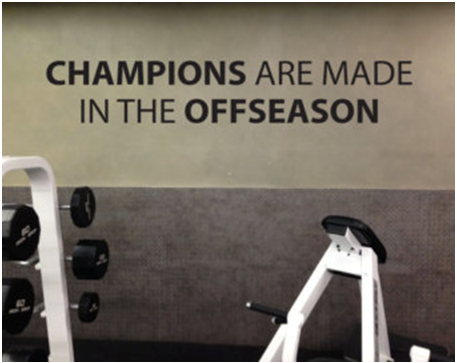
Champions are Made in the Off-season

The best teams get after it during the summer months. The best coaches effectively engage their athletes and motivate them to put in the work the work that helps them to improve. Whether it’s lifting weights, hitting balls, running miles, swimming laps, or working on technique, the old adage holds true: champions are made in the off-season.

As a coach myself, I admit it can be overwhelming to put together a schedule, communicate consistently, and deliver your off-season workout plans to your athletes.  Being organized and efficient with one’s time is the key.

champions

Programax – The One-Stop-Shop for Summer

A few months ago I came across Programax, a coaching app with a wide range of functionality designed to help coaches lead a better program.  I gave a full product overview here: Engaging Your Athletes In this article, I want to particularly highlighting the effectiveness of Programax for coaches as a tool for off-season athlete engagement.

The benefits of Programax for off-season training are tremendous. As a coach, the easy-to-use web-based tool allows you to:

  • Build mobile-friendly skill and strength workouts
  • Communicate through sync-able calendars, texts and emails
  • Manage your camp-sign up process

Check out the details for these features below. Also, I worked with Programax to secure a limited-time 10% discount for Coachestoolbox subscribers.  Make sure you ask about it when you sign up.


Mobile Strength & Skill Workouts

Your Strength and Skill Workouts Delivered to your Athletes’ Phones

Every coaching staff has an off-season workout program in place. So often the challenge is motivating the athletes to actually participate in the workouts.  Many coaches are still using paper handouts that quickly make their way to the recycle bin, or at best become a poster on the athlete’s bedroom wall. Only the most diligent actually take the time to track their workouts

As we all see everyday, kids are effectively engaged in and through technology. Programax makes it easy for you to capitalize on that trend.

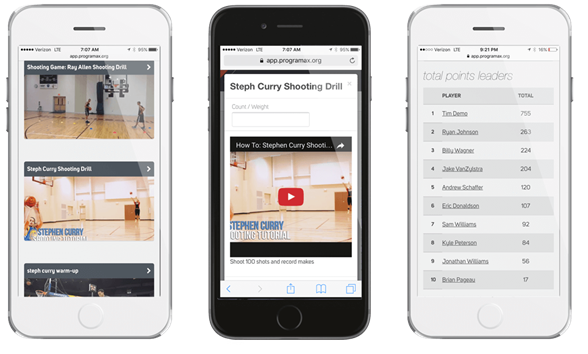
The technology-based coaching tool makes it possible for you to compile a video library of drills and exercises that instruct athletes in the precise way you want the activities executed.

As a coach, you can populate your account with your favorite drills or upload videos already offered on YouTube.

phones

Athletes can then access their own Programax accounts through their smartphones, and then view and execute the workout for the day as instructed and record their performance. Results are posted in real time on program-wide leaderboards, permitting coaches and other athletes to see who is putting in the work..

Communicate in one Place
Messaging and Scheduling

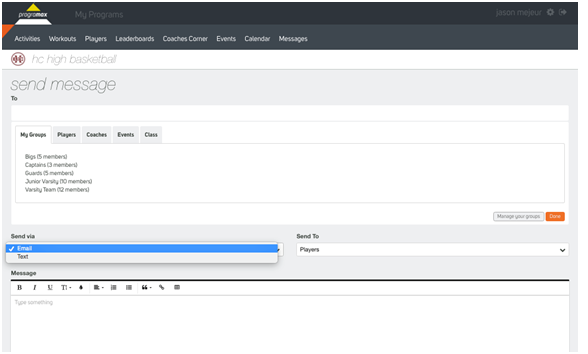
A huge challenge for summer is organizing schedules and getting the word out to your program. Programax has you covered with built-in calendars, text and email messaging services, and team roster organization.  It turns into your communication hub for reaching out to parents, coaches and athletes. Programax also eliminates the need to constantly be collecting and updating contact information by putting it in the hands of the athletes and their parents.

schedule


 Make Camps Easy
Summer Camp Registration

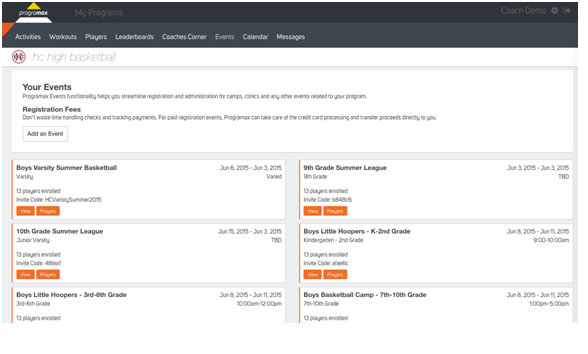
Summer camps and summer leagues can be particularly demanding of a coach’s time. The Programax Events feature enables coaches to easily create an event, invite participants through the app, and even collect registration fees. The tool populates a real time roster of sign-ups and key information on those individuals–amounting in a huge timesaver for coaches..

camps


For more information about Programax, visit their website (www.programax.org) or schedule a demo. 

Don’t forget to ask about the CoachesToolBox discount.


Filed Under: Program Building

3 Pieces of Inspiration

April 16, 2016 by

Here are three more inspirational pieces that you might consider using when you are looking for something to share with your players. The poem at the end of the post is written in the male gender, but I believe that the message can be used for ladies as well.

I Am a Winner

by William Arthur Ward

. . . because I think like a winner, prepare like a winner, and perform like a winner.

. . . because I set high, but attainable goals, work toward those goals with determination and persistence, and never stop until I reach them.

. . . because I am strong enough to say “No!” to those things that would make me less than my best, and to say “Yes!” to the challenges and opportunities that will make me grow and improve my life.

. . . because total commitment is my constant companion, and personal integrity is my lifetime mentor.

. . . because I am learning to avoid the tempting shortcuts that can lead to disappointment, and the unhealthy habits that could result in defeat.

….. because I have a well-earned confidence in myself, a high regard for my teammates and coworkers, and a healthy respect for those in authority over me.

. . . because I have learned to accept criticism, not as a threat, but as an opportunity to examine my attitudes and to improve my skills.

. . . because I persevere in the mist of obstacles and fight on in the face of defeat.

. . . because I am made in the image and likeness of my Creator, who gave me a burning desire, a measure of talent, and a strong faith to attempt the difficult and to overcome the seemingly impossible.

. . . because of my enthusiasm for life, my enjoyment of the present, and my trust in the future.

Watch

By Frank Outlaw

Watch your thoughts, for they become words.
Watch your words, for they become actions.
Watch your actions, for they become habits.
Watch your habits, for they become character.
Watch your character, for it becomes your destiny.

Equipment

By Edgar A. Guest

Figure it out for yourself, my lad,
You’ve all that the greatest of men have had,
Two arms, two hands, two legs, two eyes
And a brain to use if you would be wise.
With this equipment they all began,
So start for the top and say, “I can.”

Look them over, the wise and great
They take their food from a common plate,
And similar knives and forks they use,
With similar laces they tie their shoes.
The world considers them brave and smart,
But you’ve all they had when they made their start.

You can triumph and come to skill,
You can be great if you only will.
You’re well equipped for what fight you choose,
You have legs and arms and a brain to use,
And the man who has risen great deeds to do
Began his life with no more than you.

You are the handicap you must face,
You are the one who must choose your place,
You must say where you want to go,
How much you will study the truth to know.
God has equipped you for life, but He
Lets you decide what you want to be.

Courage must come from the soul within,
The man must furnish the will to win.
So figure it out for yourself, my lad.
You were born with all that the great have had,
With your equipment they all began,
Get hold of yourself and say: “I can.”


Filed Under: Motivation

Hey, Coach! Be a Teacher

April 14, 2016 by

Hey, Coach!  Be a Teacher

This post will be the first of a few that come from some ideas I wrote in my first two booklets A Head Coach’s Guide for Working with Assistants and The Assistant Coach’s Guide to Coaching. While those booklets were born out of some specific head coach/assistant coach issues I was facing with some members of a coaching staff for whom I was an athletic director, many of the ideas in them form the basis for good coaching principles in general. Today, I want to talk about the concept of how it is important for coaches to adopt the mindset of being a teacher.

Now I am not advocating that all coaches have to be actual schoolteachers to coach. While I have long maintained that the best job combination for a coach to have is to also be a schoolteacher, there are many great coaches who are not schoolteachers. We do not want to lose the good coaches that we have just because they are not classroom teachers in our schools.

What I am advocating is that coaches need to recognize that they are in the profession of teaching. Teaching is a critical component of coaching, and hence, coaches need to become proficient in all that they can when it comes to the art of teaching. The skills that a teacher learns in education classes and then learns by getting up in front of a class and teaching are the skills that a coach needs to possess to be able to teach kids how to play their games.

One of the most important, yet underrated, elements of coaching is the ability to teach.  Don’t get me wrong – people involved in the higher levels of coaching for many years don’t see it as underrated.  But to the average fan or person out there, it is often overlooked as one of the keys to a successful coach.

This is especially true with young coaches and with new coaches.  So often, people who are fans of a sport will sit in front of a TV set or in a gym and think, “I could do that.  I played high school ball,” or “I played college ball.  I know more than that guy.”  That may be true, but what you know is of little consequence if you can’t communicate it clearly to the kids.

I have known teachers and coaches in my time who had a vast knowledge of the subject matter or sport they were teaching or coaching.  However, they were terrible teachers or coaches because they couldn’t get it through to the kids.  Either they failed to teach it so it could be understood, or they never established good relationships with kids, or they got frustrated too easily when the kids didn’t pick it up right away, or some other reason in a long list of problems.

I have also known teachers and coaches who had a limited knowledge of the subject or sport but who were excellent teachers and coaches.  They communicated well, established positive relationships with kids, understood that not all kids are going to “get it” at the same pace, and generally just worked well within the framework of the experience.

It helps if coaches have a bit of knowledge of some basic teaching methods and a bit of understanding of how people learn, especially kids.  Obviously, there are many teaching methods in the world.  The head coach needs to help the assistant learn what will work best for working with his kids.  From teaching skills to instilling discipline and commitment to team, how a coach teaches is of great importance.

A coach needs to know how to have “classroom management”; it’s just that her classroom is a court, field, track, or some other athletic arena.  She needs to be able to have the discipline and control necessary for a group of kids to pay attention and learn.  Also, a coach needs to know “teaching techniques” to be able to help kids learn the skills and concepts she is teaching.  She must have a variety of methods on hand to use to get the points across to the kids. While a coach needs to understand teaching techniques, she also should have an understanding of “learning styles.”  Coaches need to try to tap into the different ways that kids learn in order to maximize the chances for success.

Finally, coaches need to have some level of understanding of “educational psychology.”  There’s more to teaching and coaching kids than just explaining subject matter and X’s and O’s.  It helps to know the personalities of kids and how to deal with them.  It also helps to know how to be a counselor, for coaches end up counseling kids as much as anything else they do.

The roles of teacher and coach are intertwined in many ways. I have always called myself a “coach in the classroom, and a teacher on the court” as a way of showing that both roles are linked so strongly that you can’t really tell the difference between the two. However, as is the case with most things, the teaching and coaching must be done intentionally to create the experience we are seeking to provide the children in the different arenas in which we work.


About the Author of this Article

Scott Rosberg has been a coach (basketball, soccer, & football) at the high school level for 30 years, an English teacher for 18 years, and an athletic director for 12 years. He has published seven booklets on coaching and youth/school athletics, two books of inspirational messages and quotes for graduates, and a newsletter for athletic directors and coaches. He also speaks to schools, teams, and businesses on a variety of team-building, leadership, and coaching topics. Scott has a blog and a variety of other materials about coaching and athletic topics on his website – www.coachwithcharacter.com. He can be reached by email at [email protected].

Scott is also a member of the Proactive Coaching speaking team. Proactive Coaching is dedicated to helping organizations create character and education-based team cultures, while providing a blueprint for team leadership. They help develop confident, tough-minded, fearless competitors and train coaches and leaders for excellence and significance. Proactive Coaching can be found on the web at www.proactivecoaching.info. Also, you can join the 200,000+ people who have “Liked” Proactive Coaching’s Facebook page at www.facebook.com/proactivecoach. Scott can also be reached through Proactive Coaching at [email protected]


Filed Under: Professional Development

There is Power in Your Words

April 14, 2016 by

By Scott Rosberg

There is power in the words we speak. Our words carry great weight for those to whom we say them. However, the words alone are not what make them powerful. It is our intention, our tone, our inflection, and our desired outcome of speaking those words that give words their greatest power.

Words spoken or written on a page but independent of each other do not carry nearly the same weight and power as they do when they are put together into sentences. The way we string together certain groupings of words into sentences give meaning, life, and strength to the words. It is critical that we choose our words carefully and wisely in all instances. Many of us have uttered things that we wish we could go back and “rewind the tape” so as to not say what we said. But our words cannot be unsaid; our actions cannot be undone. While we can augment, tweak, clarify, apologize, and re-state, we cannot “un-state” the words we have stated.

Therefore, it is important that we choose our words wisely. As teachers & coaches, it is absolutely critical that we “watch what we say” and “how we say it,” especially to the young people in our charge. We must always keep in mind that children are taking their cues from us.

While it is true that actions often speak louder than words, our words still speak very loudly. Kids are constantly listening to what we tell them (even when we feel like they haven’t heard a word we said!). Be careful what you say to and around them. You never know what they are picking up. Kids have a funny way of reminding you of something you said days, weeks, months, or even years later. They will talk about what you said at halftime of a game 10 years ago, and you will not even recall saying what they tell you that you said.

The other issue with that is the difference between your intended message, the actual message, and the received message. These three messages can end up being quite different from each other. I might know what I am trying to say. However, my words may come out different than the way I am thinking it. The person to whom I speak it filters the message through his/her own ideas to determine what was meant. My intention might be quite different from the final perceived message of the person to whom I spoke. Or I may have intended a message for one person, but there were others there who picked up a completely different message.

Have you ever had a parent question you on why you said a particular thing to their child, and your response was, “I never said that.”? This happens all the time. When you “rewind the tape” to consider where the miscommunication happened, think about the words you chose, your inflection, your tone of voice, and your body language. Maybe you thought you were saying a certain thing, but what came out was not exactly what you thought you were saying. Then consider what the child’s state was during the conversation. Was s/he focused & attentive? Did you get confirmation from him/her of their understanding of what you said? These types of miscommunication are common, but they can be reduced by just being more in tune with your own communications and how your audience is receiving them.

We must always keep in mind our intention with the communication we are about to have with our players. Am I saying this to serve my needs or to serve their needs? Are the words I am about to speak going to help build up these young people or tear them down? Am I creating a positive, trusting relationship with these words, or am I destroying the trust that I am trying to create? Keep these questions in the back of your mind as you are building relationships with your kids.

Our tone of voice and our body language play a major role in giving power to our words. Just as words have more power when they are strung together with other words to intentionally give them power, our tone of voice and our accompanying body language give added power to our words.

We must be careful that our tone is conveying the intended consequence in the receiver. The exact same words said in different tones of voice can mean very different things to the receiver of those words. Listen to yourself and to your players utter the simple exhortation of “Come on!” Is it said as a positive form of encouragement, or as a desperate cry for help or condemnation, or even a sarcastic dig? The tone of voice says everything in a statement like this. Be careful that your tone conveys the right message.

Also, your demeanor when you say the words can create a certain feeling and response. As the leader of your program, you need to be the face (and body) your team needs to see. A scowl on your face with your shoulders back and your hands clenched will convey a very different meaning than a smile while seated. Whatever you are trying to convey, recognize that your facial expression and your body language play a huge role in how your words are interpreted.

Children learn many things in a variety of manners from the teachers and coaches in their lives. We need to constantly be considering our words, our tone, and our body language when we are communicating with the young people in our lives. We are not only giving them a message for the moment in which we are speaking to them; we are also instilling in them the ways that they will communicate with others as they make their way through life. Never forget that there is great power in your words.

For more great info on the concept of the power of our words, check out the DVD “The Power of Your Words by Bruce Brown of Proactive Coaching. Bruce gives a powerful presentation that will resonate with coaches, teachers, and parents. You can find “The Power of Your Words“ at Proactive Coaching’s website – www.proactivecoaching.info.

About the Author of this Article

Scott Rosberg has been a coach (basketball, soccer, & football) at the high school level for 30 years, an English teacher for 18 years, and an athletic director for 12 years. He has published seven booklets on coaching and youth/school athletics, two books of inspirational messages and quotes for graduates, and a newsletter for athletic directors and coaches. He also speaks to schools, teams, and businesses on a variety of team-building, leadership, and coaching topics. Scott has a blog and a variety of other materials about coaching and athletic topics on his website – www.coachwithcharacter.com. He can be reached by email at [email protected].

Scott is also a member of the Proactive Coaching speaking team. Proactive Coaching is dedicated to helping organizations create character and education-based team cultures, while providing a blueprint for team leadership. They help develop confident, tough-minded, fearless competitors and train coaches and leaders for excellence and significance. Proactive Coaching can be found on the web at www.proactivecoaching.info. Also, you can join the 200,000+ people who have “Liked” Proactive Coaching’s Facebook page at www.facebook.com/proactivecoach. Scott can also be reached through Proactive Coaching at [email protected].


Filed Under: Professional Development

  • « Previous Page
  • 1
  • …
  • 43
  • 44
  • 45
  • 46
  • 47
  • …
  • 63
  • Next Page »

© Copyright 2026 Athletic Performance Toolbox

Design by BuzzworthyBasketballMarketing.com

Privacy Policy